








































In this article
A brand can attract affiliate interest with a generous percentage and still lose money on every approved order. The problem is often hidden in the commission base: discounts, fulfillment, product costs and returns change how much revenue is available to share. A portable power station and its replacement cable may belong to the same catalog while supporting very different arrangements.
This guide helps brand owners and ecommerce managers calculate an affordable affiliate commission, document the conditions and decide what to test. Start with the broader affiliate program launch guide if ownership, product eligibility or the selling destination remains undecided. The calculation comes before the public promise.
What revenue should your affiliate commission rate apply to?
Your commission should apply to a clearly defined base that the program can calculate consistently. State whether that base includes discounted product revenue, shipping, taxes, bundles or other charges. A percentage without those definitions is an incomplete offer.
For example, a hypothetical product has a $240 list price and a $40 customer discount. A 10% commission on the $200 discounted product revenue is $20. Applying the same percentage to the original list price produces $24. Neither amount becomes correct merely because a dashboard displays it. Your approved terms and implementation need to agree.
Should every product have the same rate?
Only if the economics and operating rules support it. A single rate is simpler to explain, but a brand can restrict eligibility or use product groups when margins differ materially.
A maker-equipment company might distinguish printers, consumables and third-party accessories. Evaluate landed cost, delivery requirements and expected support for each group. Shopify's Collabs program documentation, for example, describes collection-level commission settings. That is an implementation option, not a reason to create unnecessary complexity.
Prepare a product eligibility sheet before recruiting. Give every included group a rate, calculation base, effective date and accountable approver. Exclude products that cannot support the offer rather than letting partners discover the exclusion after an order.
How do you calculate the commission your brand can afford?
Subtract variable order costs from net product revenue, then reserve the contribution your business needs. The remainder provides an initial commission ceiling. It still needs to accommodate fixed program costs and any payment or network charges not already included.
The following example is hypothetical. It illustrates arithmetic, not C3i3 pricing, an industry benchmark or a recommended commission.
| Item | Amount | Meaning |
|---|---|---|
| Product revenue after discount | $200 | The defined commission base in this example |
| Product cost | −$100 | Assumed cost allocated to this order |
| Fulfillment | −$10 | Assumed packing and delivery cost |
| Payment fees | −$6 | Assumed transaction cost |
| Return and support reserve | −$8 | Planning assumption requiring review |
| Contribution before commission | $76 | $200 − $100 − $10 − $6 − $8 |
| Required retained contribution | −$40 | A hypothetical business requirement |
| Remaining commission capacity | $36 | 18% of the $200 base, before fixed program costs |
Does that mean the brand should offer 18%?
No. The $36 is a limit under these assumptions, before allocating fixed program costs or additional expenses. Offering the entire amount leaves no room for those costs or unfavorable changes.
Repeat the calculation for the actual product mix and plausible discount scenarios. Include costs once, document estimates separately from known amounts and ask the finance owner to approve the model. The affiliate marketing budget guide explains how setup, management and sample costs fit around the order-level calculation.
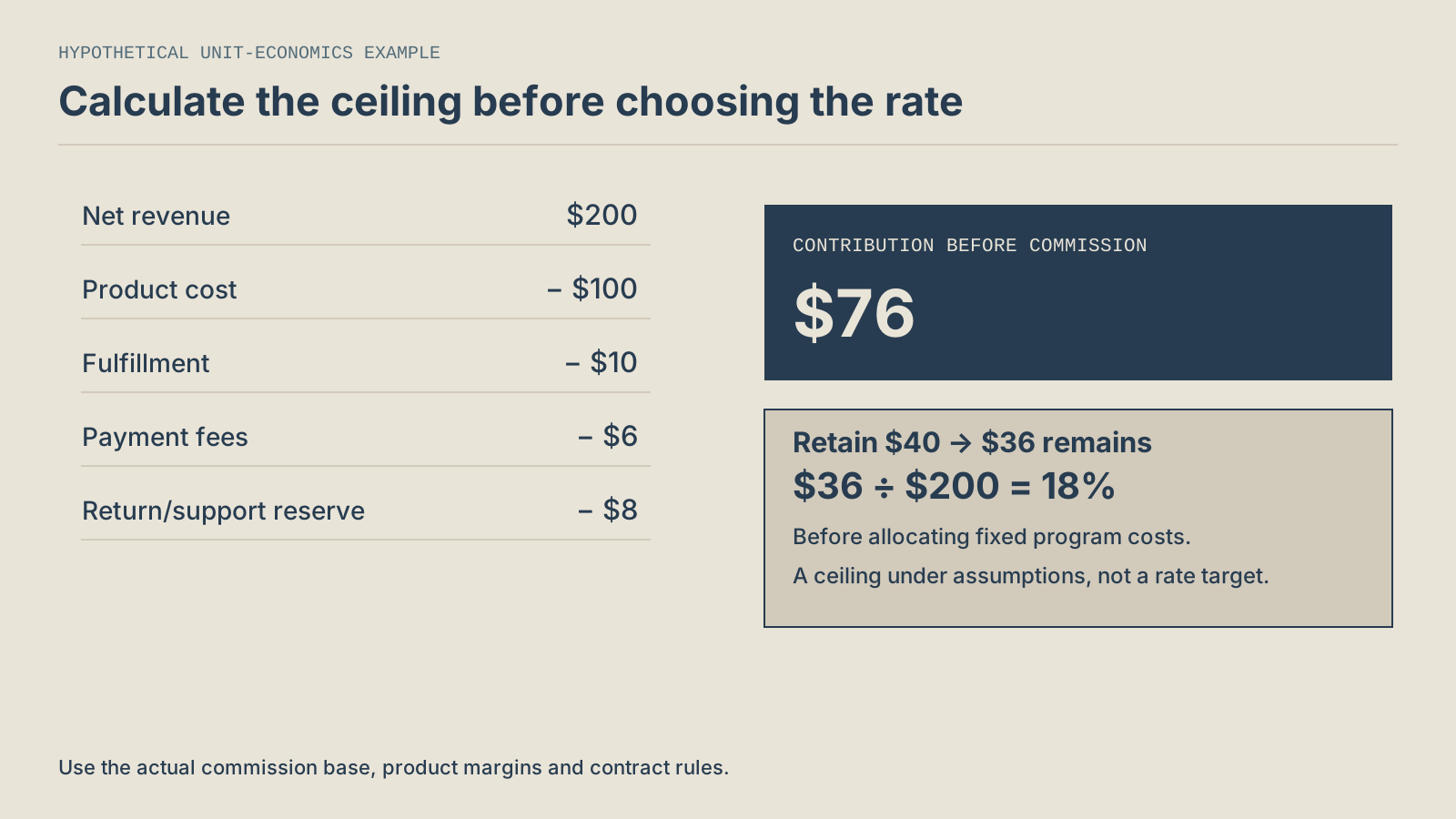
Hypothetical: $200 net revenue less $100 product cost, $10 fulfillment, $6 payment fees and $8 return/support reserve leaves $76 before commission. Retaining $40 leaves $36, or 18% of a $200 base, before fixed program allocation. This is not a recommended rate.
How should commission rates reflect the work a partner performs?
Evaluate the partner's contribution, requested deliverables and commercial risk alongside the affordable rate. A commission rewards an agreed transaction. A guaranteed demonstration video, licensed footage or detailed technical test may require a separate content agreement.
A reviewer explaining which workshop tasks a machine can handle performs different work from a publisher adding a product to an existing comparison page. Establish what the brand is actually purchasing. If you need a specific production date, script review or reuse rights, describe those requirements and the corresponding compensation rather than assuming commission covers everything.
Should you offer a higher rate to every new partner?
A temporary incentive can be tested, but it needs a defined purpose, eligibility period and affordable maximum. Increased commission alone does not repair a poor product fit, unavailable inventory or an unclear buying page.
Compare scenarios at the same net revenue and cost assumptions. A higher commission combined with a customer discount consumes more contribution than changing either item alone. Avoid negotiating each promise in isolation.
Also preserve truthful recommendations. The FTC's endorsement guidance explains material connections and disclosure obligations. A performance incentive does not justify an unsupported product claim or a fabricated personal experience. Put approved factual resources and disclosure expectations in the partner brief.
Which rules must be agreed before a commission becomes payable?
Document eligible orders, attribution conditions, exclusions, validation and payment responsibility before launch. The policy should explain what happens to discounts, cancellations, returns and competing referrals without requiring a partner to guess.
Separate four moments: an order is recorded, a commission is pending, the order is approved under the program's rules and payment is completed. The dates may differ. Shopify's merchant payment documentation illustrates a holding period during which canceled and fully refunded orders can have commissions canceled. Each platform and agreement needs its own verified treatment.
Should partners earn commission on every future order?
Only when the approved terms explicitly provide for it and the business can support the cost. Define whether repeat orders qualify, how long eligibility lasts and whether particular products or customer types are excluded.
Do not casually promise “lifetime commissions.” A replacement accessory purchased months later can have a different margin, owner and referral path from the first equipment order. The offer must match what your platform can actually administer.
Create a short policy review with product, finance, ecommerce and program owners. Assign the person who approves disputed orders and the person who answers partners. The agency responsibility guide provides a practical way to keep those duties visible. Have appropriate professional advisers review contractual or tax questions when those decisions arise.
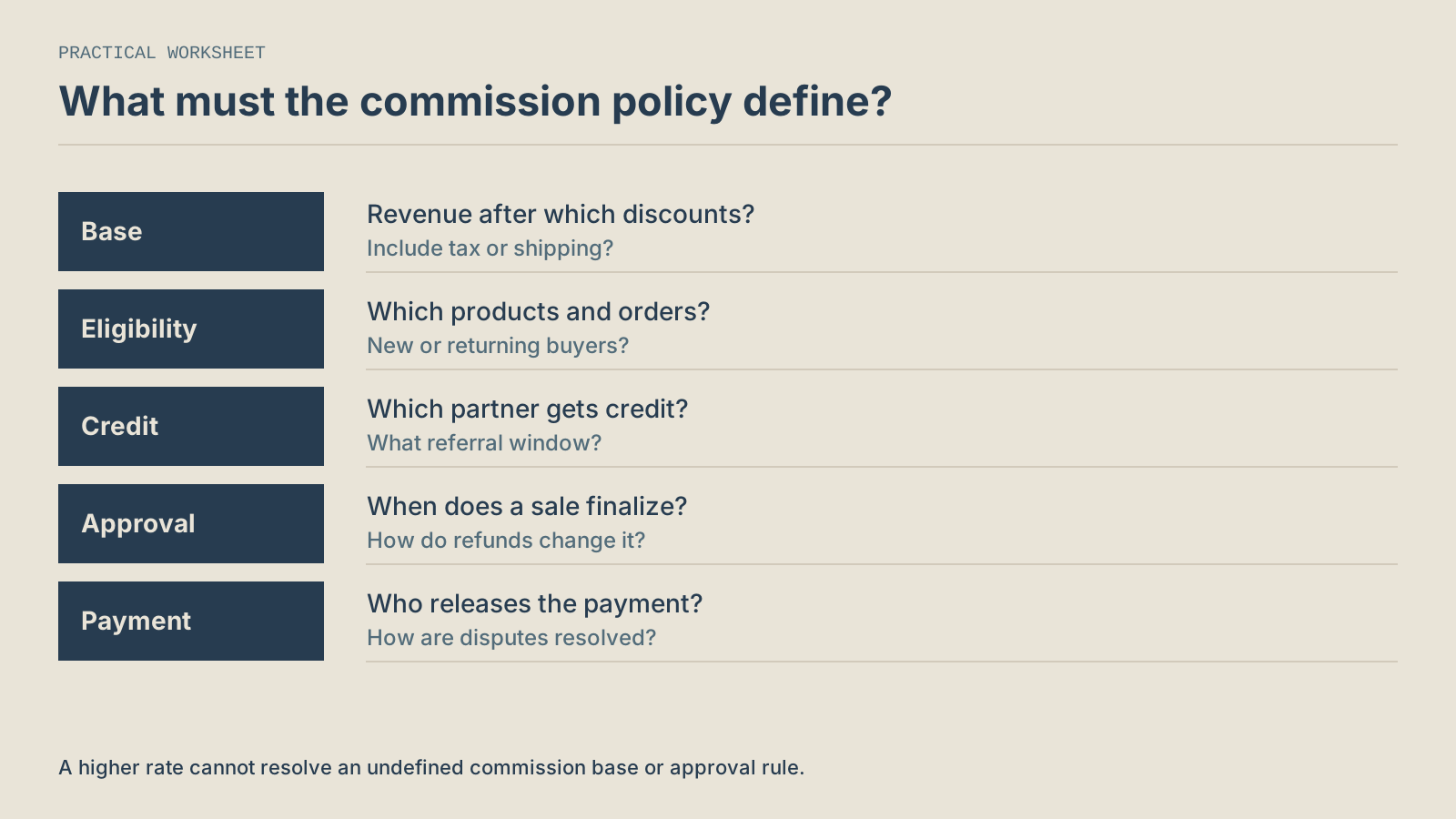
Define the commission base, eligible products and buyers, partner-credit policy and referral window, approval and refund treatment, payment owner and dispute route. A rate alone is an incomplete policy.
How do you test a commission offer without promising an unsustainable rate?
Run a bounded pilot with defined products, documented economics and a review date. Decide what evidence would justify continuing, changing or stopping the offer before the first partner begins.
Use a worksheet with five fields: eligible product group, commission base, proposed rate, maximum approved pilot exposure and review owner. Add assumptions about discounts and returns. The exposure limit should reflect possible commission liabilities under the agreement, not simply the cash paid this week.
Which results should change your decision?
Review approved orders and retained contribution alongside partner activity. Raw clicks, signups and pending commissions are useful operating signals, but they do not establish profitable acquisition.
Compare the actual product mix with your model. If affiliates mainly sell a lower-margin bundle, a blended average can conceal the problem. Check whether offers reached suitable customers and whether the destination converted partner traffic into completed purchases before attributing weak results to the commission percentage.
Change terms prospectively using the notice and approval process in the agreement. Keep dated copies so both parties can identify which offer applied to a transaction. A pilot should create a better operating decision, not a history of unexplained rate changes that damages partner trust.
What should your team approve before publishing an affiliate rate?
Approve the complete commercial arrangement, including its implementation and ownership. A public percentage is ready when someone can reproduce the calculation and explain how an ordinary order moves from referral to payment.
- Identify the eligible products, customer markets and excluded order types.
- Define the commission base and how discounts affect it.
- Calculate contribution using actual costs and labeled estimates.
- Reserve required contribution and allocate fixed program costs.
- Document attribution, returns, validation and payment responsibility.
- Confirm the platform settings reflect the approved policy.
- Set a pilot boundary, review date and partner support contact.
Keep one approved version of the rate sheet, terms and product list. Ask a colleague who did not build the program to calculate two example orders from those documents. If their answers differ from yours, resolve the ambiguity before asking partners to promote the offer. This small rehearsal can expose expensive misunderstandings while they are still easy to correct.
What else should brands know about affiliate commission rates?
Is there a standard commission percentage for technology products?
There is no universal percentage that establishes what your brand can afford. Product margins, discounts, delivery costs, returns and the partner's role differ. Public competitor offers are comparison inputs, not a substitute for your own model. Start with product-level contribution and a defined commercial arrangement, then evaluate whether suitable partners find that arrangement worthwhile.
Should commission be calculated before or after a customer discount?
Choose a base your agreement defines and your platform implements consistently. Calculating on revenue after discount can make the economics easier to reconcile, but you must verify the actual settings. Explain the choice clearly in partner materials. When a promotion changes, review its combined effect on revenue, commission and retained contribution.
Can we increase commission instead of fixing our product page?
An increased rate may improve partner interest, but it does not answer a shopper's compatibility question or remove a checkout obstacle. Review the destination and buying path first. If customers cannot establish product suitability, delivery or return conditions, more referral activity can increase costs without resolving the reason they leave.
Should a creator receive both a content fee and commission?
That can be appropriate when the agreements cover different work. A content fee might pay for a specified demonstration and licensed use, while commission applies to eligible referred sales. Define the deliverables, rights and measurement separately. Include both costs in the program budget rather than calling commission the entire acquisition expense.
Can our agency approve every commission payment?
Only if that responsibility is expressly included and supported by the required access and controls. A marketing agency's reporting work does not automatically authorize payment execution or commercial disputes. Keep brand ownership clear and document approval limits. Account credentials, finance permissions and partner communication should follow the agreed scope.

How C3i3 Can Help
C3i3 can help your brand connect its affiliate offer to the work needed to sell: product explanations, partner materials, usable destinations and a reporting process with clear ownership. We can organize the assumptions and decision worksheet so your finance and product teams can approve the commercial terms.
Explore our affiliate marketing services or bring us your product, current offer and program question. Commission funding, contractual approval and payment execution remain separately defined responsibilities. The aim is a program your team can explain, support and evaluate.