








































In this article
Your partners are sending visitors, the affiliate dashboard is recording activity and the store is receiving attention. Yet orders remain limited. Before recruiting more affiliates or increasing commissions, examine what happens between the recommendation and the completed purchase. The creator may explain one use case while the landing page presents a different product, missing configuration or unavailable offer.
Ecommerce affiliate marketing works through a connected buying path. This guide helps brand owners and ecommerce managers diagnose that path using product information, checkout checks and measured behavior. Use the affiliate program launch guide for the broader setup and ownership decisions. Here, the question is whether a suitable referred customer can confidently buy.
Does the affiliate recommendation match the page customers reach?
The destination should continue the product, use case and offer the partner presented. A visitor should immediately recognize the relevant item and understand the next step. A generic homepage often makes that task harder when the recommendation was specific.
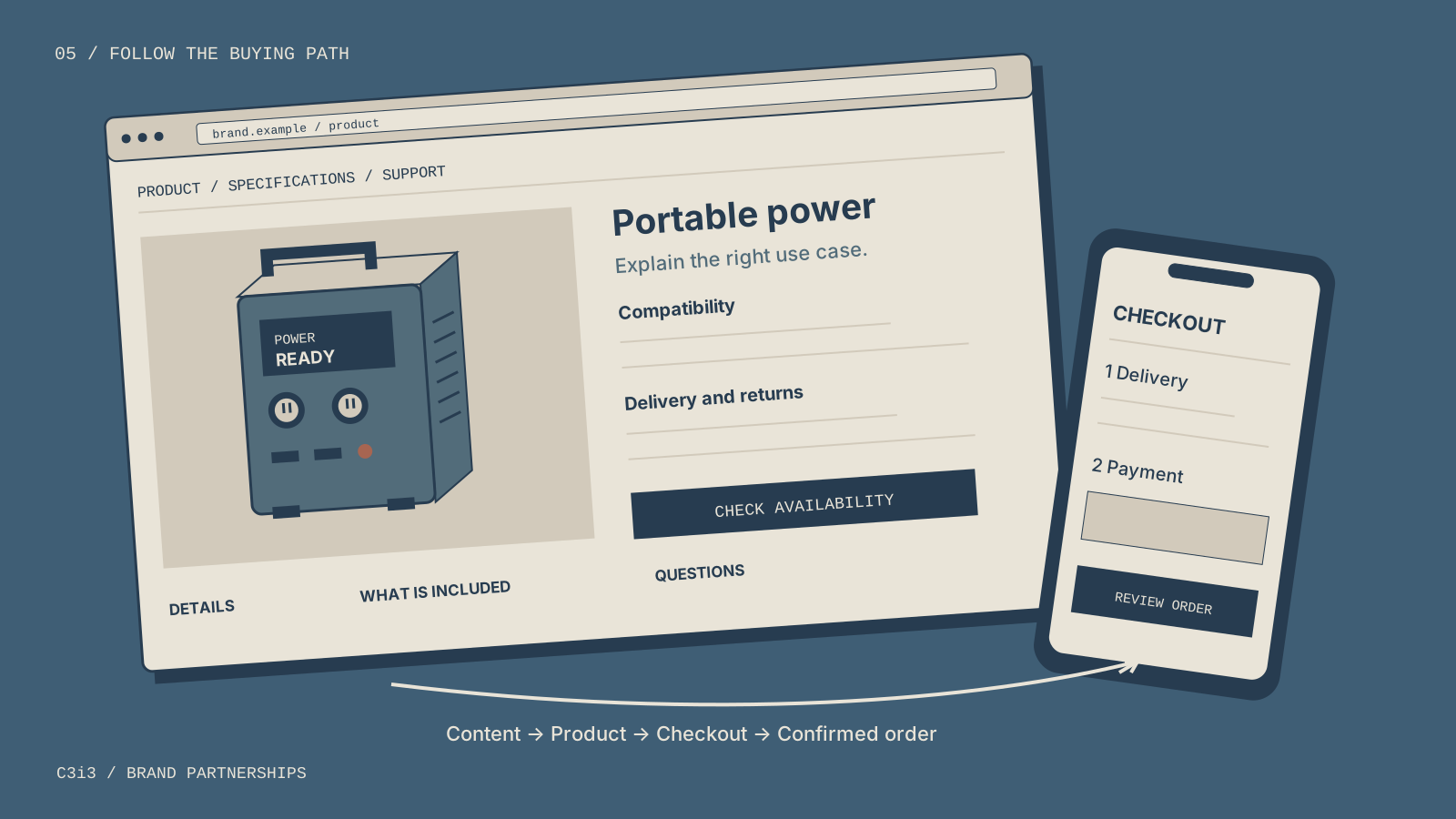
Consider a hypothetical video demonstrating a portable power station for a small mobile workshop. The customer clicks to learn whether it can run particular equipment. A page leading with an unrelated home-backup package forces them to restart their research. The product may be suitable, but the connection has been lost.
Should each affiliate receive a different landing page?
Only when a distinct audience, product configuration or offer justifies one. Use a strong existing product page when it already answers the buyer's questions. Creating many near-identical pages adds maintenance without necessarily improving the decision.
Build a destination map with partner content, promised use case, product or bundle, URL and offer expiry. Review the map whenever inventory, pricing or product specifications change. A promotion team should be able to find every active destination without searching old email threads.
Keep the commercial relationship understandable in the recommendation itself. The FTC's endorsement guidance addresses disclosure of material connections. Accurate promotion and a coherent destination support the customer's decision together; neither substitutes for the other.
What must a technical product page explain before visitors will buy?
Explain suitability, specifications, included items, compatibility and buying conditions in language the intended customer can use. The page should reduce the uncertainty that remains after the recommendation, rather than repeat the video's enthusiasm.
For a desktop 3D printer, useful questions might include supported materials, working area, required accessories and setup expectations. For a power product, shoppers may need the manufacturer's supported load information and connector details. Use verified specifications and explain limitations. Do not turn a demonstration of one scenario into a universal performance promise.
Which details should be visible near the buying decision?
Make price, variant selection, stock status, shipping information and return conditions easy to find. Put essential qualifications beside the relevant claim or choice, not in an unrelated FAQ far down the page.
Use clear photographs, useful diagrams and real product demonstrations where they answer a question. A diagram that identifies ports can be more helpful than another decorative lifestyle image. Provide the same essential information in accessible page text, and confirm that mobile visitors can read tables and operate selectors.
Maintain consistency between visible facts and structured data. Google's merchant-listing documentation describes supported product and offer information. That implementation belongs on the merchant's actual product pages and does not guarantee a special search presentation. The immediate business task remains helping the customer assess the product.
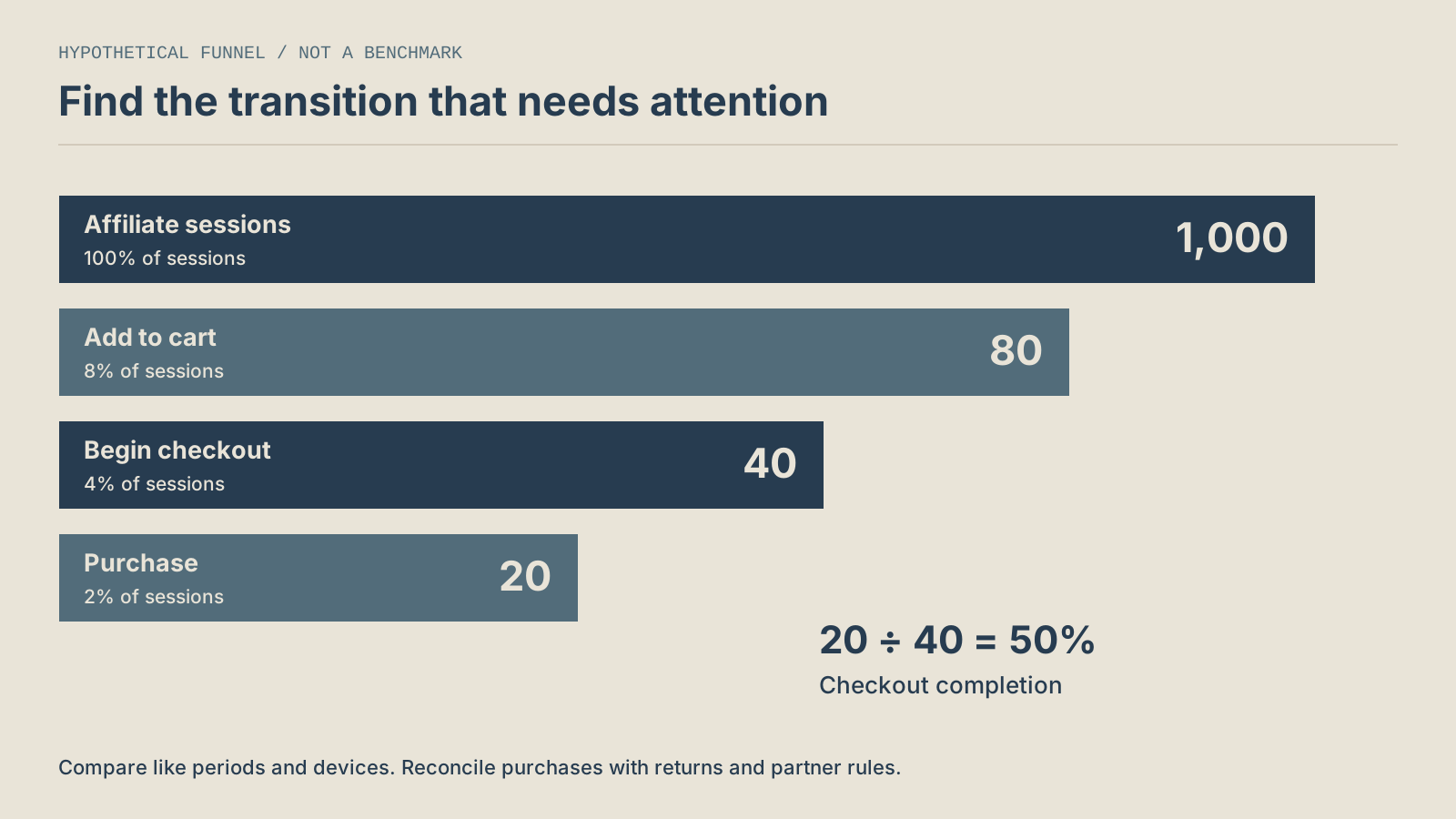
Hypothetical: 1,000 sessions, 80 add-to-cart sessions, 40 checkout starters and 20 purchasers represent 8%, 4% and 2% of sessions. Twenty purchases divided by 40 checkout starters is 50% checkout completion. These figures are not benchmarks.
Which buying-path problems should you check before sending more affiliate traffic?
Check the complete path from the real partner link through product selection, cart and checkout. Verify the destination, advertised offer, eligible geography and available stock. A page can look polished while a discount or delivery constraint prevents the purchase.
Start on a narrow phone screen with the actual link. Confirm that redirects land on the intended variant and that the page remains usable after consent choices. Check whether sticky controls cover specifications or checkout buttons. Then review shipping availability, supported payments and the information requested before a customer can proceed.
Should you place an order to test the process?
Use the store platform's approved testing process and obtain authorization for any transaction that would charge money, create a live order or trigger fulfillment. A marketing review does not require manufacturing customer purchases or fake affiliate revenue.
Shopify's checkout documentation identifies the purchase stage as a combination of order, shipping and payment functions. This illustrates why conversion diagnosis should include operations, not only page copy.
Record the device, link, selected product, expected behavior and observed result. Assign each failure to an owner. A product team may need to clarify compatibility; an ecommerce team may need to repair variant selection; operations may need to correct delivery information. Recheck the specific path after the fix instead of assuming a general site update resolved it.
How do you measure where affiliate visitors stop?
Measure meaningful stages of the purchase path and state exactly what each count represents. Use a consistent traffic definition, period and reporting scope. Avoid comparing raw event totals with unique customer or session counts as though they were interchangeable.
Useful stages include viewing an item, adding it to a cart, beginning checkout and purchasing. Google's GA4 ecommerce guidance documents events for these actions and for refunds. Confirm that the implementation records the intended action once and associates purchases with the correct transaction information.
The following is a hypothetical session-based example. Each stage represents sessions in the same defined group that reached the action, not raw repeat event counts. These figures are an illustration, not a benchmark.
| Stage reached | Sessions | Share of all sessions | Question to investigate |
|---|---|---|---|
| Added to cart | 80 | 8% | Did the page answer suitability and price questions? |
| Began checkout | 40 | 4% | Did the cart reveal unexpected costs or conditions? |
| Purchased | 20 | 2% | Could the customer complete payment and delivery choices? |
In this example, checkout completion is 20 ÷ 40 = 50%, using checkout starters as the denominator. It is a different ratio from the 2% purchase rate against all sessions. These calculations identify questions; they do not establish why a customer left.
Separate results by relevant device, destination and partner content when sample size permits. Compare like periods and annotate promotions or stock changes. A small number of orders can move a percentage sharply, so preserve the underlying counts rather than reporting an isolated improvement.
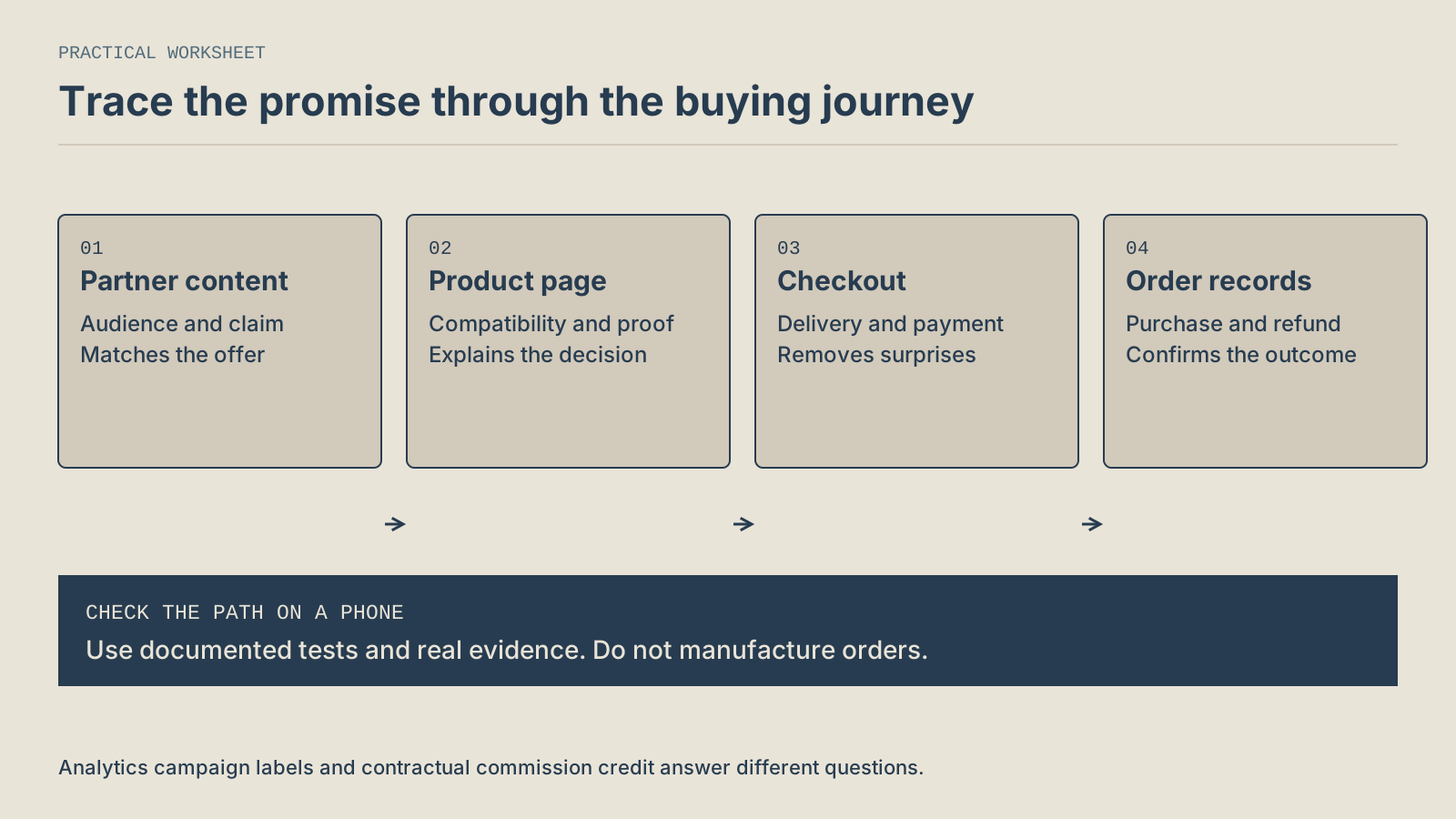
Check that partner claims match the offer, the product page explains fit and compatibility, checkout states delivery and payment terms, and order records confirm purchases and refunds. Use documented tests without manufacturing conversions.
How do you decide which conversion problem to fix first?
Prioritize confirmed failures that block a suitable buyer, then test the most plausible explanation for the largest meaningful drop. The useful order is evidence, correction and remeasurement. A complete redesign should not be the default response to one uncertain metric.
A broken checkout button is a concrete failure. A weak cart rate is an observation with several possible explanations, including audience mismatch, price, missing information or an unexpected variant. Write down the hypothesis and the evidence that would support it before changing multiple parts of the experience.
What does a manageable conversion test look like?
Change one decision-relevant element, define the outcome and record the context. For example, test whether a verified compatibility table helps visitors select the correct accessory. Keep the product offer and partner brief stable where practical so the result is interpretable.
In a controlled experiment, use the platform's supported allocation and measurement process. If traffic is insufficient for a reliable experiment, use a documented before-and-after review and state its limits. Do not describe a handful of purchases as proof that a page treatment caused an uplift.
Coordinate content changes with partner materials. If a product page removes a bundle, update the active link and brief as well. The affiliate program management guide explains how recurring checks keep offers and destinations aligned after launch.
When do more affiliate orders represent useful business growth?
More orders help when they meet the program's commercial conditions and leave an acceptable contribution after relevant costs. Review discounts, returns, commission and operating expenses alongside sales. A rising order count can still conceal an unfavorable product mix.
Keep three records distinct: the store's completed orders, analytics observations and the affiliate platform's approved commissions. Google's traffic-source scope guidance explains that reports can describe acquisition at different scopes. Do not use a source label alone to decide a partner's contractual entitlement.
This guide focuses on improving the buying path. If the specific problem is that reports disagree, use the separate affiliate links and coupon reporting guide rather than rebuilding the same investigation here.
Connect approved orders back to the commission economics worksheet and program budget. Identify whether customers bought the intended products, required unusual support or returned items after the campaign. Review those findings with product and operations teams. Better conversion should support a better customer fit, not simply pressure more visitors into a purchase they do not understand.
What should brands ask about ecommerce affiliate conversion?
Should affiliate links go to a product page or our homepage?
Use the destination that continues the recommendation and answers the next buying question. A product-specific demonstration usually benefits from a relevant product or bundle page. A broader introduction may suit a useful category page. Check the actual journey on mobile and ensure the page does not require visitors to search again for the offer they clicked.
Will more affiliates automatically produce more sales?
No. More partners can increase activity while exposing the same destination or product-fit problem to more people. Review current visitors, offer relevance and purchase obstacles first. Expand when your team can support the partners and evaluate the resulting orders. Affiliate count is an operating measure, not a sales forecast.
What conversion rate should our product achieve?
Set a business requirement from your product economics and use your own reliable baseline for comparison. Product price, decision time, audience, device and offer can change observed rates. A generic benchmark cannot establish whether your store is working well. Keep counts and definitions visible so your team can understand what changed.
Can we use a discount to fix weak conversion?
A discount may influence some decisions, but it cannot resolve every compatibility, delivery or trust question. Calculate its combined effect with affiliate commission before launch. Test the actual problem when possible and define the promotion's conditions. Increasing sales while reducing retained contribution below your requirement is not a successful commercial outcome.
Does product structured data replace better product content?
No. Structured data describes information a customer should also be able to find on the page. Clear product explanations, accurate offers and a working checkout remain necessary. Implement the relevant markup correctly on the merchant's product pages, keep it current and treat rich-result eligibility separately from actual search appearance or sales.

How C3i3 Can Help
C3i3 can help connect your partner content, product explanations and website buying path. We can review a defined journey, organize the measurement questions and prepare clearer content or demonstrations for the decision your customer is making.
Explore our affiliate marketing services or send us the product page, partner content and obstacle you want to investigate. We will help establish a practical scope, accountable owners and evidence for the next decision. The work begins with the journey your customers actually experience.