








































In this article
An affiliate program can look busy while the brand still carries every difficult decision. Partners are approved, products are shipped and a monthly dashboard arrives, but somebody inside your company still has to chase missing content, explain changing stock and decide which commissions are payable. Hiring an agency should make those responsibilities clearer.
This guide explains what affiliate program management should deliver after launch. It is written for product brands evaluating an agency or reviewing an existing arrangement, with examples from technology and specialist equipment. If the program itself is still being planned, start with the brand affiliate-program launch guide. Here, the focus is the recurring work, the decisions you retain and the evidence that shows whether that work happened.
What should affiliate program management include each month?
Monthly management should maintain the conditions that allow suitable partners to promote the right products accurately. It should also identify obstacles early enough for your team to act. A list of partner names or a screenshot of revenue does not describe the work.
Define a recurring cycle around your products. A portable-power brand might need to update accessory compatibility, stock availability and approved runtime explanations. A workshop-equipment supplier might need a clearer demonstration brief before a creator can film safely. Those tasks belong in an operating plan with an owner and a due date.
Which deliverables should you be able to inspect?
Ask for a partner activity record, current offer register, content and destination review, transaction-status summary and decision log. The format can be simple. What matters is whether the record explains what changed, why it changed and what happens next. Shopify’s merchant documentation illustrates how recruitment, gifts, partner connections and payments can sit within a program. Your agency’s scope should say which of those activities it handles.
Specify volume and depth. “Partner support included” could mean answering a shared inbox or providing proactive brief reviews for a defined group. “Reporting” could mean exporting a dashboard or investigating unexplained changes. A useful proposal distinguishes these activities so that neither side assumes more than was purchased.
Which decisions should your brand keep and which should the agency own?
Your brand should approve the commercial rules and authoritative product information. The agency should execute the agreed workflow and bring decisions back when it reaches its authority limit. Delegation works when routine actions can move without giving an outside team unrestricted control.
| Decision or task | Brand responsibility | Agency responsibility |
|---|---|---|
| Products and margins | Approve eligible products, commission limits and discount policy. | Apply approved rules and flag conflicting offers. |
| Product information | Supply verified specifications, limitations and permitted claims. | Maintain briefs and raise unsupported statements for correction. |
| Partner relationships | Approve exceptions and sensitive partnerships. | Handle routine communication and documented onboarding. |
| Payments | Fund obligations and approve the payment process. | Prepare or reconcile records within the agreed permission level. |
How should an agency handle exceptions?
Use a short exception rule: the issue, the impact, available options and the decision owner. Suppose a reviewer requests an expensive product loan instead of a gift. The agency can assess the content fit and proposed deliverables, but your brand should approve the asset exposure and return terms. That separates a useful recommendation from an unauthorized commitment.
Keep your business as the owner of platform accounts and final assets. Give the agency the access required for its work, then review that access when the scope changes. The same principle applies to shared folders, product feeds and reporting exports. A working relationship should leave you able to change providers without rebuilding your entire operating history.
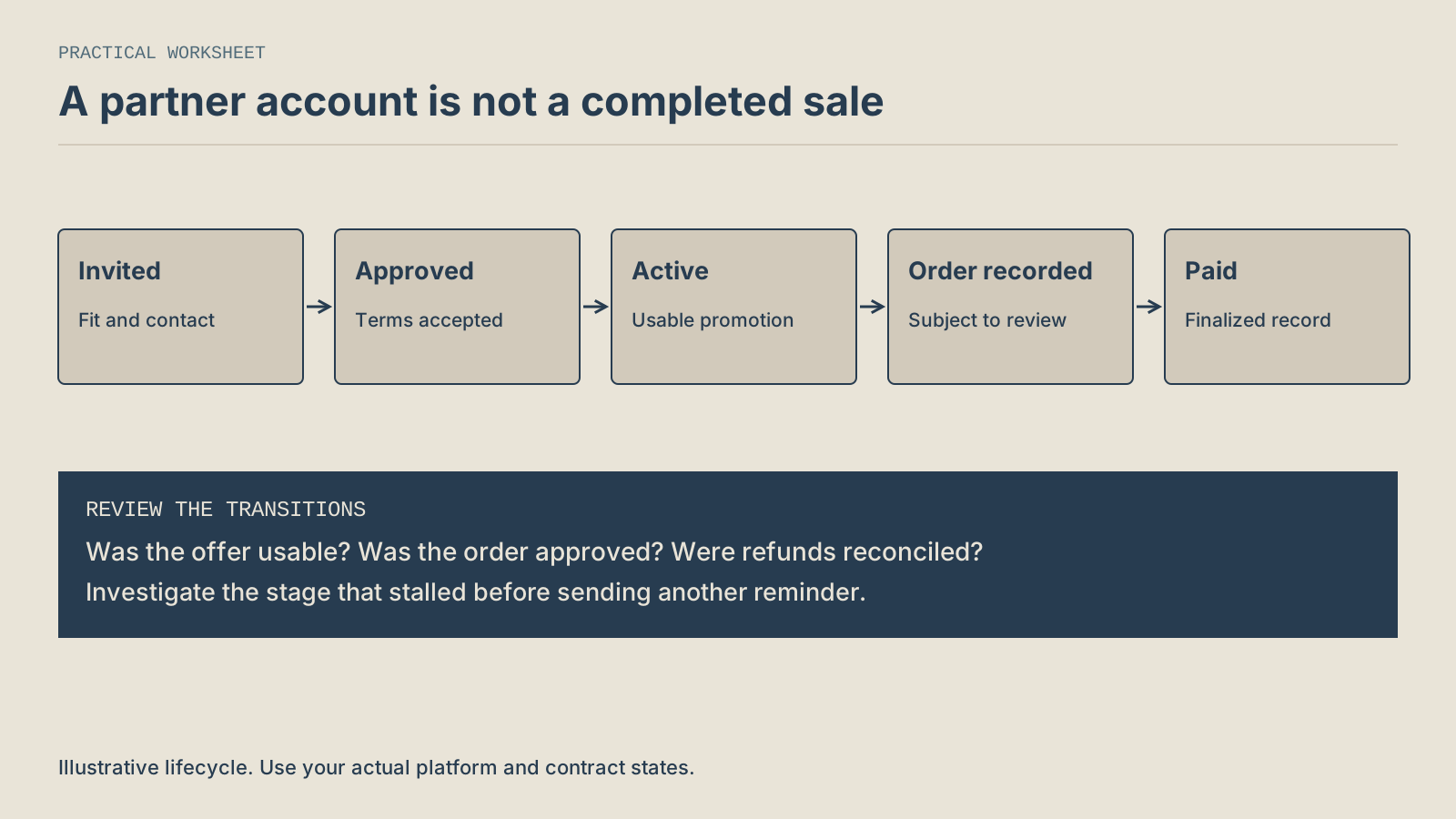
Invited, approved, active, order recorded and paid are different states. Investigate the transition that stalled and use the platform and contract definitions rather than treating all accounts or tracked orders as revenue.
How should the agency help approved partners become active?
The agency should find the reason an approved partner has not progressed and remove practical obstacles within its scope. Repeated generic reminders are a poor substitute for checking whether the partner has the product, the correct destination and a workable brief.
Track meaningful stages separately: invited, approved, brief received, product delivered, content scheduled, content published and orders awaiting review. These stages help explain the work without treating approval as a sale. Not every partner needs every stage, but the program should use consistent definitions.
What does useful support look like for a technical product?
Consider a hypothetical 3D-printer brand. A creator may be willing to film but unsure which materials the review unit supports or whether a certain accessory is included. The program manager can obtain the verified specification, update the brief and confirm the package contents. If the issue requires an engineer, the agency should route a precise question to that person.
Agree on response targets for ordinary questions and urgent failures. A broken campaign destination during a scheduled launch needs a different route from a request for next month’s photography. Define what “urgent” means, who can authorize a correction and how the team records the resolution. Response targets should reflect real staffing and service hours.
The agency should also identify partners who need a different arrangement. A detailed demonstration may require a production agreement separate from affiliate commission. Explain the difference between paying for specified content and rewarding eligible sales, then obtain approval before changing either obligation. Our affiliate marketing budget guide shows how to separate these costs.
What should be checked before partners promote an offer?
Check that the offer, product information and destination agree. A working affiliate link can still lead to an unavailable item, an expired discount or a product page that leaves the customer’s main question unanswered. Those problems need an owner before additional traffic is encouraged.
Use a campaign register containing the eligible products, target market, start and end dates, approved discount, commission arrangement and destination. Record which partners received an update. When a promotion ends, check the materials that remain in active use rather than assuming that a calendar date removes every old claim.
Who checks claims and relationship disclosures?
Your brand supplies supportable product information; the agency’s agreed review process should flag unsupported statements and missing relationship context. The FTC’s endorsement guidance explains that material relationships can need clear disclosure and that endorsements must be honest. The operating task is to provide usable instructions, check the agreed content and document corrections.
For a power station, a statement about powering equipment needs its conditions. Ask whether the demonstration names the actual device, operating mode and relevant limitation. Avoid handing a creator a personal-experience claim they cannot honestly make. A brand can explain the facts without requiring every partner to deliver the same opinion.
Review the destination on the devices and markets used by the campaign. A useful check includes the final page, product selection, discount behavior, delivery information and the next purchase step. When the visit itself needs investigation, use the guide to converting affiliate traffic.
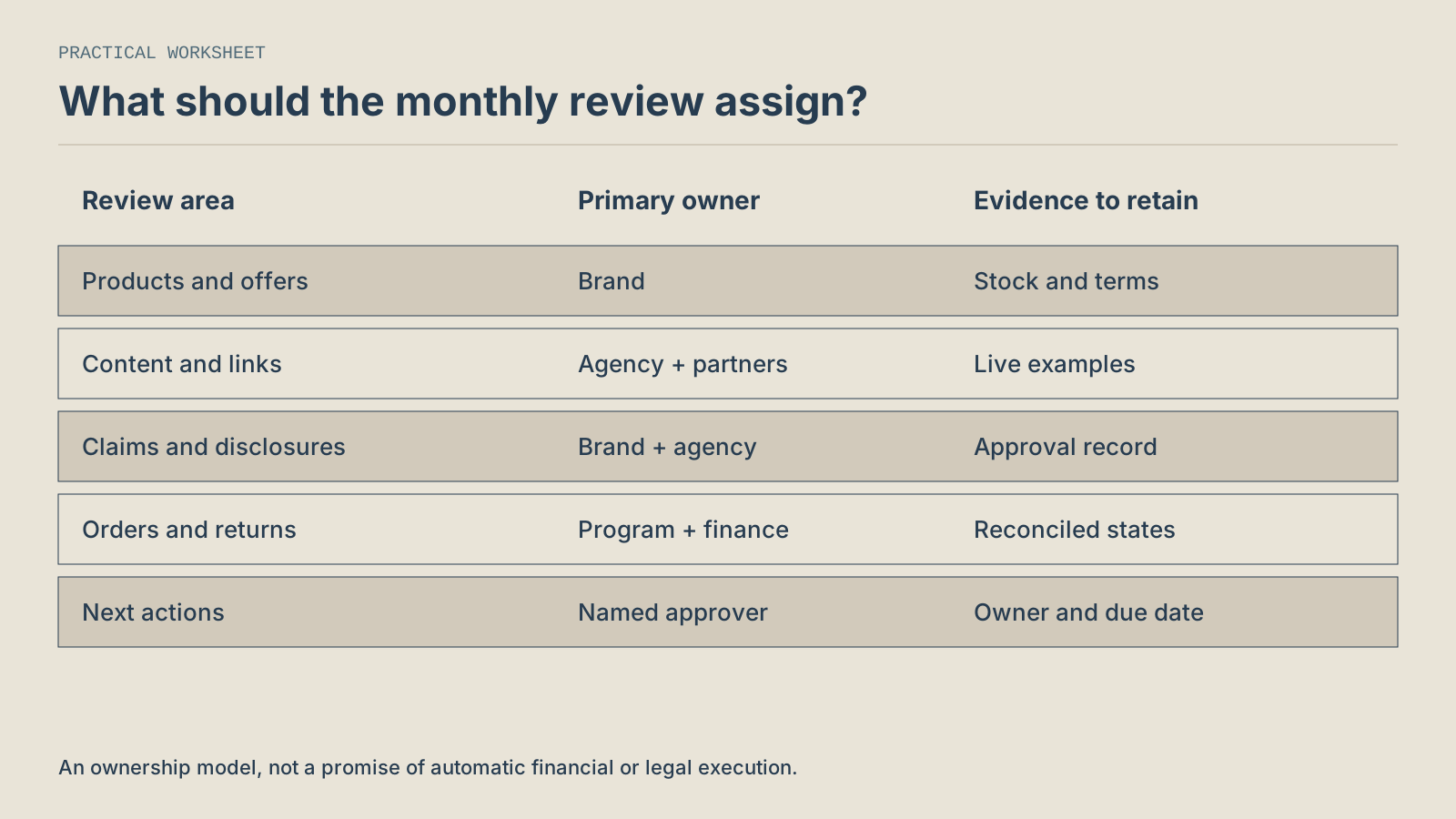
Review products, content, claims, orders and next actions. Retain evidence for each area and name the person who can approve or resolve the decision. Payment and legal work remain separately scoped responsibilities.
How should commissions and exceptions be reviewed without confusing order states?
The agency should distinguish tracked activity from approved obligations and completed payments. It should apply the platform’s documented process and the brand’s actual agreement, then escalate exceptions before deadlines pass. A monthly total loses meaning if those states are combined.
impact.com’s contract documentation distinguishes referral rules, action locking, invoicing and payout scheduling. That is a useful reminder to document the stages used by your own program. Your agreement should identify who reviews reversals, who communicates a dispute and who can approve payment.
What should happen when an order is refunded?
Follow the current platform rules and partner terms. For example, Shopify Collabs’ payment documentation describes a holding period and cancellation of commissions for canceled or fully refunded orders during that period. Do not assume the same treatment applies to every platform, partial refund or already-paid transaction.
Use an exceptions list with order reference, current state, amount affected, required decision and deadline. Avoid distributing unnecessary customer information. If an agency prepares the reconciliation but your finance team approves payment, the handoff should be explicit. An unresolved balance should remain visible rather than disappearing when a new month begins.
Agree the commission basis before reviewing results. A percentage of discounted product revenue differs from a percentage that includes delivery or tax. The commission-rate worksheet helps your brand make that commercial decision before it becomes a reporting disagreement.
What evidence should a monthly review contain?
A monthly review should connect actions to observed changes and identify the next decision. It should not imply that every attributed order was incremental or that a busy recruitment month automatically improved profitability. State the reporting period, definitions and limitations.
Start with completed work: which briefs were updated, which partners were supported, which destinations were checked and which issues were closed. Then show partner activity, relevant traffic, eligible orders, refunds and approved commissions using consistent periods. Include the cost of operating the program when reviewing its commercial contribution.
What should the decision log look like?
Write each recommendation as an action with a reason, owner and review date. “Update the compatibility table before sending the next demonstration brief” is actionable. “Increase engagement” is too vague to assign. Preserve the prior decision so that a later reviewer can understand why a product was paused or a partner received different terms.
Before the meeting ends, confirm the next month’s eligible products, required brand approvals, expected launches and unresolved dependencies. A program manager cannot fix an unavailable product or approve an unsupported specification through reporting alone. The review earns its value when it changes a decision your business can actually carry out.
What else should brands ask about affiliate program management?
Does an agency need to handle every partner conversation?
No. Define which relationships the agency owns and which remain with your internal team. Existing strategic partners may need direct brand involvement, while routine questions can follow a shared support process. Record the boundary so that partners do not receive conflicting answers or wait because each team assumes the other has replied.
Can commission payments be included in the management fee?
They can be structured in different ways, but your proposal must identify what the fee covers. Agency compensation, partner commissions, software and product costs are separate economic items even when one invoice collects them. Ask who funds payments, who approves them and which records establish that an obligation was settled.
Should the agency guarantee a number of sales?
Evaluate the responsibilities and evidence the agency can control. Sales also depend on product demand, price, stock, destination quality and partner activity. Agree measurable work and review criteria without confusing them with a guaranteed commercial outcome. If a proposal contains a performance commitment, examine its definitions, exclusions and financial consequences carefully.
How can we review a program with few orders?
Use the available evidence to identify the next constraint. Check whether appropriate partners became active, customers reached the intended product and the purchase path functioned. Small samples require cautious interpretation. Keep the program’s spending and test duration within an approved limit while investigating causes instead of presenting early percentages as reliable benchmarks.
What should we receive when the agency relationship ends?
Request current partner and offer records, approved materials, reporting definitions, open issues and a documented access handover. Confirm who will answer partner questions during the transition. Your contract should address asset ownership and continuing obligations, including unresolved commissions. A clean handover preserves both operational continuity and the history behind important decisions.

How C3i3 Can Help
C3i3 can help your brand define the operating work behind an affiliate program: clear responsibilities, usable product content, partner communication, destination improvements and a review process tied to available evidence. We can connect that work with product demonstrations, search content and website support where your scope requires them.
Bring your existing program, current offer and the decisions still landing on your desk. Explore our affiliate marketing services for brands or discuss the management support you need. We will establish the responsibilities, access and deliverables before work begins.