








































In this article
Affiliate marketing costs are easy to underestimate when the conversation starts and ends with a commission percentage. A brand can pay only for eligible sales and still spend money preparing product pages, supporting partners, shipping samples and managing the program. Those costs affect whether the arrangement makes commercial sense.
This guide helps product brands build a practical budget before hiring an agency or launching a pilot. It uses technology and specialist-equipment examples, with clearly hypothetical arithmetic rather than a promised price. If the program design is still being decided, begin with what your brand should prepare before launching an affiliate program. The budget should follow that scope, not substitute for it.
Which affiliate marketing costs should your brand budget for?
Your budget should include the work required to make the program usable and the obligations created when it operates. A commission-only view misses preparation and management. A fixed agency retainer can also omit costs that remain with the merchant.
| Cost group | Possible items | What to confirm |
|---|---|---|
| One-time setup | Program brief, configuration, product information, initial creative and tracking checks. | Deliverables, revision limits and implementation owner. |
| Recurring operation | Agency management, software, reporting and internal coordination. | Frequency, included workload and extra-work rules. |
| Activity-based spending | Samples, delivery, product loans and commissioned demonstrations. | Quantity, approval process, return terms and usage rights. |
| Sales-related obligations | Approved commissions, transaction-related charges and relevant reserves. | Commission basis, eligible orders and payment timing. |
Do not assume every item belongs in every program. A brand with strong product pages may need little initial web work. A technical-equipment company with incomplete specifications may need substantial preparation before any partner can explain the offer accurately. Budgeting means identifying your actual dependencies.
What should be written beside each estimate?
Record the source, owner, payment timing and confidence level. “Agency proposal received” is stronger than a guessed amount. A provisional shipping allowance should say how it was calculated and which markets it covers. This makes the budget reviewable without pretending that every uncertain cost is already known.
How should you compare agency fees with commission-based compensation?
Compare the work, financial incentives and responsibilities behind each proposal. A fixed fee can purchase defined operating capacity. A performance component can link part of compensation to a specified result. Neither arrangement removes the need to define eligibility, reporting and exclusions.
Ask what the agency will actually do: program planning, partner support, content coordination, destination review or transaction reconciliation. Then check workload assumptions and who approves extra work. The monthly affiliate-management guide provides a responsibility framework for that comparison.
What can make two apparently similar fees very different?
One proposal may include a limited partner group and basic reporting, while another includes technical implementation and content production. A lower fee may leave more coordination with your staff. State the expected internal hours and required expertise before concluding which offer costs less for your business.
For a performance fee, define the calculation base. Does it use attributed revenue, approved revenue after refunds or another measure? Are existing customers, taxes, shipping and discounts treated differently? Who resolves disputed orders? impact.com’s contract documentation distinguishes payout conditions from locking and payment schedules, showing why a percentage alone does not describe an agreement.
Keep agency compensation and affiliate compensation visible as separate lines. If both use a percentage of sales, your model must include both on the appropriate basis. Request a worked invoice example using hypothetical orders before signing, so the same assumptions appear in the proposal and your budget.
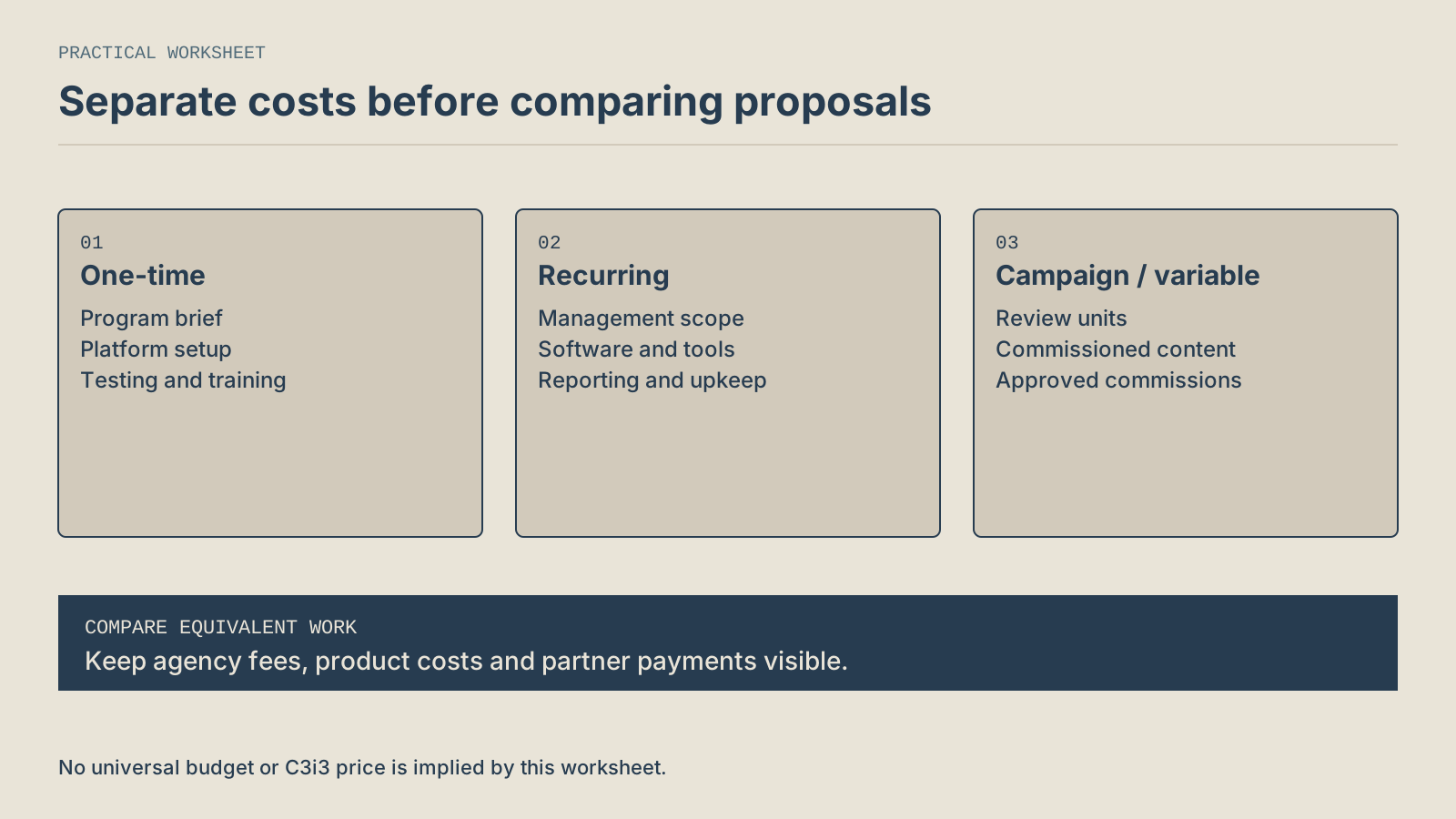
Classify the commercial brief, setup and testing as one-time; management, tools and upkeep as recurring; and samples, commissioned content and approved commissions as campaign or variable expenses. Compare equivalent scope.
How do samples, product loans and content rights change the budget?
They create obligations beyond sales commission. A sample consumes inventory and delivery resources. A loan requires handling and a return process. Commissioned content pays for agreed work and usage rights, whether or not that work generates attributed purchases.
Should you value a sample at its retail price?
Use the economic view appropriate to the decision and explain it. Cash planning might include the product’s actual cost, packaging and shipping. A profitability review may also consider scarce inventory or other opportunity costs. Retail price is useful context, but it does not automatically equal the merchant’s cash cost.
For an expensive review unit, compare a gift with a documented loan. A loan may preserve the asset, but outbound and return shipping, inspection, damage exposure and staff time still matter. Assign an owner and record the unit’s condition. Do not describe a loan as free simply because the product is expected back.
What should a content-production quote specify?
Clarify the format, deliverables, revision process, publication obligations and permitted uses. If the brand wants to reuse a demonstration in paid advertising, that permission should be agreed separately where required. Do not assume an affiliate relationship transfers a creator’s footage or grants unlimited edits.
Sending a product also requires clear communication about the relationship. The FTC’s endorsement guidance explains that receiving value can create a relationship consumers need to understand. Budget time for accurate briefs and review instead of treating disclosure and claims checks as an afterthought.
What could a clearly scoped pilot budget look like?
A pilot budget should show how the arithmetic changes when the scope or sales assumptions change. The following figures are invented planning inputs, not market averages, C3i3 prices or expected results. Replace every input with your own quote or business record.
Assume a hypothetical equipment brand tests a small program for three months. Its one-time setup allowance is $1,200. It budgets $600 per month for defined outside support and $100 per month for software. It also allocates $450 across the pilot for samples and delivery. No paid advertising or separately commissioned videos are included.
| Component | Calculation | Pilot amount |
|---|---|---|
| One-time setup | $1,200 once | $1,200 |
| Outside support | $600 × 3 months | $1,800 |
| Software | $100 × 3 months | $300 |
| Samples and delivery | Assumed pilot allocation | $450 |
| Subtotal before commissions | $1,200 + $1,800 + $300 + $450 | $3,750 |
| Illustrative approved commissions | 100 eligible orders × $20 | $2,000 |
| Listed cash budget | $3,750 + $2,000 | $5,750 |
The 100 orders are an assumption for demonstrating the model, not a forecast. With zero eligible orders, the listed fixed and activity costs would still total $3,750. With 50 eligible orders at the same commission, the listed total becomes $4,750. With 150, it becomes $6,750. Your cash obligation therefore changes with activity while setup and operating commitments remain.
What is missing from this example?
Internal labor, product cost on customer orders, payment processing, refunds, taxes, additional production and any platform-specific transaction charges are excluded unless already represented by a stated allowance. That is why $5,750 is a listed cash budget, not a complete profit calculation. Add your omitted costs before deciding whether the pilot is affordable.
Record when each amount is payable. A setup invoice due at launch and commissions payable after validation create different cash requirements, even if the total remains unchanged. Preserve enough available cash to meet approved obligations rather than relying on a headline sales figure.
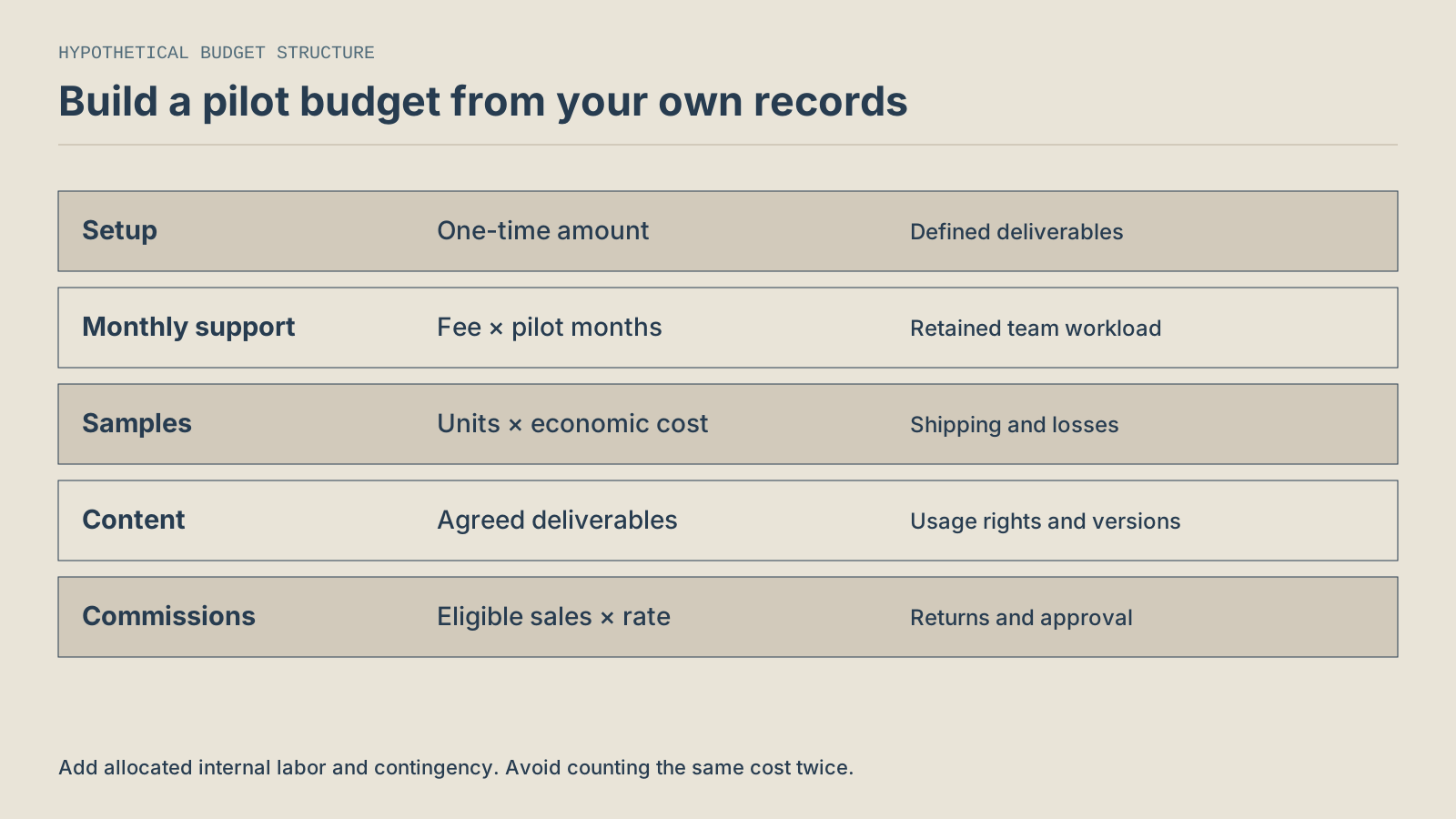
Budget setup plus support for the pilot period, review units at economic cost, agreed content and eligible commissions. Include shipping, usage rights, internal labor and contingency without double-counting.
How do you connect the program budget to product margins and cash flow?
Start with the contribution available from an eligible order, then include the program’s fixed costs separately. Revenue is not the amount available to pay affiliates. Discounts, product cost, fulfillment and other order-related costs reduce that amount before agency overhead is considered.
For a hypothetical order, assume net product revenue after discount is $200 and product cost, fulfillment, payment fees and a stated return/support reserve total $124. Contribution before affiliate commission is $76. A $20 commission leaves $56 before fixed program costs. If all 100 assumed orders in the pilot had those same economics, they would contribute $5,600 after commissions. Subtract the earlier $3,750 fixed and activity subtotal and the illustrative remainder is $1,850 before excluded costs and tax.
This arithmetic does not prove the orders were caused by the program or that those assumptions will hold. Some customers might have purchased without an affiliate. Product mix, returns and delivery costs may differ. Use the example to understand the model, then test the assumptions against actual records.
Why can a commission report differ from a cash payment?
Program timing matters. Shopify Collabs’ payment guidance describes commissions passing through a holding process before payment and warns against duplicate payment outside its system. Use your platform’s current rules to model the timing. A pending obligation, an approved amount and money already paid should remain separate in the budget.
For a deeper SKU-level calculation, use our guide to affordable affiliate commission rates. Check difficult cases such as bundles, discounted accessories and unusually expensive delivery before making a sitewide offer.
What spending controls should be agreed before the pilot starts?
Agree a spending limit, approval process and review date. Define which changes require a new decision: more samples, another market, a higher commission, paid content or additional website work. A capped pilot can still exceed expectations if each team interprets the cap differently.
Use one forecast that distinguishes committed spending, provisional allowances and activity-dependent amounts. Review it alongside actual invoices and approved commission records. Include the internal owner who can stop an offer or approve a necessary correction. That makes financial control part of program operation.
When should the budget increase?
Increase spending when evidence supports the next specific test and your business can support the obligation. An observed destination failure calls for a scoped fix, not automatically a larger recruitment budget. Stronger partner activity may justify more support if margins, stock and fulfillment remain suitable.
Set a review around decisions rather than a promised return date. Ask what was learned, which assumptions changed and whether the next allocation has a clear purpose. If traffic reaches the store but purchases do not follow, investigate the affiliate purchase journey before buying more attention.
What else should brands know about affiliate marketing costs?
Is affiliate marketing free until a sale happens?
A program can reward eligible sales while still requiring setup, software, product samples and staff time. Even if your chosen platform has no fixed fee, check transaction charges and operational work. Build the budget around all responsibilities rather than treating the partner’s commission as the entire cost of the channel.
Should a small brand hire an agency immediately?
Base that decision on the work, expertise and available capacity. A focused planning or implementation engagement may solve an initial dependency without committing to full ongoing management. Compare what your team can reliably handle with the responsibilities in the proposed scope. Small order volume does not make every operating task disappear.
Can one commission rate work for every product?
It can be simple, but first test the rate against your eligible products and promotions. Products with different margins may require different treatment. Shopify’s program configuration guidance, for example, supports different rates by product collection. Your rate design should follow your economics and the platform’s capabilities.
How do we compare a fee with a revenue-share proposal?
Apply both proposals to the same hypothetical order scenarios and scope. Include the calculation basis, excluded orders, refunds, minimum commitments and internal workload. Compare low, expected and higher activity using clearly labeled assumptions. A favorable calculation in one scenario does not establish that one arrangement is always cheaper.
What should we ask for before approving a quote?
Request the deliverables, duration, included capacity, exclusions, payment schedule and access requirements. Ask which costs belong to the agency, platform, creator and brand. Confirm how new work is approved and how you receive a handover. A clear quote gives you enough information to replace estimates with accountable commitments.

How C3i3 Can Help
C3i3 can help your product brand scope an affiliate program around the work it actually needs: planning, product content, partner coordination, website improvements and useful reporting. We can identify which preparation belongs before recruitment and which recurring tasks need an owner.
Bring your product range, current website and any existing program or agency proposal. Explore our affiliate marketing services or discuss a scoped launch or management project. Fees, outside costs and approval responsibilities are established in the written proposal.