









































In this article
A San Jose ecommerce integration can appear successful because a product record reaches the store once. The business still needs to know how inventory, orders, corrections and failed updates behave over time. A useful development brief defines the connection in terms of operational events and reviewable outcomes.
Planning a project? Explore San Jose web design and marketing support and ecommerce design and development services.
What should a San Jose ecommerce development company test first?
Start with the business process and a small set of representative records. Identify which system owns product identity, pricing, inventory and order information. A test cannot establish correct behavior if the team has not agreed which source should win when values differ.
Include the staff who handle catalog and fulfillment exceptions. They can explain the conditions a normal demonstration misses, such as an amended order or a delayed stock correction. The development scope should name those conditions and how they will be verified.
How do I find the best ecommerce developer near me for an ERP integration?
Ask candidates to describe a sample mapping, a failure-handling method and an operational handover. The provider should distinguish a connector’s stated capability from the behavior it has verified in your environment.
For San Jose B2B work, technical access and subject review may matter more than a platform badge. Ask who will coordinate with your ERP owner, which sample data is needed and what remains a discovery task. A responsible estimate makes those dependencies explicit.
Which data and update rules belong in the integration brief?
List the fields, their authoritative source, the update direction and the conditions that trigger a change. Include how identifiers and variants are matched. A connection that uses an ambiguous product name instead of a stable identity can create operational confusion.
Agree how empty values, discontinued items and intentional overrides are handled. The correct rule depends on the business. Document it before development so a technical default does not silently become the merchandising policy.
For the connected decision, read B2B Ecommerce: How Can Manufacturers and Distributors Let Customers Order Online?.
What failure cases should an ecommerce integration test include?
Test relevant delayed updates, repeated events, invalid records and interrupted processing. The system should have an agreed way to identify exceptions and avoid turning a retry into an unintended duplicate action. Use the platform’s current documentation and the actual integration design to define appropriate checks.
Also test a correction after an earlier success. An integration needs to handle change, not merely import an initial record. Record the expected result, observed result and evidence for each case so the acceptance discussion can distinguish confirmed behavior from an assumption.
How should orders and operational exceptions be reviewed?
Follow a representative order from the store to the responsible system and team. Confirm which identifiers link the records, what status means and who handles a mismatch. Include the relevant amendment, cancellation or return scenarios in the agreed scope.
A visible exception queue can be more useful than a promise that synchronization is automatic. Staff need to know what failed, what has already happened and the next safe action. Define permissions and escalation so the process does not depend on one developer remembering an undocumented step.
What should integration handover and rollback include?
Request mapping documentation, operational checks, support responsibilities and a plan for deployment or rollback. Explain how the business will detect missing updates and which system remains authoritative during an interruption. Backups and recovery procedures should match the changes being made.
C3i3 can help clarify the ecommerce requirements, product information and implementation handoffs within an agreed project. Bring the systems involved and the operational problems you need to solve. Acceptance should follow demonstrated tasks rather than the fact that a connector has been installed.
How do the key evaluation criteria compare?
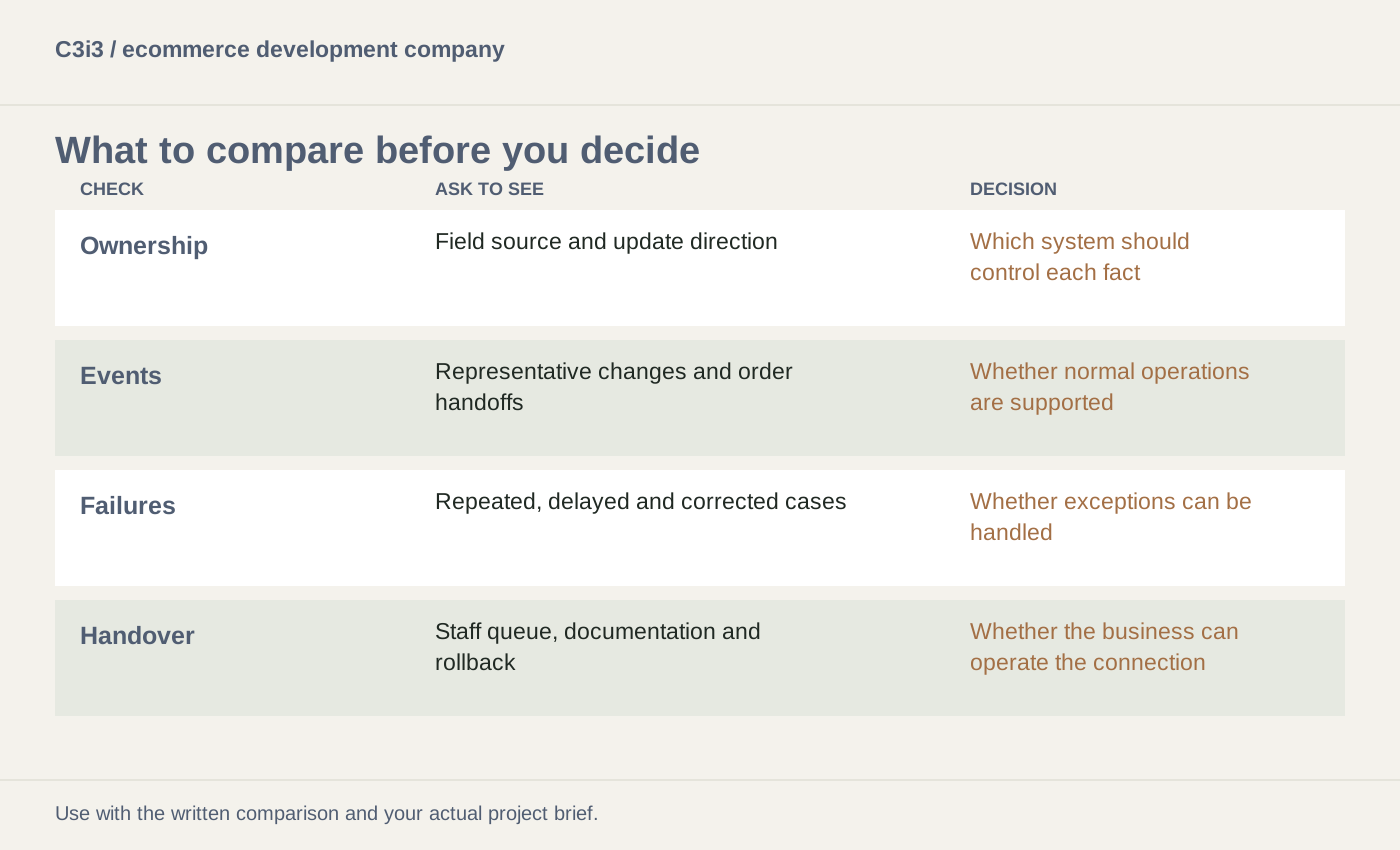
| What to compare | Evidence to request | Decision it supports |
|---|---|---|
| Ownership | Field source and update direction | Which system should control each fact |
| Events | Representative changes and order handoffs | Whether normal operations are supported |
| Failures | Repeated, delayed and corrected cases | Whether exceptions can be handled |
| Handover | Staff queue, documentation and rollback | Whether the business can operate the connection |
How could a San Jose distributor test more than an initial import?
Imagine a distributor that successfully imports a product and then tests a stock correction, an order amendment and a repeated update. The team compares the observed results with its written rules and discovers that one exception lacks a responsible reviewer.
It adds the review workflow before accepting the connection. This hypothetical test does not prescribe a particular ERP or connector. It demonstrates why a working first import and a reliable ongoing business process are different acceptance questions.
What should you remember before the next step?
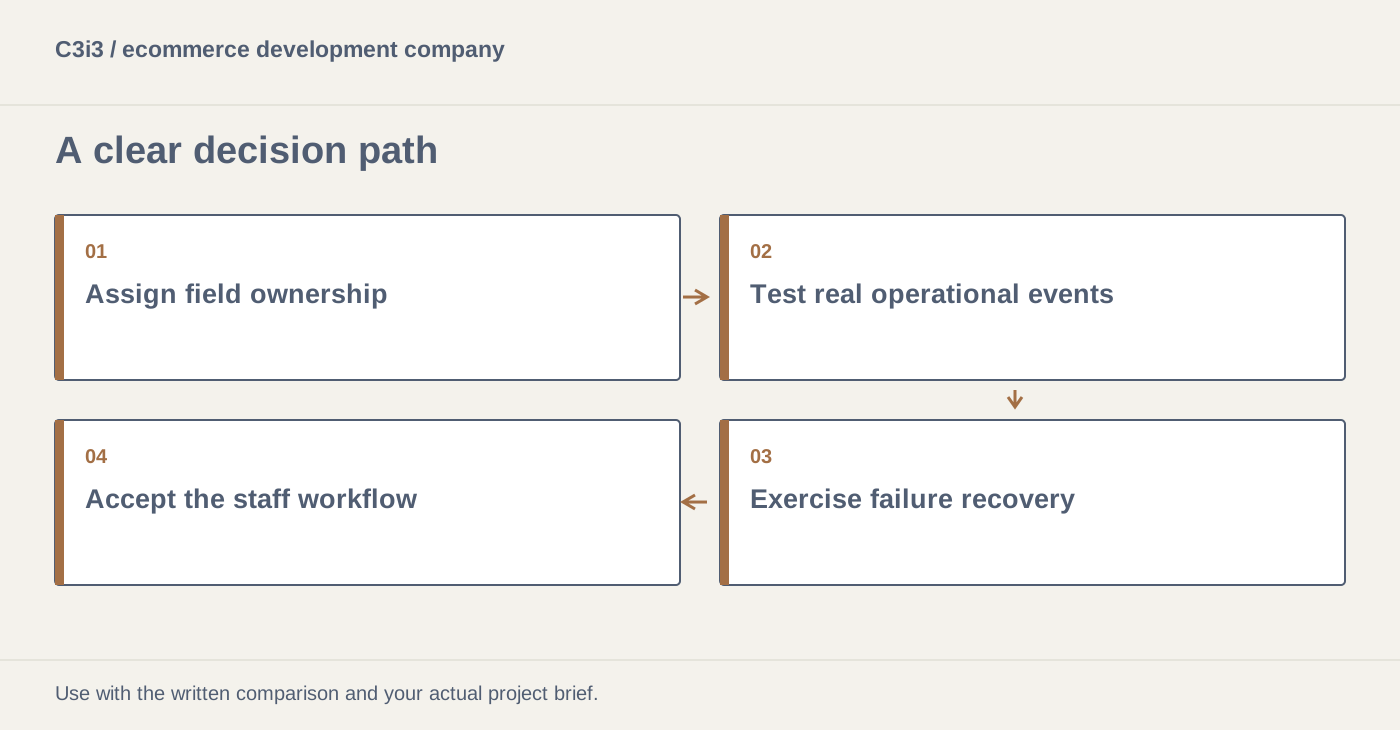
- Assign field ownership.
- Test real operational events.
- Exercise failure recovery.
- Accept the staff workflow.
What else do local business buyers ask?
Does installing a connector complete the integration?
No. Verify the mapping, operational cases and staff workflow required for your actual systems.
Should every field update in both directions?
Not necessarily. Define authoritative ownership and update rules for each field instead of assuming bidirectional synchronization is appropriate.
Can the project start without ERP access?
Planning can identify requirements, but important behavior and estimates may remain unverified until the appropriate technical review and access are available.
Which sources can help you verify these decisions?
The frameworks and hypothetical examples are C3i3 editorial analysis. The linked primary sources provide platform, usability or disclosure context for the relevant decisions.
How can C3i3 help you plan the right next step?

Share your current website, the customers you want to reach and the work you want to improve. C3i3 brings design, content, technology and marketing into a coordinated project scope.
Review C3i3’s background, explore ecommerce design and development or tell us about your project.