








































In this article
A business with several Bay Area locations needs more than the same page repeated under different city names. Customers need to know which branch can help, where the relevant service is available and what happens after they contact that location. The marketing team needs a reliable way to keep those answers accurate as the business changes.
Local SEO for multiple locations is the work of connecting each real branch with a useful website destination, an appropriate public business listing and a measurement record that preserves its identity. Some information should be consistent across the company. Other information must reflect the individual location. This guide explains how to make that distinction before multiplying pages or buying another management tool. It focuses on an established business with genuinely separate locations, not an attempt to manufacture a local presence.
What does local SEO for multiple locations actually need to coordinate?
It needs to coordinate the real business, the information customers see and the route from discovery to the right branch. A location page, a Google Business Profile and a booking destination should describe the same operation. They are separate assets, so a correction in one place does not establish that the others are correct.
Start by distinguishing a physical branch from a city the business serves. A showroom with its own visitor arrangements presents a different information problem from an installation team that travels throughout a region. The same company can have both models. Its public descriptions should explain the difference instead of presenting every city as an interchangeable storefront.
When is a regional service page the better choice?
A regional page is often more useful when the offer, staff and customer process are shared across the service area. Separate pages need separate customer value. Our guide to deciding whether served cities need individual pages addresses that editorial decision. It should not be confused with documenting branches that actually exist.
For an illustrative equipment supplier, a San Francisco demonstration location and a San Jose service location may support different customer tasks. Their pages should explain those tasks clearly. A list of every nearby city would not tell a buyer where to bring a unit, request a demonstration or ask a technical question.
What should be in one dependable record for every branch?
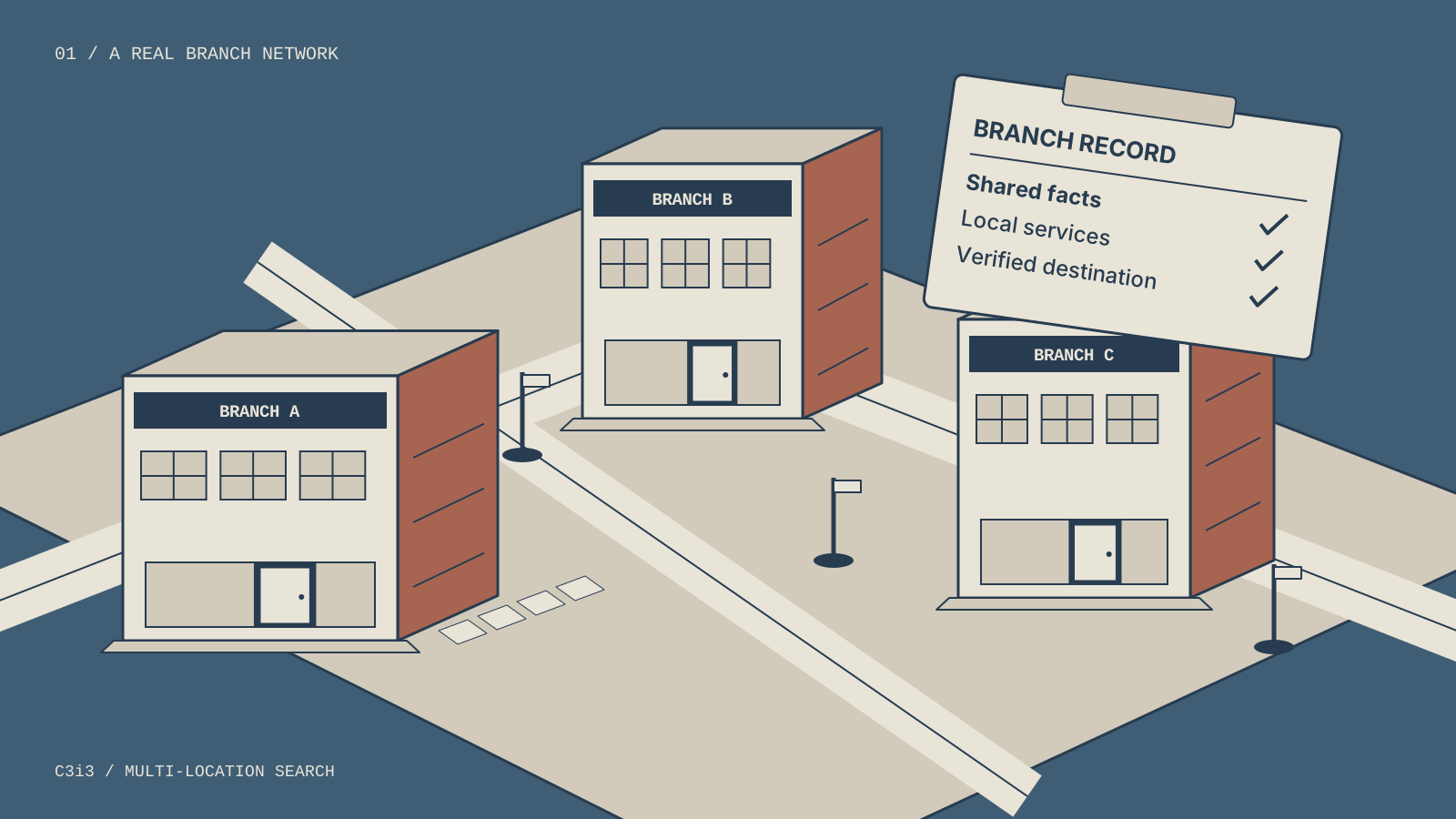
Keep a branch record containing its internal identifier, public name, actual operating model, verified contact details, page URL and public profile references. Add the source and confirmation date for facts likely to change. The record is a coordination tool, not another public directory.
A branch identifier prevents confusion when names are similar or a manager refers to a location by a neighborhood nickname. Choose a stable internal label and record the other names employees recognize. Keep the identifier separate from the wording customers see. An internal code should not be inserted into a public business name merely to make a spreadsheet easier to sort.
Which fields deserve a named reviewer?
Assign a reviewer to customer-facing hours, visitor access, services and the contact route. The person checking service availability may differ from the person confirming building access. Marketing should be able to ask a specific question rather than circulate a full document and hope someone notices an error.
Include exceptions explicitly. A branch might receive scheduled demonstrations while directing repairs elsewhere. A shared phone team might answer calls for several branches while appointments remain location-specific. Recording these arrangements allows the website to explain them honestly.
A useful first exercise is to compare one branch record with its live page while a local team member watches. Mark every fact as confirmed, outdated or unresolved. Resolve the unanswered customer questions before copying the structure to the rest of the network.
Which information should stay consistent and which should vary by location?
Keep shared business identity and terminology consistent. Let the customer-facing facts vary when operations genuinely differ. Consistency means that the information has a coherent source, not that every branch must make identical claims.
Brand naming, descriptions of company-wide capabilities and the meaning of service categories usually benefit from a common standard. A branch’s available services, appointment requirements, collection arrangements and photographs should come from that branch. Avoid using a company-wide capability statement to imply that every location can fulfill every request.
How do you make exceptions understandable?
Write the standard rule first, then identify the location-specific exception where it matters. An illustrative supplier could explain that technical inquiries begin with the same online form while demonstrations are offered only at selected locations. On each relevant page, name the actual demonstration arrangement and the destination for other requests.
A simple decision table can guide editors:
- Company fact: use the approved company source and update connected pages together.
- Branch fact: confirm it with the local information owner.
- Temporary condition: show the effective dates and set a recheck.
- Unconfirmed detail: ask for evidence before publication.
This division also makes maintenance smaller. A brand description can be corrected once through the existing publishing system. A temporary access change should not require rewriting every branch page. The goal is accurate reuse with visible exceptions, rather than identical copy in many places.
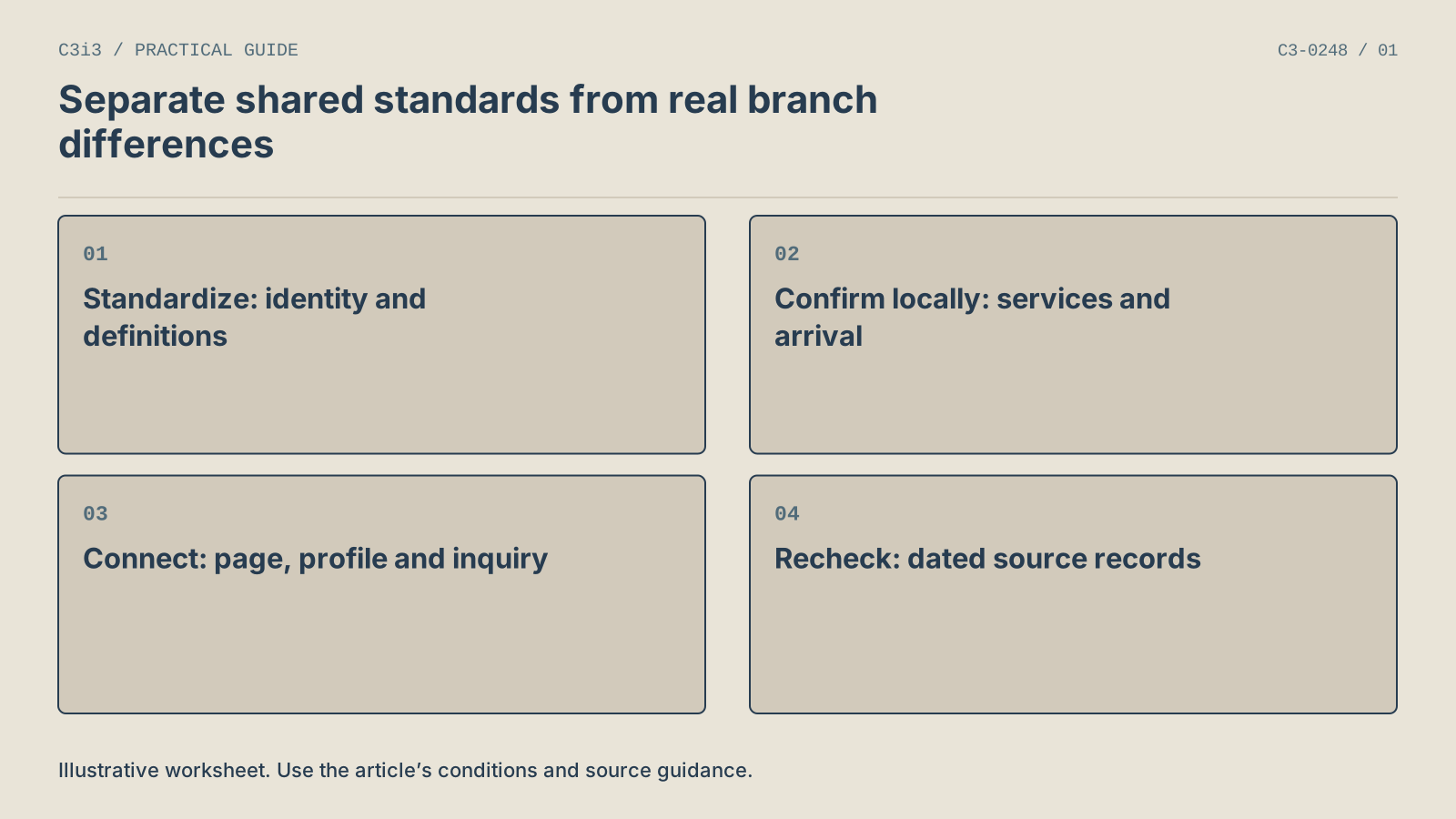
Standardize shared identity and definitions. Confirm local services and arrival details. Connect each branch page with its profile and inquiry route. Recheck those facts against dated source records.
How should location pages connect with service and product pages?
Use location pages to explain where and how the customer can engage with a real branch. Use service and product pages to explain the offer in depth. Connect the pages when the relationship helps a visitor choose the right destination.
A locations hub should let someone identify a suitable branch without opening every page. Useful distinctions might include appointment-only visits, demonstration capability, pickup arrangements or a service team. Do not hide those distinctions behind generic cards that all say the same thing.
Should every branch have a separate version of every service page?
No. A shared service page can explain a consistent offer, with links to the branches that provide it. A separate branch-service page earns its place when the process or information differs enough to answer a different customer question. Creating all possible combinations can produce a large maintenance burden without creating useful choices.
For example, a common calibration service could have one detailed service explanation and a clear list of participating locations. A location that only accepts equipment for transfer should say so. Its page should not imply that the work takes place on site.
Make the relationship visible through ordinary descriptive links. Google’s link guidance explains the importance of crawlable links and understandable anchor text. A visitor should also be able to reach location information without relying entirely on a map interaction. The focused San Francisco location-page guide develops the page brief.
How should public business profiles map to the branch network?
Map a profile to the real operation it represents, then connect it with the website page that accurately describes that operation. Check eligibility before creating or expanding listings. A desired market is not proof of an eligible location.
Google’s business representation guidelines describe requirements for real-world locations, service-area businesses and chains. They also distinguish eligible operations from a rented mailing address. Use those requirements to review the actual business model, rather than choosing a profile structure solely for keyword coverage.
What does a practical profile-to-page map contain?
Record the branch identifier, public profile reference, canonical location-page URL and customer action destination. Include the observed public name and verification state so the team can identify the correct record when making a change. Keep access details in the organization’s approved secure system rather than in public editorial notes.
Test the mapping from the customer’s view. Follow the profile’s website link and check whether the visitor lands on information for that branch. If a shared booking system is used, confirm that the selected branch remains clear through the handoff.
The multiple-location Business Profile guide for San Jose teams covers the inventory and update workflow. It does not replace the eligibility review or suggest that every branch must have every Google feature.
What makes a branch page useful beyond its address?
Useful branch information helps a person decide whether the location can handle the intended task and how to arrive prepared. The address identifies a place. Service details, current photographs and a clear action explain why someone would use it.
Ask local staff about the questions customers repeat before visiting. They may ask whether a demonstration requires an appointment, where a pickup occurs, what equipment can be accepted or whether a specialist is available at that location. Those questions are a stronger starting point than adding a generic paragraph about the city.
Which evidence should be collected locally?
Collect current images of the customer entrance and relevant public-facing areas where appropriate. Confirm that photographs reflect the branch being described. A stock warehouse image should not be presented as evidence of that branch’s inventory or facilities.
Where a team biography or project example helps, use information authorized for public use. Explain the scope of a capability rather than decorating the page with unsupported superlatives. A business can be clear and persuasive without claiming that every location is the largest or most advanced.
Write directions only after checking them. Arrival details are operational instructions, so avoid assumptions about parking, accessibility or entrance routes. If a detail changes often, explain how a visitor can confirm the current arrangement. The page should reduce avoidable confusion while staying within what the business can substantiate.
How do you launch a new branch without spreading unfinished information?
Separate preparation, public announcement and operational availability. A branch can be planned before it can receive customers. The website and listings should make that distinction clear instead of displaying future arrangements as current facts.
Create the internal branch record first. Confirm the opening state, public contact route, service scope and the person who will answer inquiries. Prepare a location page with the information the business can currently verify. Then decide which public updates are appropriate for that stage.
What should happen before a launch announcement?
Walk through the customer journey from announcement to arrival or inquiry. Check that a future-opening message does not lead to a booking form that offers unavailable appointments. Confirm that branch details are consistent across the main locations hub, relevant service pages and the destinations in the announcement.
For platforms supporting future openings, use the platform’s current instructions. Google’s opening-date documentation explains its supported process. Do not treat a planned date as a guarantee of when a profile will be visible or a substitute for completing the required verification.
After opening, recheck the public experience rather than assuming the launch checklist covered everything. The new-location listings workflow provides a more detailed sequence for coordinating these changes.
How do you keep branch details accurate after launch?
Use an event-based update process alongside periodic checks. A changed service, entrance, operating schedule or inquiry route should trigger a review when the change occurs. A calendar reminder provides a second opportunity to catch information that nobody reported.
Keep an update record with the branch, changed fact, effective date, affected destinations and confirmation evidence. Separate an edit being requested from an edit being visible. Public platforms may review changes, and a website deployment does not confirm a third-party listing update.
Which checks should be centralized?
Central teams can check the locations hub, broken links, page metadata and the consistency of shared descriptions. Local teams are better positioned to confirm the customer entrance, availability and what actually happens when a person contacts the branch. Combine the two perspectives in one record.
An illustrative monthly check could begin with the branches that changed during the previous month. Review those fully, then sample the remaining pages against their source records. This is a suggested operating method, not a universal platform requirement.
For a branch move, closure or temporary interruption, create a specific change plan. Do not silently remove a useful page if customers still need to understand what happened. Decide where previous visitors should go and preserve an accurate explanation during the transition. Route decisions through the website’s established publishing process so temporary fixes do not become permanent inconsistencies.
How should you compare performance across Bay Area branches?
Compare branches using the same definitions and comparable periods, while recording differences in maturity, services and operating conditions. The branch with the largest raw total is not automatically the branch with the strongest customer journey.
Keep discovery, website activity and qualified inquiries separate. Search Console can describe website search visibility. Business Profile performance describes supported interactions with a profile. Analytics can show observed website behavior. The business’s inquiry record can establish whether a request was suitable and reached the right location.
What would a fair comparison change?
Suppose an illustrative San Francisco branch has operated throughout the reporting window, while a San Jose branch opened partway through it. A raw comparison would mix an operating-period difference with a marketing difference. Report the dates and compare a shared period before drawing conclusions.
Likewise, a demonstration location and a repair intake location may have different useful actions. One might value demonstration appointments, while the other needs qualified equipment inquiries. Keep those definitions visible instead of combining both into an unexplained conversion total.
Google’s Business Profile performance guide defines its available interactions. A call-button click is not evidence that a call was answered or that a job followed. The dedicated San Francisco and San Jose reporting guide shows how to keep comparison assumptions visible.
What should you standardize first if the current network is inconsistent?
Start with one representative branch and build a complete, verified record of its customer journey. Use that branch to discover which fields, page components and checks the network actually needs. Then expand the method to locations with different operating models.
Do not start by rewriting every page at once. A shared template can spread a misunderstanding quickly. First resolve whether the business has clear branch identities, a useful locations hub and dependable routes to local information.
- Identify the real operation and its current customer task.
- Confirm the branch record with the people responsible for those facts.
- Map the page, public profile and inquiry destination.
- Record what is shared and what differs from other branches.
- Test the customer route and assign the first necessary fixes.
- Choose the measures and review period before evaluating the changes.
As an illustrative review, imagine a buyer arriving through a branch profile to a general company home page. The site may be accurate overall but still require the person to find the branch again. A targeted location destination could remove that unnecessary decision. The improvement to verify is the clearer route; any change in traffic or inquiries needs separate observation.
What would the pilot reveal about two different branch types?
Consider a hypothetical supplier with a demonstration location and an equipment intake location. Use the same worksheet headings for both: customer task, available services, preparation, evidence and next action. The headings are the standard. The answers are allowed to differ because the operations differ.
At the demonstration location, the reviewer might discover that the product family is clear but the appointment arrangement is missing. At the intake location, the page might explain the arrival process while omitting which equipment the team can accept. Neither finding calls for a new generic city introduction. Each calls for a specific fact and a person who can confirm it.
Record the planned correction, the public destination and the observable check. For the first branch, the check could be whether a new visitor can find the appointment requirement and correct inquiry route. For the second, it could be whether the accepted equipment and next step are understandable. Do not invent a conversion improvement to complete the worksheet.
That exercise shows whether the common page structure can support different customer needs. If the structure cannot express an important difference, revise the component before expanding it across the network. If the structure works and a fact is missing, solve the information gap rather than redesigning every branch page.
Once the pilot is usable, document the standard in plain language. Make it short enough that an editor or branch manager can apply it consistently. A dependable operating method is more valuable than a large collection of unmaintained local pages.
Give the next reviewer the evidence needed to continue the work. A note saying that a page was checked is less useful than a dated observation naming the branch, the customer task and the remaining question. That record prevents a later editor from accidentally restoring information the business has already corrected.
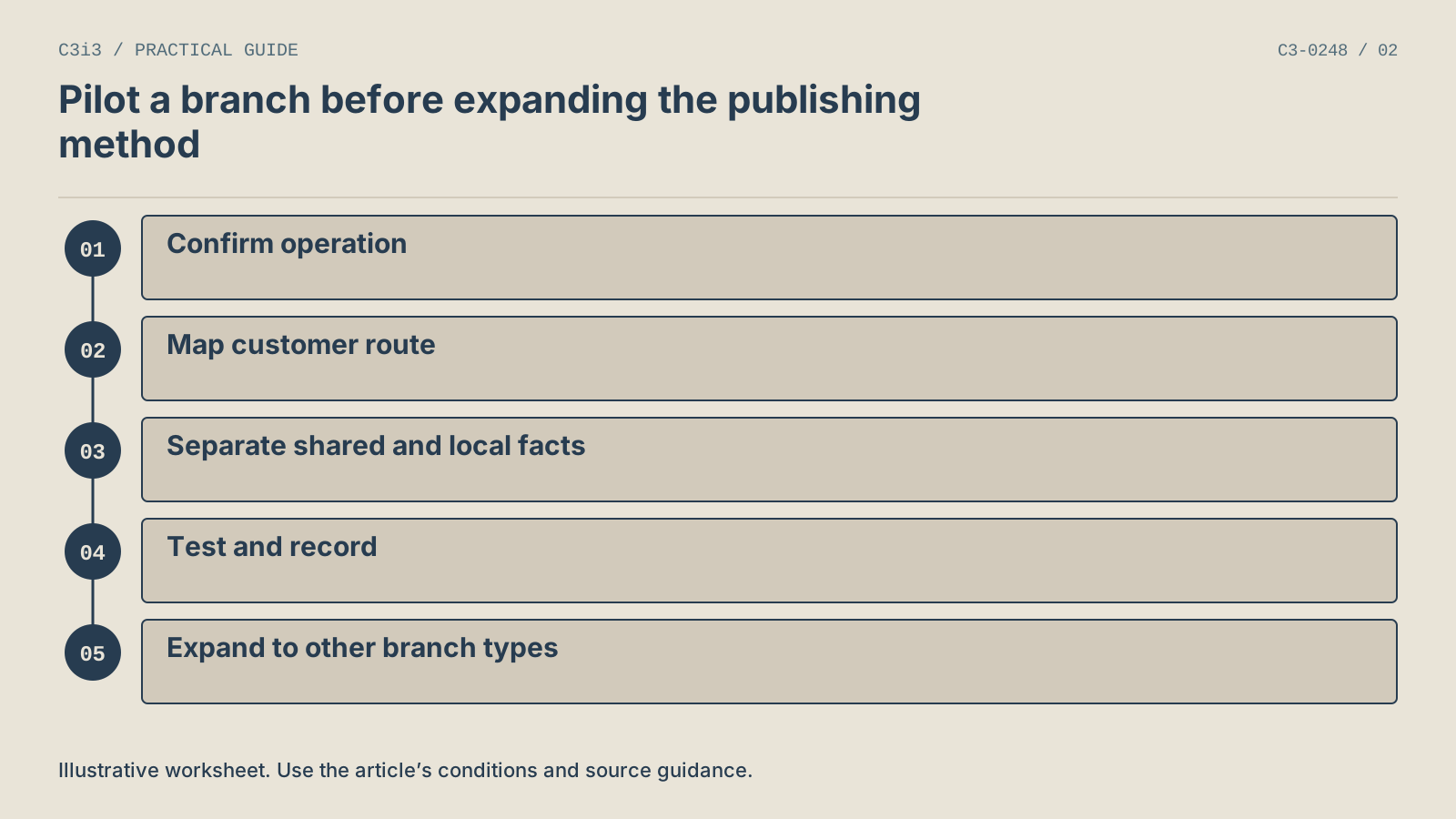
Confirm the actual operation, map the customer route, separate shared facts from branch facts, test the route and record the result. Expand only after the method handles a different branch type.
What else do businesses ask about SEO for multiple locations?
Does every branch need its own website?
No. Many businesses can explain their locations clearly within one well-organized website. Separate websites create additional publishing and maintenance work and should serve a real business need. Begin with the customer journey and the differences between branches. Do not choose separate domains merely because each branch wants its city in a web address.
Can the branches share some page wording?
Yes. Shared company facts and consistent service explanations can remain consistent. Each location page should still supply the facts needed to use that location. Rewriting identical information with synonyms does not create a meaningful distinction. Branch-specific availability, arrival details and action destinations provide a stronger reason for the separate page.
Should every branch use a different public business name?
The public name should reflect the real business rather than an internal SEO naming formula. Google has specific guidance for chains, brands and other business models. Review the actual operation and current documentation before changing names. A branch identifier can keep records organized internally without becoming an extra phrase in the public name.
Does structured data replace the visible location information?
No. Structured data should describe the real information on the page. It is not a substitute for an accurate address, understandable service scope or a working inquiry route. Google’s LocalBusiness documentation explains supported properties and eligibility. Use applicable markup accurately without inventing reviews, awards or a public office.
How do we know whether a location page is indexed?
Use Search Console’s URL inspection tools for the exact canonical URL when the appropriate access is available. A successful page load confirms that a visitor can access the page, not that Google has indexed it. Likewise, indexing does not establish a high position or prove that the page generates qualified inquiries.
Can one agency coordinate the whole branch network?
An agency can help organize the records, publishing and measurement when the scope is clear. The business still needs reliable sources for local operating facts. Ask how proposed updates will be confirmed and how completed changes will be documented. The right arrangement makes differences visible rather than hiding them under a standard template.

How C3i3 Can Help
C3i3 can help connect your branch information, website structure and local search work around the way customers actually use each location. Bring a current branch list, representative location pages and the customer actions you want to support. We can identify where shared standards would help and where the pages need more specific information.
Our local SEO services can support a focused review and implementation plan. If the main question is your broader provider relationship, the existing Bay Area SEO agency-selection guide addresses that separate decision. Talk with C3i3 about the locations and customer journeys you want to improve.