








































In this article
A person searching for a San Francisco business location may already know what the company offers. The immediate question is more practical: can this branch handle the request, is a visit appropriate and what should happen next? A location page should answer those questions without sending the visitor through the whole website again.
San Francisco local SEO benefits from accurate local information, but a city name does not make a page useful by itself. This guide is for businesses with a real location to describe. It covers the branch page’s content and links, not a formula for creating pages for every city a service team can reach. For the wider operating model, start with the multi-location local SEO guide.
What customer decision should a San Francisco location page answer?
The page should help someone determine whether this real location is the right place for the intended task. That decision comes before a request for directions, an appointment or an inquiry. Choose the task before choosing the page sections.
Ask what customers need from the location. A showroom visit, a scheduled consultation, equipment pickup and a service intake are different journeys. Even when the same business offers all four, a particular branch may support only some of them. The page should make the boundary visible.
How do you write a useful first screen?
Use the recognizable business and location identity, a short statement of what happens there and a clear next step. Do not make a visitor infer that a corporate office is a walk-in service counter or that a demonstration space carries every product for immediate collection.
Consider an illustrative technology supplier whose San Francisco location receives scheduled product demonstrations. A useful introduction would explain the demonstration arrangement and direct repair inquiries to the correct process. A broad claim about serving the entire Bay Area would not resolve either question.
The opening does not need a long account of the city. It needs enough context for a new visitor to recognize the correct business operation. The existing local service-page guide addresses a different task: explaining a particular service. The location page should connect with that explanation rather than reproduce it.
What information should each real branch page include?
Include the branch identity, service availability, practical visit information, relevant evidence and a working action destination. Confirm the information with people responsible for that location. A complete template is useful only when its contents match the operation.
Begin with a content worksheet. For each component, record the customer question, the current answer, the confirming source and any condition that changes the answer. This helps the writer distinguish missing information from a design problem.
- Identity: Which branch is this, and how do customers recognize it?
- Availability: Which services or customer tasks are supported here?
- Preparation: What should a visitor do before arriving or contacting the team?
- Evidence: What can the business show about this location?
- Action: Where does the customer go next?
Which facts should be easy to find without opening another page?
Put the details required for the immediate branch decision on the page. Depending on the operation, that can include customer-facing hours, appointment arrangements and the appropriate contact route. More detailed technical explanations can sit on their own pages, connected by descriptive links.
For an illustrative service intake location, the branch page could state that equipment is accepted by prior arrangement and explain the first information the team needs. It should not imply that every repair is completed there. A clear limitation can save an unnecessary trip and produce a better inquiry.
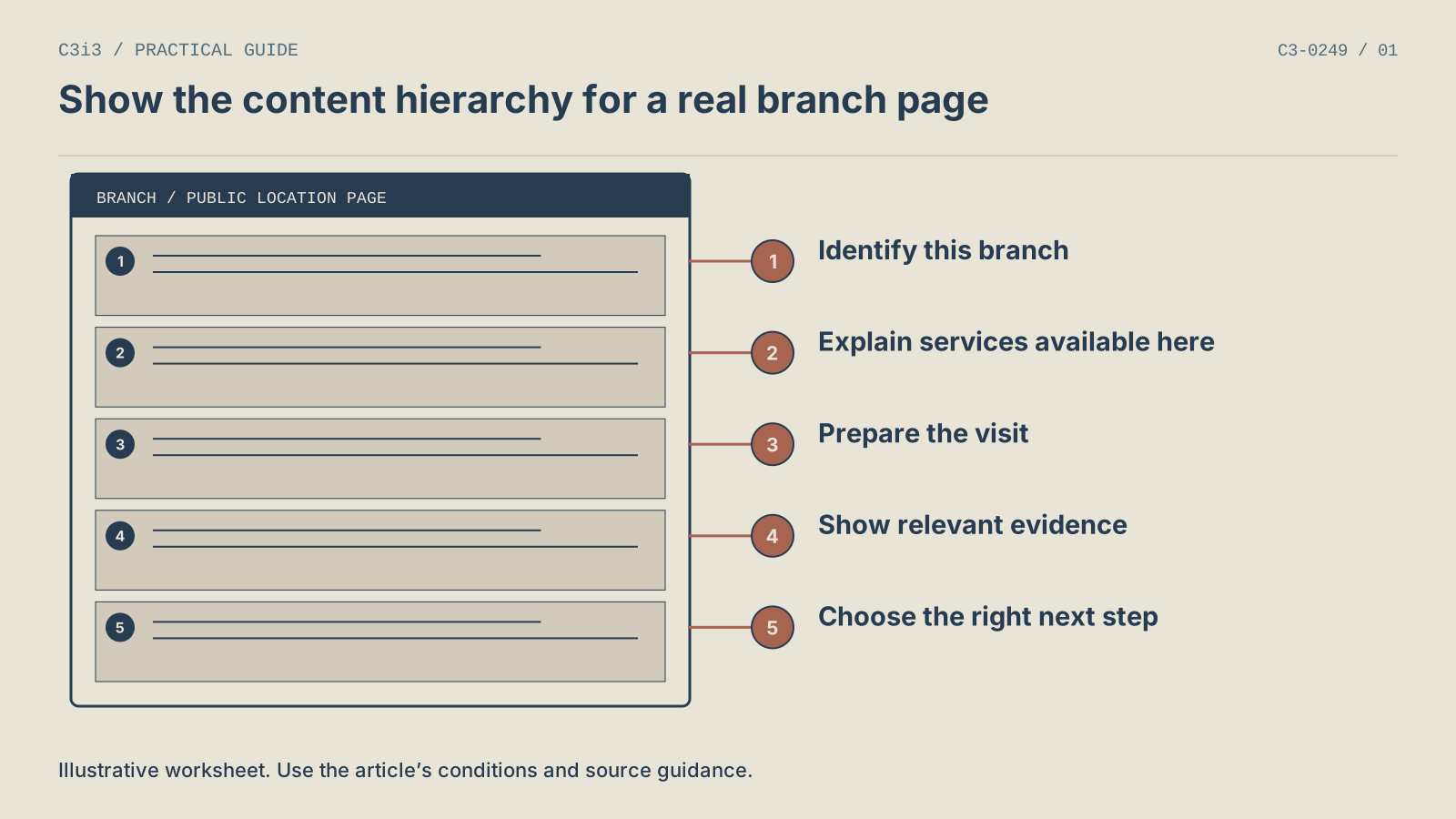
Identify the branch, explain what it offers, supply verified visit information, show evidence from that location and provide an appropriate next step.
How do you make arrival details accurate and useful?
Describe the route customers actually use and verify practical instructions before publishing them. Arrival information is operational content. It should come from someone who knows the current arrangement rather than from an assumption based on a map.
A San Francisco branch may have a customer entrance that differs from the building’s main entrance, or it may receive visitors only after an appointment is confirmed. Those are illustrative possibilities, not claims about a particular building. Include only the details that apply to the business being described.
What should you ask the local team to confirm?
Ask which entrance a customer should use, whether a prior contact is required and whether pickup or delivery has a separate process. Confirm any parking or access statement with the responsible team. Do not label an entrance or facility accessible without an appropriate basis for that claim.
Photographs can help people recognize the correct entrance when they are current and accurately labeled. A close image of the customer-facing entrance may be more useful than a dramatic city panorama. Check that the image still matches the signage and route described in the text.
Where arrangements change, provide a dependable confirmation route and schedule a content recheck. Avoid inventing precise travel times, transit advice or parking availability. A location page can be locally useful without making promises about conditions outside the business’s control.
Test the page on a phone before considering the task complete. Important arrival information should remain readable and easy to locate while a person is preparing to visit.
What evidence makes a branch page credible without repeating the corporate website?
Use evidence that helps someone understand this location’s role. Current branch photographs, a clear description of the public-facing operation and authorized examples of relevant work can provide useful context. Company-wide history can remain on the company pages.
Ask whether each item changes the customer’s understanding of the branch. An image of a demonstration area can explain the visit. A generic skyline image may establish a visual setting but does not demonstrate a local capability. Keep the distinction clear in captions and surrounding text.
How should shared capabilities be described?
Explain where the branch participates in the company’s process. For example, a location could help with initial selection while specialist testing takes place elsewhere. Describe that relationship plainly. Do not convert a company-wide capability into a claim that the local team performs the work on site.
An illustrative business could use a short “what happens here” description followed by links to technical services and the relevant specialist contact route. That gives the branch a specific role without requiring a full duplicate of every service page.
If a team member appears on the page, use accurate public information and appropriate authorization. Do not create a fictional local reviewer or publish private staff contact details as a shortcut to local relevance. Evidence is stronger when its scope is clear and its source can be maintained.
How should the page connect with services, listings and other locations?
Link the branch page to the information needed for the next decision. A service page explains the offer in depth. A locations hub helps someone compare real branches. A public listing helps a person identify the operation on that platform. The links should preserve the location context.
For example, a visitor reading about a San Francisco demonstration should be able to reach the relevant product or service explanation without losing the branch’s appointment arrangement. If another branch handles a different task, explain why that link is useful instead of presenting it as an interchangeable location.
Should the location page link back to the home page?
It can, but the home page should not be the only useful destination. Add ordinary links to the relevant service, branch-selection hub and inquiry path. Google’s crawlable-link guidance provides the technical reference. Descriptive anchor text also helps readers understand what they will find.
Check the public profile’s website destination where the business controls it. Google’s business representation guidelines explain the importance of representing the actual location. The branch-profile mapping guide develops the network inventory needed to keep these connections organized.
Use stable URLs for established branch pages. If the website already has useful pages, identify overlap before creating another one. A renamed title does not make an additional page necessary, and the new page should not compete with an existing page answering the same branch question.
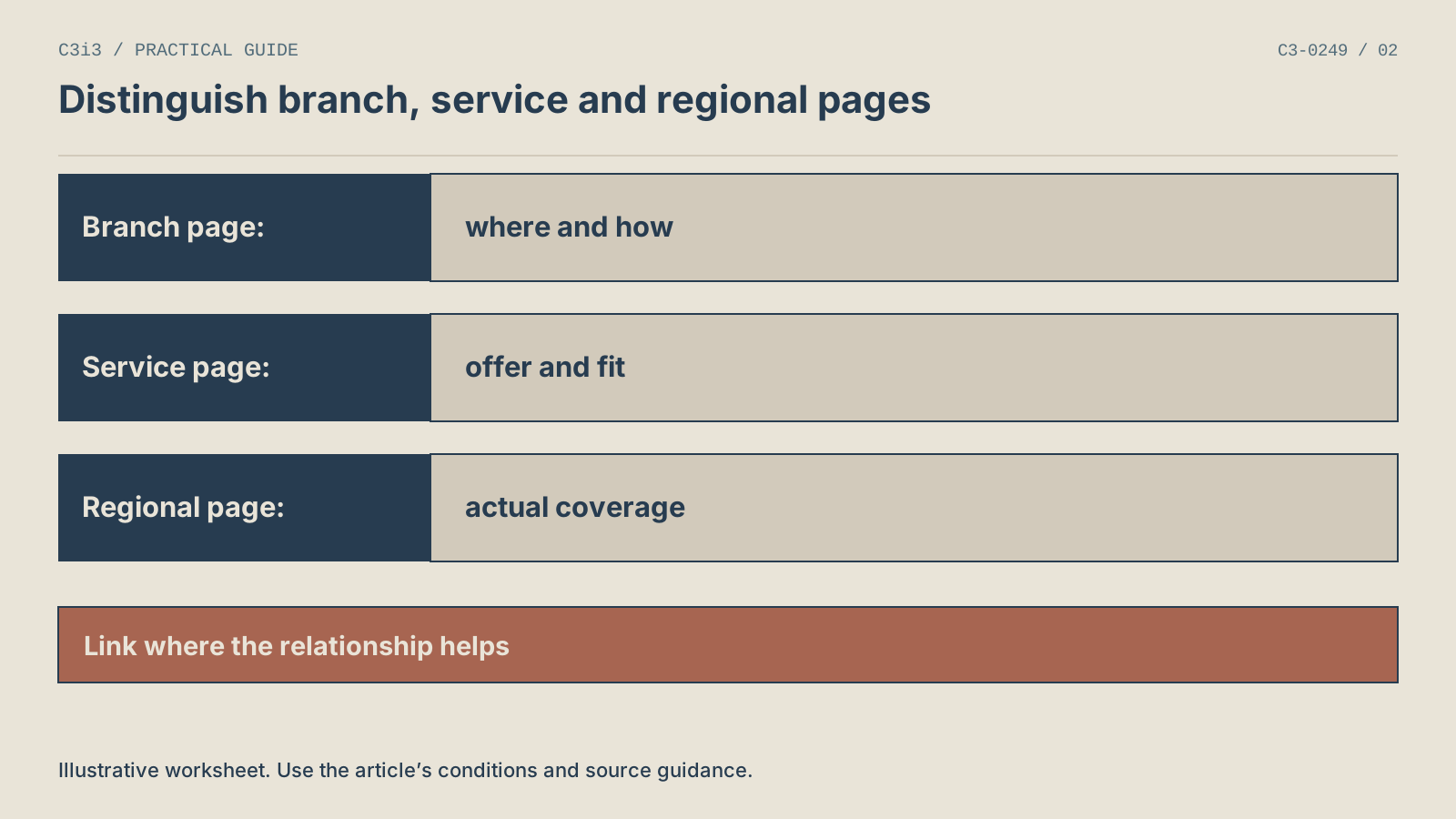
A branch page explains where and how to engage. A service page explains the offer and suitability. A regional page explains actual coverage. Connect the pages when that relationship helps a customer.
How do you check whether the location page is ready for customers?
Test a realistic branch task from discovery through the next action. Ask someone unfamiliar with the page to identify the location’s role, the preparation required and where to go next. Record what the person cannot determine without help.
Use an illustrative visit scenario: a buyer wants to see a product demonstration and needs to know whether to book first. The tester should find that answer, reach the correct appointment or inquiry route and confirm that the branch remains identifiable. Do not submit an actual inquiry or appointment during an unapproved test.
Which technical checks support the content review?
Check that the intended public page loads, has the correct canonical identity and can be reached through the site’s navigation or locations hub. Inspect mobile layout, broken links and images. If structured data is used, it should match the visible facts. Google’s LocalBusiness reference explains supported markup, but markup does not replace the customer-facing explanation.
After publication, separate delivery checks from search and business outcomes. Search Console can help review the exact page’s search performance. An analytics event should be verified before it is treated as a completed inquiry. Use the branch reporting guide to keep the comparison meaningful.
Recheck the page when its operating facts change. A useful location page is a maintained customer reference, not a one-time city keyword assignment.
What else should you know before publishing location pages?
Should the city appear in the title?
Use the city when it helps identify the actual location and the page’s purpose. It is a useful orientation detail, not a reason to repeat the city in every heading. Write the title for the customer’s decision and keep the branch name understandable. The page still needs accurate information that supports the geographic description.
Can we create a page for an area without a physical branch?
A useful service-area page may be appropriate, but it should explain actual coverage rather than imply a storefront. That is a different page role. The existing guide to regional and individual city pages discusses when a separate coverage page earns its place. Do not reuse a branch template to suggest an operation that does not exist.
Do all branches need completely different writing?
No. Shared facts can use consistent wording. The individual page should explain what a customer needs to know about that branch. Changing sentence structure without adding branch information does not resolve a missing local purpose. Identify the facts that differ first, then choose a page structure that presents those differences clearly.
Should a page list every nearby neighborhood?
Only include geographic detail when it helps explain the actual operation or customer journey. A long place-name list can distract from the branch decision. If the important distinction is scheduled visits, a separate delivery route or a service boundary, explain that directly. Do not invent geographic coverage to make the page look more local.
What if the branch is not open yet?
State its current opening status and avoid displaying future arrangements as available today. Confirm how inquiries will be handled before an announcement sends people to the page. The new-location launch guide covers the sequence from verified branch facts to public updates and post-opening checks.
Will a complete page guarantee a better ranking?
No. A useful page helps the business communicate accurately and gives customers a clearer route. Search visibility depends on more than page completeness and remains subject to the search platform’s systems. Review indexing, discovery and qualified inquiries separately. Do not turn a successful content check into an unsupported claim about ranking or sales.

How C3i3 Can Help
C3i3 can review whether your location pages explain the real differences between branches and connect visitors with the right next step. Bring a representative page, the local team’s confirmed operating details and the questions customers ask before visiting. That gives the review a concrete customer task.
Our local SEO services can support the page brief, content and connections within the existing website. Contact C3i3 to discuss the branch information you want to make clearer and easier to maintain.