








































In this article
A new Bay Area location can be ready for an announcement before it is ready for an unscheduled visitor. The website may show a future opening date while an old contact form sends requests to another branch. A directory may pick up an incomplete description before the team has agreed what customers can actually do there.
Business listings management for a new location should coordinate those facts in a deliberate order. The task is not to submit the same record everywhere as quickly as possible. It is to publish accurate information at the right stage and keep the customer’s next step working. This guide covers a genuine new branch, not a move, a citation cleanup or a new city you hope to serve. The multi-location local SEO guide explains the broader branch framework.
Which branch facts should be confirmed before you create listings?
Confirm the real operation, public identity, location details, intended customer tasks and opening state. Identify the person who can verify each fact. An announcement brief is not a substitute for the operating information customers will need.
Start with a branch worksheet that separates confirmed facts from plans. Record what happens at the location, which services are available there and how a customer should make the first contact. Include the source and confirmation date so later editors can tell whether the information is current.
What questions reveal a hidden launch dependency?
Ask whether the branch can receive visitors, accept appointments or respond to inquiries in the way the public page will suggest. A location might be physically established while its customer-facing process is still being prepared. That difference changes the wording and the action the page should offer.
For an illustrative technology supplier, a new branch could begin with scheduled demonstrations while other services remain with an established operation. The launch materials should explain that arrangement instead of importing the full company service list.
Review the relevant platform’s eligibility before creating a profile. Google’s business representation guidelines provide the primary reference for its listings. A location in an expansion plan does not, by itself, establish eligibility. Resolve the operating facts first and keep unconfirmed details out of public descriptions.
How should preparation, announcement and opening be separated?
Treat them as different publication states. Preparation establishes dependable facts and destinations. Announcement explains what customers can expect and when. Opening confirms what is actually available. A later recheck finds differences between the intended launch and the public experience.
This sequence helps a team avoid sending people to an unfinished journey. A page can truthfully explain a planned location while offering a route for questions. It should not invite an immediate visit if the location is not receiving customers.
What should change when the branch becomes operational?
Review the opening status, available actions and any temporary instructions together. The launch announcement may remain online, but the main branch page should describe the current operation. Check whether the locations hub and relevant service pages now direct customers appropriately.
Google supports a future-opening process described in its opening-date documentation. Use the current instructions where applicable and confirm the profile’s actual state. Do not assume that preparing a page, submitting a profile or announcing a date establishes public visibility.
An illustrative launch record could have four states: facts confirmed, preopening information published, operating experience checked and post-opening records reconciled. Name the evidence that moves the branch between states. This is a practical editorial method, not an additional platform rule. It gives the team a shared way to describe what is finished and what is still dependent on operations.
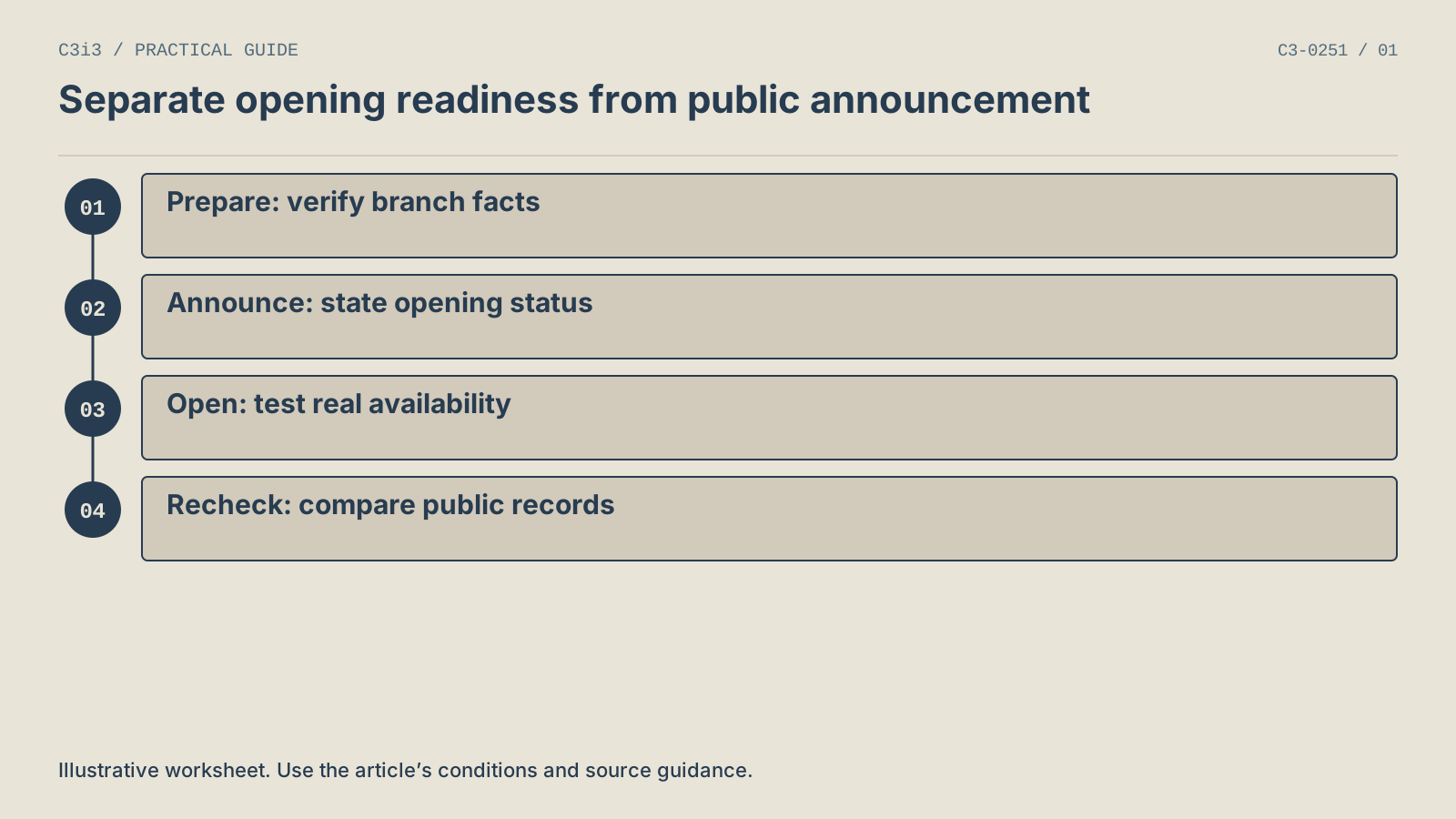
Prepare verified facts before publication. Announce the opening state accurately. At opening, test the real customer route. Recheck public records against the current source record.
Which pages and listings should be updated first?
Confirm the owned website destination first, then the principal public profiles and the directories customers actually use. Make announcements agree with the destination they link to. Prioritize the points where an error would send a person to the wrong place or action.
The branch page should answer the immediate decision before launch traffic reaches it. The locations hub should distinguish the new operation from established branches. Relevant service pages should explain whether the new branch participates in the service rather than imply that every location does everything.
How do you choose relevant directories?
Choose them for their role in customer discovery and accurate business representation. A sector directory used by the intended buyers can matter more to the journey than a large list of unrelated submission sites. Check whether the directory allows the business model and the facts the team can substantiate.
Maintain a distribution register naming the destination, public URL, submitted facts, current state and date checked. It should distinguish a listing requested from a listing observed. Do not report an entire distribution list as completed merely because a submission tool accepted the data.
The branch-profile inventory guide explains the connections between a branch identifier, public profile and website page. Use that relationship when expanding the network. The objective is a coherent customer route, not the largest possible number of records carrying a city name.
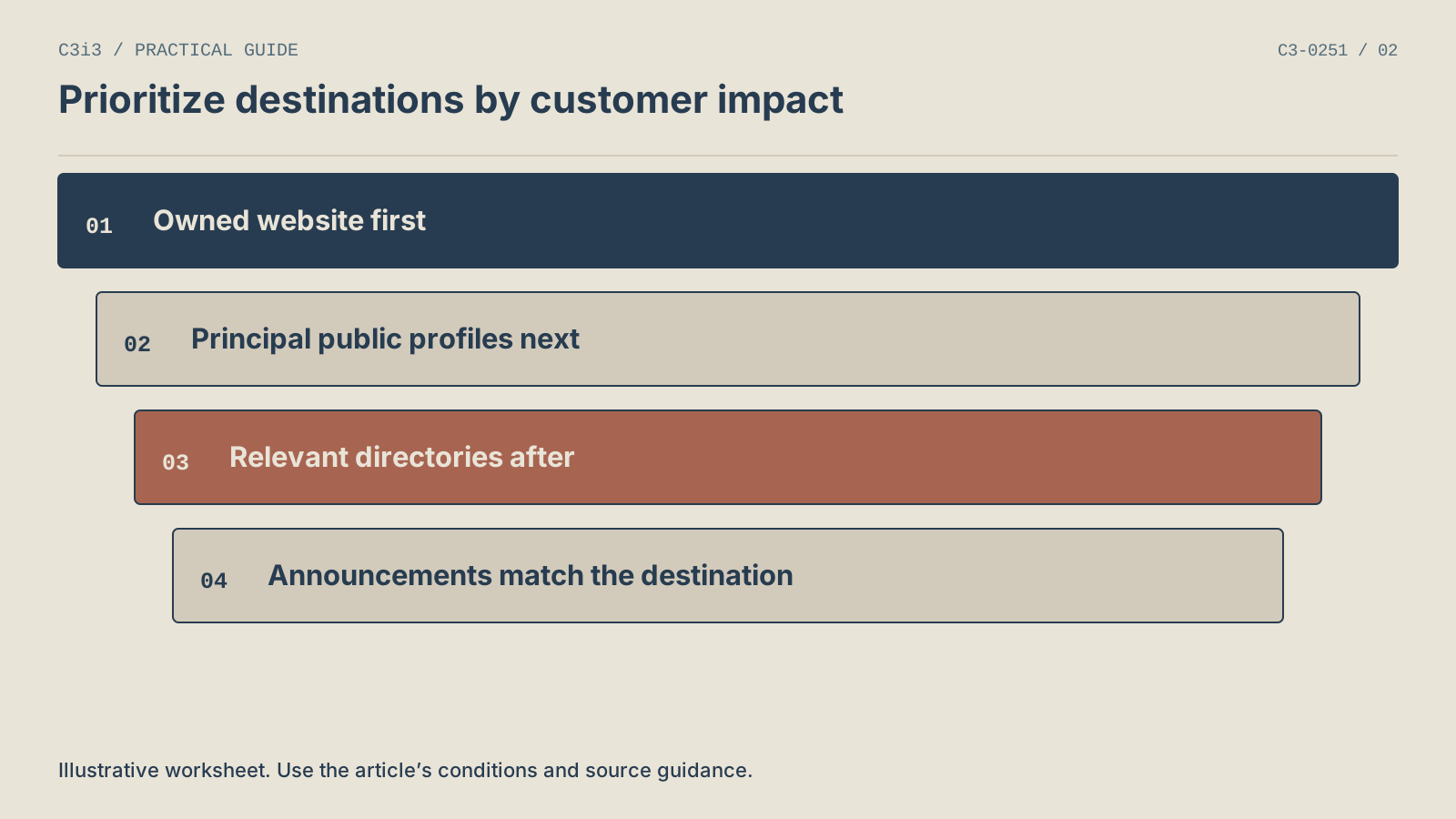
Confirm the owned website first, then the principal public profiles, then relevant directories. Keep launch announcements consistent with the page and action they link to.
What should the new branch page and inquiry route explain?
The page should explain the branch’s role, current availability and appropriate next step. The inquiry route should preserve that context. A customer asking about the new location should not have to repeat the entire situation because the website discarded the branch selection.
Review the action destination before sending visitors there. If a central team handles early questions, explain the arrangement accurately. If appointments become available later, do not show a booking path that suggests immediate availability before the business can fulfill it.
What would a useful launch test look like?
Use a clearly labeled internal scenario. For example, an illustrative prospective buyer wants to know whether the new branch can demonstrate a particular product family. The reviewer should locate the opening status, understand the branch’s role and find the right inquiry route without guessing.
The test can inspect the route without submitting a real inquiry. If an actual end-to-end submission is needed, arrange an authorized test with the people who will receive it. Record what was tested and what remained unverified.
The focused location-page guide supplies a content brief for a real branch. Use its questions to identify missing information, not as a reason to copy the same paragraphs across locations. The new page needs its own confirmed facts, evidence and operating conditions.
How do you keep late launch changes from creating conflicting records?
Keep one dated source record and a distribution log of where its facts have been published. When an opening detail changes, identify the affected destinations from that log. Update the public message and customer action together where the change affects both.
Late changes can involve the opening state, customer-facing schedule, available service or visitor process. Avoid letting each team infer the implications independently. Name the exact changed fact and the destinations that currently display it.
What belongs in a change record?
Record the branch identifier, previous public statement, confirmed replacement, effective date, affected destinations and observed outcome. Do not include private staff information or credentials in a distribution sheet. The record should help a reviewer find and check the public content.
An illustrative opening-date change could affect the branch page, locations hub, a public profile and a scheduled announcement. Changing only the page leaves other messages inconsistent. The useful question is not simply “was the website edited?” but “which customer-facing statements still need to change?”
Google’s profile-editing guidance explains that submitted edits undergo review. Keep platform state visible rather than assuming all destinations update simultaneously. A branch launch can be communicated clearly while individual third-party records remain pending, provided the team accurately records what customers can currently see.
What should you verify after the location opens?
Compare the public branch journey with the real operating experience. Check the main page, principal listings, service connections and inquiry route. Then establish a measured baseline that reflects the branch’s actual opening period.
Ask a local information owner to confirm the facts most likely to differ from the plan. Check visitor arrangements, available services and how inquiries are being received. Correct a concrete mismatch before interpreting weak response as a demand problem.
How should early performance be interpreted?
Keep publication, visibility and customer outcomes separate. A live page confirms publication. Search Console can provide website search observations. Business Profile performance describes supported platform interactions. Qualified inquiries need their own business record and definition.
Do not compare a newly opened location’s partial month directly with an established branch’s full month without explanation. Use the fair branch comparison guide to record the operating window, intended action and important differences. Early observations are a baseline, not evidence that a particular launch template caused success or failure.
Finish the launch record by assigning the ongoing update process. The person who organized the announcement may not be the person who can confirm branch facts later. A short handoff naming the source record, public destinations and next review prevents the launch materials from becoming stale after the project is considered complete.
What else should businesses know about new-location listings?
Should we announce the branch before every listing is visible?
The announcement decision should follow the business’s actual readiness and the information customers can use. Make the opening state clear and provide a dependable destination for questions. A third-party listing can remain pending without making the whole announcement inaccurate, but the team should not claim that every profile is live when it has not verified them.
Can we reuse the existing branch’s description?
Shared company facts may remain consistent. The new branch still needs its own operating details and scope. Reusing the old description without review can imply that the new location has the same services, schedule or visitor arrangements. Separate the shared explanation from the facts that need confirmation at the new operation.
Is this the same process as moving an existing location?
No. A move introduces questions about an existing location’s identity and the customers who still have its previous details. This guide covers a genuinely new branch. Record which situation applies before editing established listings or pages. Do not turn an existing record into a new operation simply because that appears easier than reviewing the correct change process.
Should we submit the new location to every directory?
No. Begin with destinations relevant to the actual business and customer journey. Each additional listing creates another record that may need maintenance. A directory should have a clear purpose, allow the business model and display facts the team can verify. Submission volume is not a useful substitute for accurate, relevant public information.
Can a new branch inherit another location’s performance history?
A new branch needs a baseline that reflects its own operating history and customer journey. Company experience may inform planning, but it does not establish that the new location will receive the same response. Record its opening period and compare relevant observations. Keep illustrative expectations separate from measured results and avoid presenting a forecast as an observed outcome.
When is the listings launch finished?
Define completion as a verified set of public facts, working customer destinations and a documented handoff for maintenance. Some external records may remain unresolved, in which case list them explicitly. Do not keep repeating the whole launch because one listing is pending. Preserve the completed work and follow up on the specific destination that still needs attention.

How C3i3 Can Help
C3i3 can help turn a new branch announcement into a connected website and local search plan. Bring the confirmed opening state, the branch’s intended customer tasks and the pages or profiles already prepared. We can identify missing information, disconnected destinations and the checks needed before wider distribution.
Explore our local SEO services or contact C3i3 about the new Bay Area location. The first useful deliverable is a clear record of what customers can do now and which public updates remain to be completed.