








































In this article
Your team knows the products. An agency knows how to turn a useful explanation into a social post or video. The difficulty begins when neither side knows what the other needs next. A writer waits for photographs, a product specialist receives an unclear request and the calendar fills with pieces that are almost ready.
Social media outsourcing works better when the handoff follows the material, rather than a broad instruction to “manage social.” This guide explains which inputs belong with the business, which production tasks can move to an agency and how to keep work moving when a product changes or a recording session is delayed. For the broader deliverable picture, begin with the SMO agency services guide.
Which social media inputs should remain with your business?
Your business should supply the priorities and first-hand material an outside team cannot reliably infer. This includes the product or service you want to explain, the customer question behind the content and the current source that answers it.
A hypothetical commercial lighting supplier might want to explain how two fixture formats differ in installation space. The internal team can identify the actual products, provide current drawings and describe the question it hears from project buyers. The agency can then choose how to show that difference. Asking the agency to invent the application from a product photograph creates unnecessary uncertainty before writing begins.
Does every internal input require a long meeting?
No. A short recorded walkthrough, a marked-up product page or a few clearly labeled photographs can be enough. The important part is context. A folder of images is less useful than a folder identifying the model, what each image demonstrates and which question it can answer. The person supplying the material does not have to write finished marketing copy.
Keep a recurring list of questions from ordinary sales conversations. Remove personal customer details and use the underlying question as a content input. Mark whether the business already has a public explanation. This lets the agency connect the new asset to useful information instead of creating an isolated answer. The broader outsourced marketing guide explains the staffing model; the social workflow starts with these concrete inputs.
Which tasks can an agency take through to a finished asset?
An agency can develop the audience question into a brief, organize the explanation, produce the creative assets and prepare the platform-specific version. The scope should identify which of those stages it owns and what it needs to finish them.
A useful assignment is “create a short visual comparison showing how these two formats differ for the buyer’s task,” accompanied by current source material. “Make this go viral” does not define a production task somebody can complete or inspect. The agency should be able to turn the first assignment into a draft opening, a sequence of visuals and a suitable destination.
What does platform adaptation add?
Adaptation changes the presentation to suit the channel and the audience’s situation. A professional audience may benefit from a diagram explaining the selection question. A short-video audience may need to see the physical difference immediately. The same underlying explanation can support both without forcing identical wording and framing.
LinkedIn’s official Page resources describe several available publishing formats. Those formats give the agency options, but the task still determines which format is useful. Ask for finished exports and the working files needed for future revisions. A clear file record should identify the source, the final asset and the live version. The product content creation guide follows that transformation in greater detail.
What should be in a brief that an agency can use without guessing?
The brief should identify one audience, one question, the source material and the next useful customer action. It should also state the boundaries of the piece so a narrow explanation does not grow into an unfinished campaign.
A brief can fit on one page. Include the product family, the intended audience, the exact question, the public source page and the available photographs or footage. State what the asset should help the viewer decide. If the material is incomplete, mark the missing item visibly rather than hiding it in an email thread.
| Field | Example input | Agency use |
|---|---|---|
| Audience | A facilities buyer comparing fixture formats | Choose a practical selection explanation |
| Question | How do the formats differ in the space they need? | Write a focused opening and visual sequence |
| Source | Current product pages and dimension drawings | Build the comparison from existing facts |
| Material | Labeled photographs of both formats | Show the physical difference clearly |
| Destination | The matching family comparison page | Continue the same evaluation task |
This example is illustrative, not a client project. The useful result of the brief is a shared definition of the asset. It lets a designer ask for the missing side view before editing begins and lets the business see why that image matters. If the agency still cannot explain the intended customer decision after reading the brief, clarify the task before creating more material.
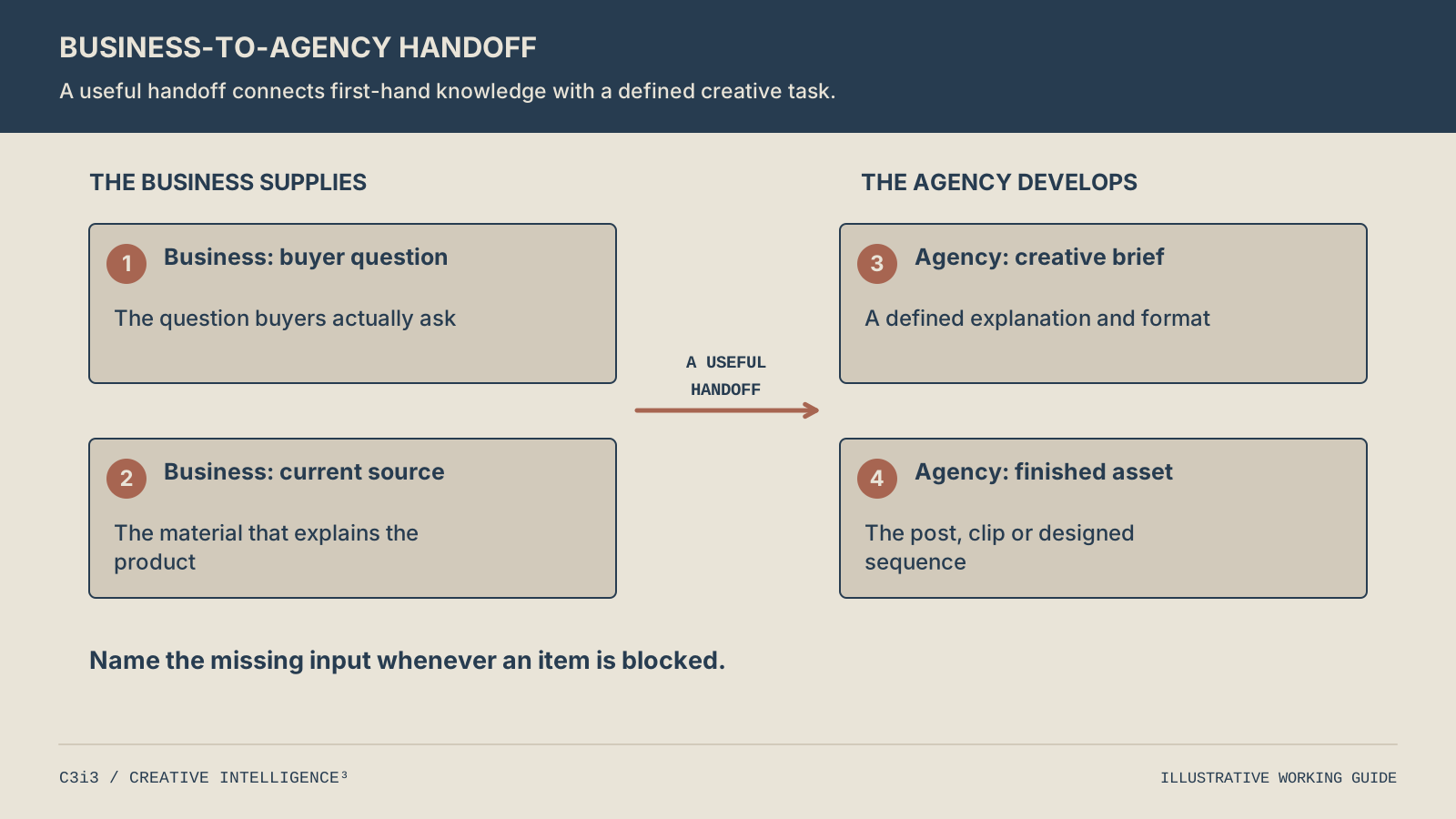
The business supplies priorities, buyer questions and current source material. The agency organizes the explanation and creates the appropriate assets. Each side names the material needed for the next step.
How do you keep recurring social media work from stalling?
Use a small number of visible stages and name the next required input at each stage. The purpose is to make a delay understandable, so the team can resolve it without restarting the whole assignment.
For example, a content item can move from source material received to outline, draft, feedback, final asset and published record. Avoid a single “in progress” label for every unfinished piece. A comparison waiting for a missing photograph is in a different state from a finished video waiting for its planned release date.
What should the team review together?
Review the next few items, the material each still needs and any event that changes their order. A short production check can concentrate on decisions rather than read every caption aloud. When feedback arrives in several places, consolidate it into the content record so the editor can see one current direction.
Use a realistic supply rhythm. A product team that can demonstrate several models together may prepare a useful session around a shared customer task. A business with irregular field access may need a plan that combines existing imagery with occasional new material. The business content calendar guide explains how to schedule around those dependencies. A workable calendar reflects material readiness; it should not simply assign a new filming requirement to every available date.
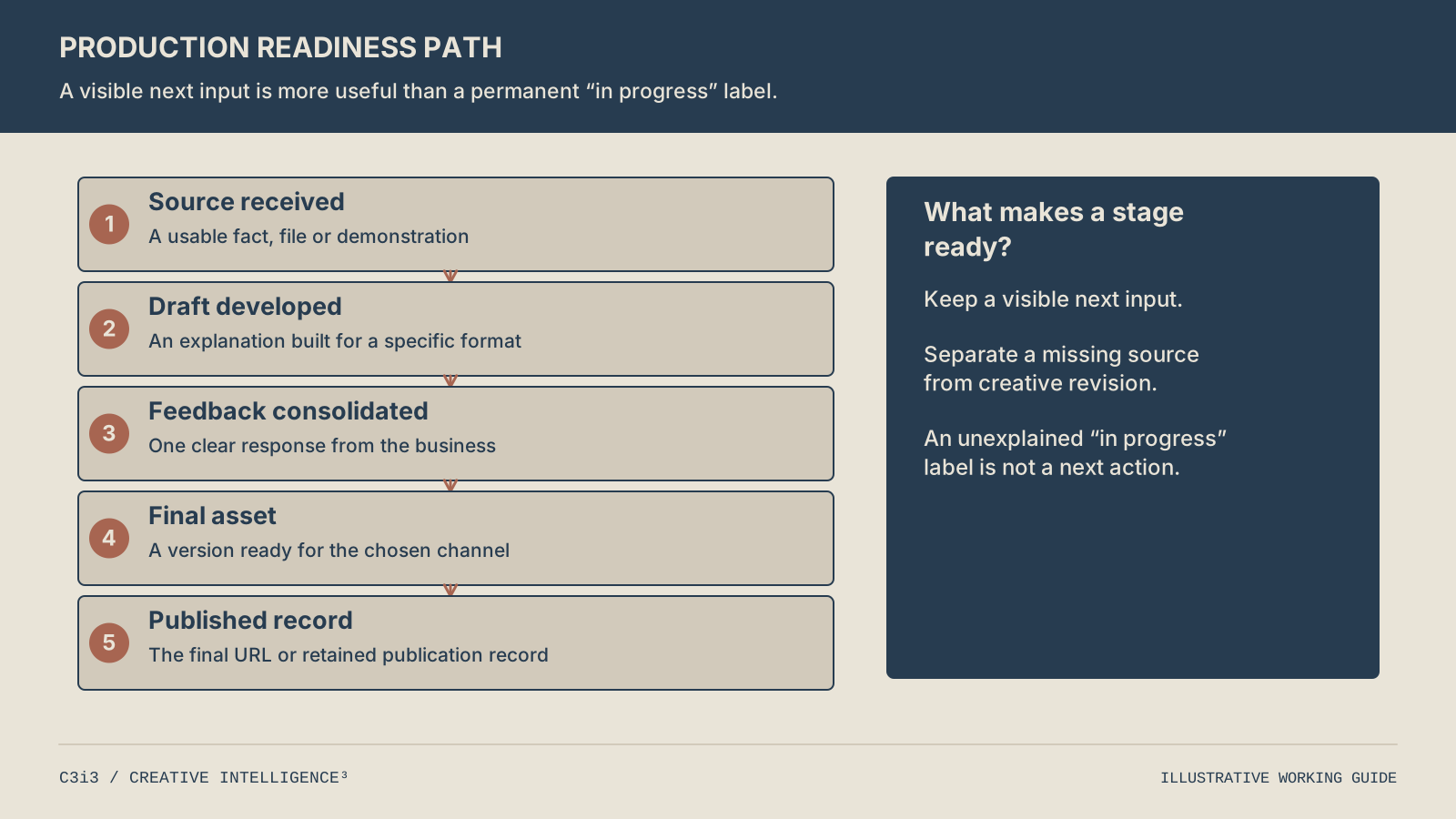
Track source receipt, draft development, consolidated business feedback, final asset and the live record. A blocked item needs a named missing input rather than an unexplained delay.
What should happen when a product update changes planned content?
Pause the affected asset, identify which source changed and decide whether to revise, replace or defer the piece. Record the decision where the production team can see it.
A product change does not automatically invalidate every asset in the calendar. A demonstration of a physical setup may still be useful while a model-specific introduction needs revision. Review the parts of the explanation affected by the change. This is more reliable than either publishing everything as planned or abandoning an entire month of useful material.
How can the agency reduce avoidable rework?
Ask the business which upcoming changes are already known before producing a large batch of assets. Keep material tied to identifiable product pages or source documents. A concise source record helps the editor find what needs revision when a model name or application changes. It also makes the final file easier to reuse because the team knows what it actually shows.
Keep a small pool of relevant evergreen explanations that can replace a delayed piece. “Evergreen” should mean useful beyond a particular date, not exempt from review. A comparison can become stale when the products change. Check the source again before rescheduling it. The strategy services guide helps decide which themes deserve ongoing attention, while the outsourcing workflow keeps the material current enough to use.
How do you tell whether the social media handoff is improving?
Review whether the team can move a useful idea through production with fewer unresolved questions and whether the resulting asset serves the intended audience. Evaluate both the workflow and the published content.
Start with operational observations: how often does a draft wait for material, how frequently is an asset revised because the source was unclear and can the business find the final files? These are process measures, not proof of market impact. They help locate friction the team can directly address.
What should the published-content review add?
Inspect the explanation and the next step, then review the available audience evidence. Does the finished piece answer its assigned question? Does its destination continue that task? If the content links to the website, Google’s campaign-tagging guidance can help the team organize observable referral visits. Consistent records make it easier to connect a content item with its reporting without pretending that every customer journey is visible.
End the review with one practical adjustment. Improve the source brief if editors repeatedly ask the same question. Change the production sequence if photography arrives too late. Revise the creative approach if the audience cannot recognize the main point. The social reporting guide covers the distinction between platform activity and confirmed inquiries. Outsourcing succeeds when better coordination produces material the business can use and evaluate.
What else should you clarify before outsourcing social media?
Can we outsource social media if we have no internal writer?
Yes. The business does not need to supply polished captions. It does need somebody who can explain the offer and locate current product material. An agency can turn a recorded walkthrough or a clear set of notes into an effective draft. Begin with one question and a manageable source set so the process can be tested before several teams start supplying material differently.
Should an agency create content ideas or should our team provide them?
Both can contribute. Your team brings first-hand questions and product context. The agency can organize those inputs, identify gaps in the explanation and suggest formats worth testing. Keep ideas connected to a specific audience task. An outside suggestion is useful when it explains why the material belongs in your customer journey, rather than simply borrowing a popular format from another industry.
Can we keep photography in-house while outsourcing writing and editing?
Yes, if the photographer receives a usable shot brief. Share the intended opening, necessary views and the specific difference the asset needs to show before recording. The agency should inspect a small sample early. Discovering that a critical connector or physical detail is never visible after a full session creates rework that a short planning exchange could have prevented.
How should we start if our product team is already busy?
Choose a small assignment using current public material and one short source conversation. Ask the agency to show the questions it still needs answered. Use that experience to define a repeatable brief. A workable process should make the next contribution easier for your product team, not require it to become a full-time content department before anything can be published.
Does outsourcing mean the agency should replace our business judgment?
No. Outsourcing moves defined research, creative and production work to a team equipped to perform it. The business still determines which customers and offers matter. A useful agency relationship makes those decisions easier to turn into consistent material. When the assignment is unclear, the right next action is to clarify the customer task and available facts before increasing production.

How C3i3 Can Help
C3i3 can help build a practical connection between your product knowledge and a dependable social content workflow. We can shape source conversations into briefs, develop useful creative assets and connect the finished material to relevant website information.
Explore social media optimization support or bring us one content item that keeps getting stuck. That example can help identify the material, production step or handoff your team needs to improve first.