








































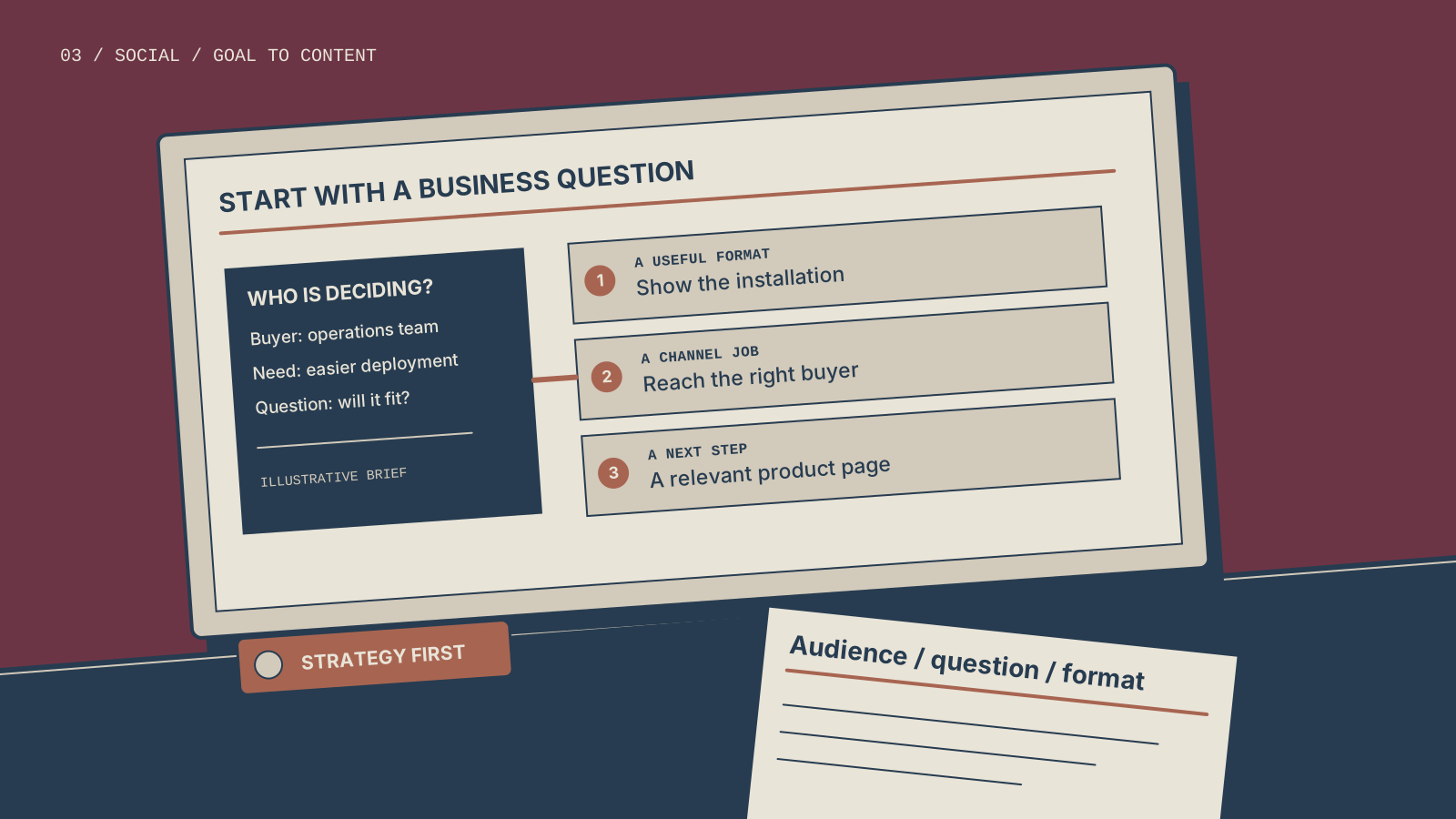
In this article
A business asks for a social media strategy and receives a list of post ideas. The ideas may be attractive, but nobody can explain why those subjects should matter to the customers the company wants. Filling a calendar at that point turns an uncertain direction into a larger production commitment.
Social media strategy services should make the choices that come before scheduling: which audience to serve, which questions to answer, which channels have a useful role and what the business needs to learn. This guide helps a brand or service business turn a commercial objective into those decisions. The SMO agency deliverables guide explains the larger engagement. Here the focus is the reasoning behind the plan.
How do you turn a business goal into a useful social media objective?
Translate the business goal into an observable customer action that social content can reasonably support. Keep the goal specific enough to guide choices without claiming that social media controls the whole buying process.
For example, “grow the business” does not tell a writer what to explain. A hypothetical industrial label-printer supplier may instead want more suitable buyers to understand when its compact range fits a small production line. Social content can help those buyers recognize the application, compare relevant formats and reach the product information needed for a technical discussion.
What should the objective leave out?
Leave out unsupported outcome promises and measures that have no clear relationship to the task. A larger follower count may be useful in context, but it does not explain whether production managers understand the printer’s application. The team needs a reason to pursue that audience and a way to inspect the explanation it provides.
Write the objective in three parts: the audience, the decision and the useful next step. In this example, the audience is a production-line buyer, the decision concerns application fit and the next step is reviewing the appropriate product family. That sentence can guide a brief. It also helps the agency explain why a popular topic does not belong in the assignment, even if the topic could attract unrelated attention.
Which customer questions should shape the content plan?
Choose questions that affect recognition, evaluation or the next buying action. Use first-hand conversations and current public information to distinguish a genuine decision from a topic the team merely finds interesting.
Build a small question map before selecting formats. Record the audience, the question, why it matters and the public source that can support an answer. A production-line buyer might ask how much working space a printer setup needs, which materials the relevant range supports or what information is needed for an application discussion. The business should confirm the details before the content team decides how to explain them.
How do you separate early curiosity from serious evaluation?
Look at the task behind the question. “What is this device?” calls for a different explanation from “Which format fits this operating arrangement?” Neither is inherently more valuable, but the second may belong closer to a product comparison or a technical destination. The strategy should connect those moments rather than use the same next action for every viewer.
Research tools can add evidence without replacing business context. TikTok’s Creator Search Insights announcement describes a tool for exploring topics people search for on the platform. Availability and relevance should be checked for the account and market. A discovered topic belongs in the plan only when the business can answer it credibly and has a reason to serve the people asking it.
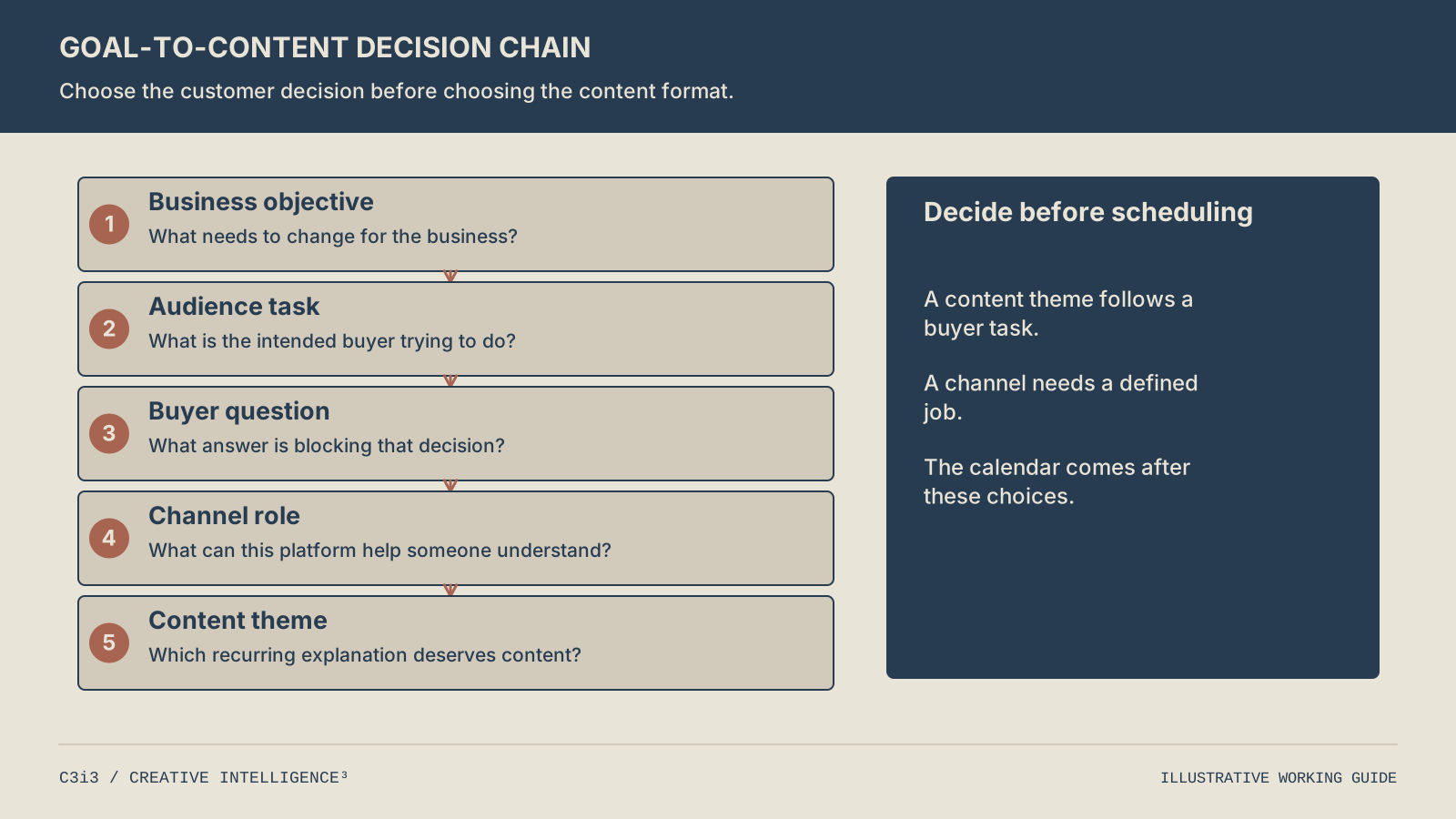
Translate the business objective into an audience task, identify the question blocking that task, assign a useful channel role and select a content theme that can answer it.
How should strategy services assign a role to each platform?
Give each platform a job in the customer journey, then decide whether the business has the material to perform that job consistently. Do not begin with a requirement to be active everywhere.
A professional channel might introduce an application problem to people involved in equipment selection. A video channel might carry the fuller demonstration that lets a viewer inspect the operating sequence. A visual feed might help an audience recognize a physical difference quickly. These are planning hypotheses, not universal facts about every business or person using those platforms.
What evidence makes a channel choice more credible?
Look for relevant public conversations, the business’s own audience observations and the kind of explanation the channel can carry. Inspect the current profiles and content rather than relying only on broad demographic descriptions. A business may discover that the questions it needs to answer require longer context than its existing creative approach allows.
LinkedIn’s Page guidance outlines formats including video and documents. Use those capabilities to evaluate the job the channel could do, not as a reason to publish every format. The existing social media SEO guide covers discovery inside apps. This strategy decision comes earlier: whether that discovery would help the intended customer and what useful explanation should be there when the person arrives.
How do customer questions become distinct content themes?
Group questions by the decision they help a customer make, rather than by superficial topic labels. A useful theme can support several genuinely different explanations without repeating the same message in new wording.
For the illustrative printer supplier, one theme could be application fit. It might contain a workspace explanation, a material-handling demonstration and a comparison of suitable configurations. Each asset should have its own job. Three posts that all say the range is compact would not provide the same depth.
| Decision | Content question | Useful explanation |
|---|---|---|
| Recognize the application | Where does this type of setup fit? | An annotated overview of the operating task |
| Evaluate a constraint | What space and handling details matter? | A visible walkthrough of the relevant arrangement |
| Compare approaches | Which configuration answers this requirement? | A comparison using current product information |
| Prepare the next conversation | What should a buyer provide for an application review? | A practical preparation guide and matching destination |
The worksheet does not prescribe actual printer capabilities. The business must supply those facts. Its value is the separation of decisions. This makes the eventual production plan easier to prioritize: a missing application explanation may deserve attention before another general brand introduction. The product content creation guide explains how to turn one selected question into a finished creative asset.
What should connect the strategy to product evidence and website pages?
Every important content theme should connect to the material that supports its explanation and the destination that continues the customer’s task. This keeps the strategy grounded in what the business can actually show.
Review the destination before assigning a new series. If a post introduces a configuration difference but the website does not explain that difference, the social team has identified a page dependency. Record it in the plan. Sending more attention to a confusing destination may make the problem more visible without helping the buyer.
What if there is no useful destination yet?
Decide whether the content can complete the immediate explanation within the platform or whether a supporting page is needed first. A simple visual demonstration may stand alone. A detailed application comparison may need a durable page that can carry context, references and the next step. The decision should follow the information required, not a blanket rule that every social item must link out.
Also identify material the business can supply repeatedly. A strategy relying on weekly demonstrations is weak if the products are rarely available to film. The outsourcing handoff guide helps connect subject-matter input to creative work. Once those dependencies are understood, the content calendar guide can turn the agreed priorities into a schedule the team can maintain.
How do you test the strategy without confusing activity with progress?
Write down the assumption behind each important choice and select evidence that can inform the next decision. A useful test should explain what the team will learn, not merely what it will publish.
For example, the team might hypothesize that buyers need to see a physical setup before they will inspect the family comparison. The planned explanation is a clearly framed walkthrough. The observations might include attention to the relevant segment, visits to the comparison page and questions indicating application evaluation. These signals inform the hypothesis without proving that one asset caused a later sale.
What should the team record before publishing?
Record the content version, audience task, destination and comparison period. If several elements change together, note that limit when interpreting the result. Keep organic and paid activity distinguishable. Google’s campaign URL guidance can help organize tagged referral traffic, but the plan should not treat tags as a complete view of every customer interaction.
At the review, choose a specific action. Repeat the theme if it answers a useful question and the evidence supports continuing. Revise the explanation if the intended distinction remains unclear. Reconsider the audience or channel if the content attracts attention unrelated to the business’s offer. The social media reporting guide explains why confirmed inquiries need to remain distinct from reactions, views and website visits.
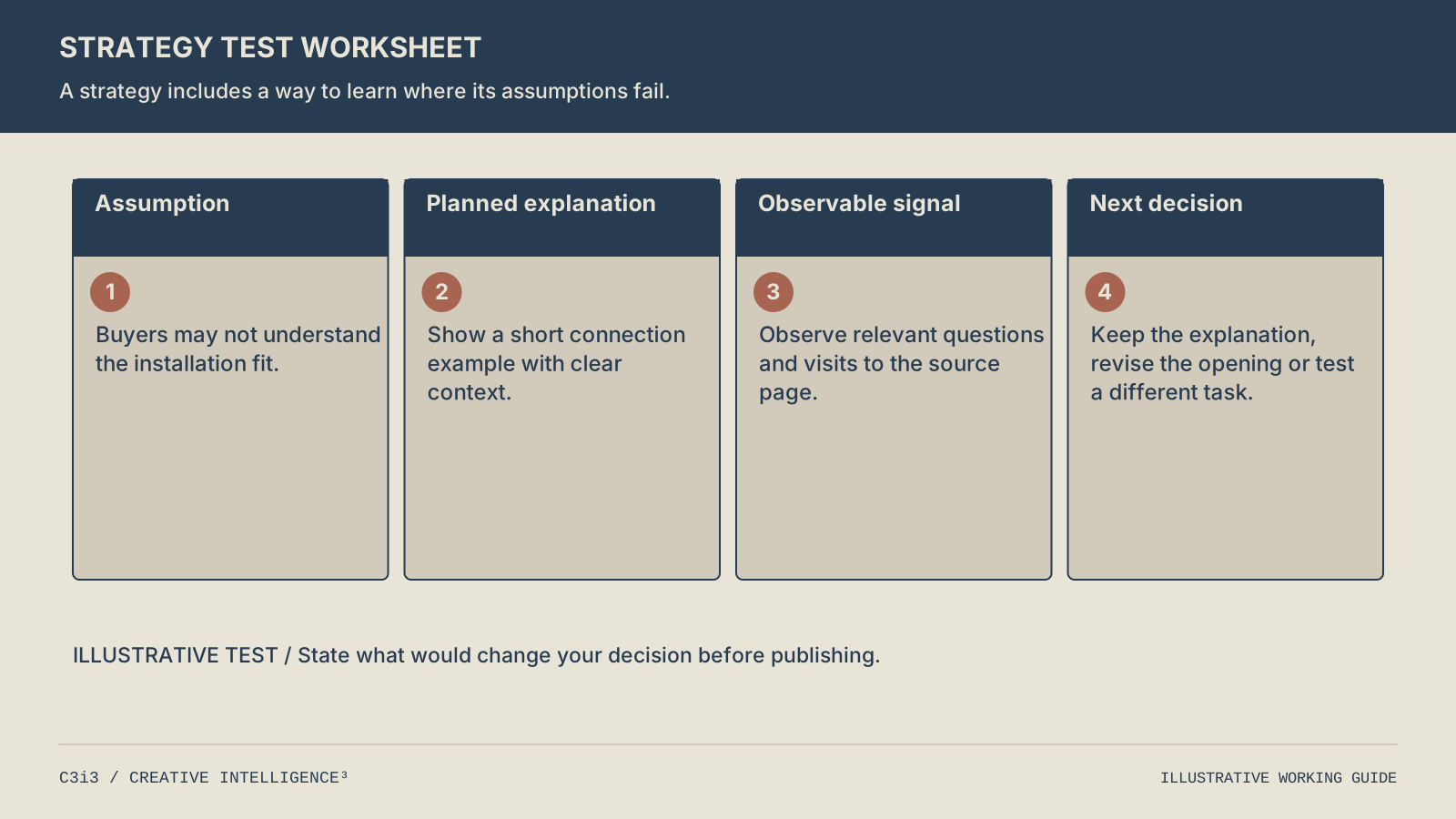
State the assumption, define the explanation that tests it, choose an observable signal and record what would justify repeating or revising the approach. Results in examples are not claimed campaign outcomes.
What else should businesses ask about social media strategy services?
Is a content calendar the same thing as a social media strategy?
No. A calendar assigns material to dates and helps coordinate production. A strategy explains which audience the business wants to serve, what that audience needs to understand and why selected channels can help. A calendar can be well organized while carrying the wrong material. Make the main strategic choices first, then use the calendar to execute them at a pace the team can sustain.
Can we build a strategy for just one platform?
Yes. One platform can be a sensible starting point when the audience task is clear and the business has appropriate material. Define what that channel should contribute and what it cannot do alone. The website or another owned destination may still be necessary for the detailed evaluation. Expanding to another platform should add a useful role rather than simply repeat the same presence elsewhere.
Should every content theme directly ask viewers to contact us?
No. A viewer learning what a product does may need an explanation before a conversation. Another viewer comparing a specific application may be ready for a detailed guide or an inquiry. Choose a next step that matches the question answered by the content. Repeating the same generic invitation under every asset can miss the different decisions the audience is trying to make.
How often should we change the strategy?
Review it when new evidence challenges an important assumption or when the business offer changes. Avoid rebuilding the entire direction in response to one unusually strong or weak post. Examine a meaningful sample, the audience task and the conditions of distribution. A strategy can remain stable while individual openings, visual treatments or destinations are improved through smaller experiments.
What should we receive at the end of a strategy assignment?
You should receive a usable account of the objective, priority audience, question map, channel roles, content themes, source dependencies and review plan. It should be clear enough for another team member to explain the direction without a long handover meeting. A deck full of broad aspirations is incomplete if nobody can turn it into a specific creative brief or identify which assumption to test first.

How C3i3 Can Help
C3i3 can help turn a broad request for social media activity into a focused plan around customer decisions. We connect strategy, creative development and relevant website information so the planned content has a clear purpose.
Explore social media optimization services or share the audience and business goal you want to work toward. Bring the channels you use, the questions you hear and a sample of your current material. Those inputs make it easier to choose a useful first direction.