








































In this article
Your brand has active social accounts, a library of product images and somebody posting regularly. Yet the business cannot explain which changes would make those channels more useful to a prospective customer. Hiring an SMO agency should resolve that uncertainty with a clear body of work, rather than add another stream of posts.
This guide is for business owners and marketing teams comparing social media optimization services. It explains the deliverables to request, how to distinguish improvement work from routine publishing and what evidence should accompany the work. It does not assume that every company needs every platform. A specialist equipment supplier and a consumer technology brand may need very different content even when both describe the assignment as social media optimization.
What should an SMO agency improve beyond your posting schedule?
An SMO agency should improve how a relevant person recognizes your offer, understands the content and reaches an appropriate next step. Publishing is part of that work, but the number of posts is not a sufficient description of the service.
Imagine a hypothetical manufacturer of portable inspection cameras. Its account contains attractive photographs, but a purchasing manager cannot distinguish the camera for routine building inspection from the model intended for a tighter access point. Publishing more photographs of the same equipment does not resolve that comparison. The useful assignment is to make the model distinction understandable through the profile, selected demonstrations and supporting product information.
How is optimization different from recurring management?
Optimization changes something for a reason: the opening of a demonstration, the organization of a profile or the destination attached to a product explanation. Recurring management sustains the publishing workflow. A business may need both, but the proposal should identify them separately so an improvement does not disappear inside a general activity list.
Use the existing guide to what SMO means for the fundamentals. When comparing agency support, ask for a sentence completing this thought: “A prospective customer currently struggles to understand or do this, and these changes should make that task easier.” An answer limited to more frequent posting still leaves the main assignment undefined.
What should the initial research and improvement plan contain?
The initial plan should connect observed problems to a small set of proposed changes. It should identify the audience, record the current customer path and explain which findings deserve attention first.
Request an inventory of the channels relevant to the assignment, a dated sample of existing content and a review of the destinations those channels use. The purpose is not to document every historical post. It is to establish enough evidence to choose useful work. An agency that recommends a new video series should be able to show the unanswered question that series will address.
What makes a finding actionable?
A useful finding names the observation, consequence and next action. “The profile needs improvement” is too broad. “The profile introduces the product family but does not help a visitor identify the model shown in the pinned demonstration” is specific enough to investigate. The proposed action might be a clearer product reference, a comparison post and a direct link to the matching family page.
The final plan should distinguish corrections, content improvements and experiments. A broken destination is a correction. A more useful comparison is an improvement. Testing two openings is an experiment. Those categories require different evidence. Corrections can be verified directly; experiments need a comparison window and an interpretation. The social media audit checklist covers the underlying review in more detail, so the agency scope does not need to reproduce that entire process.
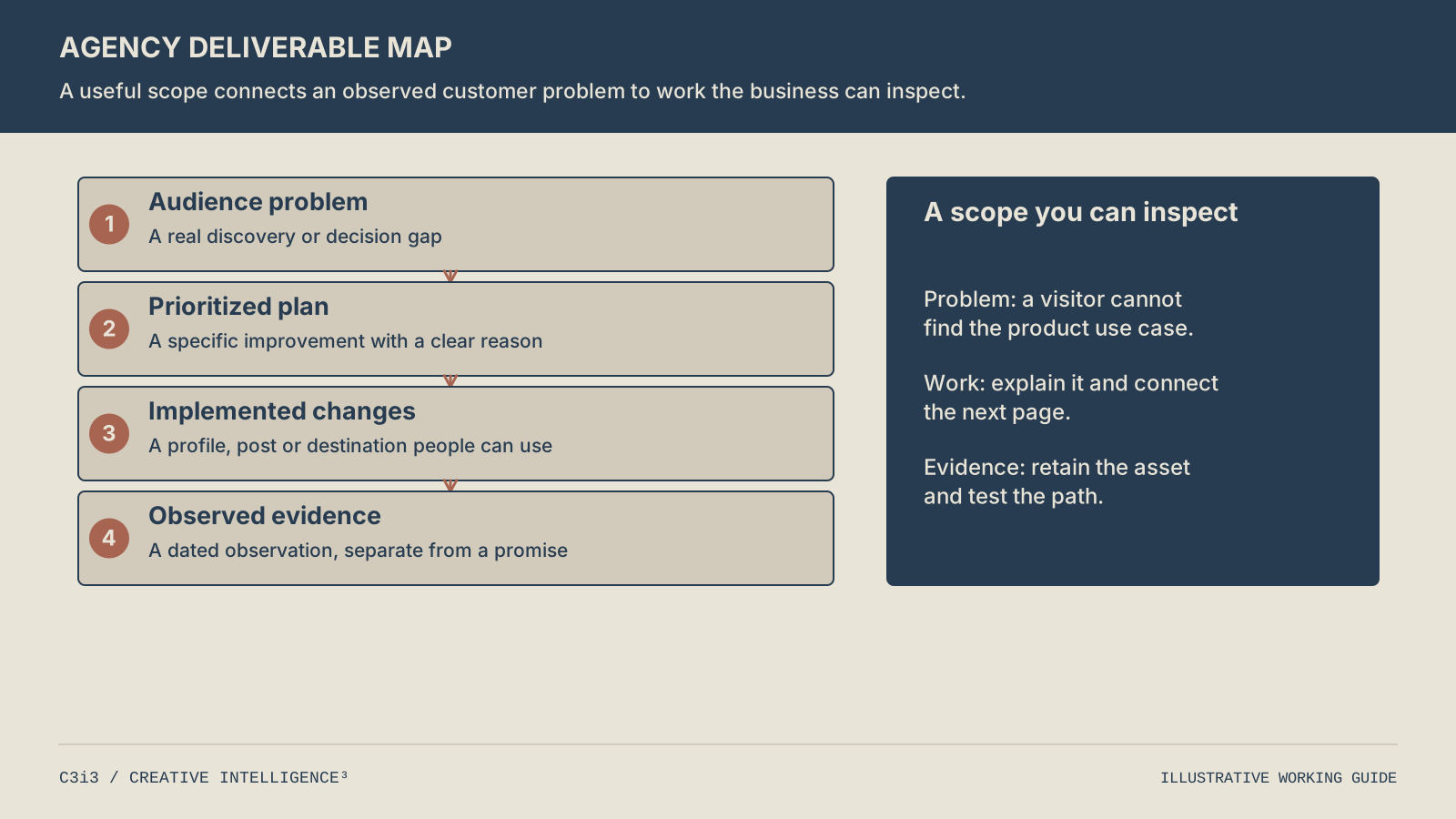
Identify the audience problem, choose a prioritized plan, implement profile/content/destination changes and review dated evidence. Posting volume alone does not define an optimization service.
How should the agency choose audiences and platforms?
The agency should choose platforms by the buyer task and the material the business can supply. It should explain where the intended audience looks for information and what each selected channel is expected to contribute.
Start with a defined situation rather than an age range alone. A facility manager checking how equipment fits a maintenance workflow has a different question from a homeowner watching a quick demonstration. Both may use the same app, but their reasons for watching and the follow-up information they need differ.
A channel brief should state the audience, recurring questions, useful formats, source material and destination. It should also name any assumption the team still needs to test. This keeps a plausible idea from becoming a claimed fact about your customers. The social media strategy services guide explains how to make these choices before filling a calendar.
Should every agency scope include every major platform?
No. A focused assignment can be more useful when the business has a clear audience and limited original material. A supplier with detailed demonstrations may need a strong video library and a professional distribution channel before it needs several additional accounts. LinkedIn’s official Page guidance describes company information, publishing formats and Page analytics. Those capabilities are inputs to a channel decision, not proof that LinkedIn is right for every brand. Ask the agency to explain the fit for your actual offer.
Which profile improvements should social media optimization services deliver?
Profile work should make the business recognizable and help a new visitor understand what to explore next. Deliverables should be visible changes, accompanied by a before-and-after record and a reason for each significant edit.
Depending on the platform, the work may include clearer introductory language, updated brand imagery, reorganized highlighted content and better destinations. The agency should use the features actually available to your account rather than promise a standard feature on every service. A useful profile improvement can be small: showing the exact product family discussed in a frequently viewed video may help more than rewriting the entire description.
How should a business check whether the new profile works?
Give an unfamiliar reviewer one customer task. Ask them to identify the product or service, explain who it suits and find the supporting detail without coaching. Record where they hesitate. This is an editorial usability check, not a statistically representative study, but it can expose a confusing first impression quickly.
For a hypothetical industrial sensor brand, the profile may need to distinguish measurement applications and point to a family overview. For a consumer accessory brand, the priority may be showing compatibility and an easy route to the relevant product. The same profile template should not be applied blindly to both. Ask the agency to supply the actual revised text and destination list so the business can retain the work, not merely a screenshot saying optimization is complete.
What should a platform-specific content deliverable look like?
A complete content deliverable should identify the customer question, show how the creative answers it and provide the finished assets appropriate to the selected channel. A file named “social post” does not explain those decisions.
For a product demonstration, request the opening, the visible action, the necessary explanation and the destination. The creative brief should identify which product or configuration appears. If the audience needs a comparison, a sequence showing two meaningful differences may serve the task better than an unrelated montage.
What should change when one idea appears on several channels?
The underlying facts can stay consistent while the presentation changes. A short video can show the decision quickly. A document-style post can explain the comparison in a format somebody can revisit. A longer demonstration can carry setup and context that a short clip cannot reasonably include. Reusing the question is efficient; distributing the same export everywhere without reviewing its fit can create avoidable confusion.
The product-feature content creation guide provides a worked example of that transformation. In the agency scope, also request usable source files, captions where appropriate and a clear naming convention for versions. These are practical production deliverables. They help the next piece build on the previous work and reduce the chance that the team unknowingly reuses an old model image or an incomplete cut.
How should the agency connect social content to your website?
The agency should match the content’s promise to a destination that continues the same customer task. A post about a specific product question should lead to information that answers that question, rather than leave the visitor to search a broad homepage.
Request a simple destination map. Each important content theme should name the corresponding product family, comparison, application guide or inquiry route. This does not mean every post needs an external link. Some content completes a useful explanation within the app. The agency should still know what a genuinely interested viewer can do after that explanation.
What if the destination page is the real weakness?
Record the dependency instead of treating it as a social performance failure. A demonstration may attract the right viewers while the page omits the configuration they just saw. The assignment may then require a coordinated page improvement before another round of promotion. The agency should identify who will supply that page work and how it will be checked.
Use a phone to review the transition from content to destination. Look for continuity in product naming, visible examples and the next action. A useful handoff lets a visitor confirm they arrived at the right place without remembering every detail from the original post. The broader social media lead generation guide examines where interest stalls, while the agency deliverable should document the specific paths improved in your assignment.
What should the production and publishing workflow include?
The workflow should make it clear what material is needed, when a draft can be produced and how a finished piece reaches the selected platform. It should fit the business’s actual ability to supply useful examples.
Ask for a short production map covering the source material, draft, business feedback, final asset, publication and record of the live post. The purpose is dependable execution, not an elaborate process diagram. A company that can supply one well-prepared demonstration session a month needs a different workflow from a business that regularly records new installations.
The social media outsourcing guide explains how to divide that work between an internal team and an agency. The monthly content calendar guide turns ready material into a workable schedule. Keep those supporting documents connected, so a calendar does not contain promises the production team cannot fulfill.
What evidence shows that a workflow is functioning?
Track a few meaningful handoffs. Can the writer find the current source material? Does the editor know which version is final? Can the business locate the live post and its destination? If a piece cannot proceed, the work log should explain the missing input. This gives the team a specific problem to resolve instead of a vague description that content is “in progress.”
What evidence should accompany an SMO agency’s report?
The report should connect the work completed to observable changes and separate those observations from business outcomes. It should explain what was measured, over which period and what the available evidence cannot establish.
Request a dated change log alongside the channel data. A change in views is easier to interpret when the team knows which content changed, whether distribution changed and whether an unusual event affected attention. Do not combine every platform’s differently defined measures into a single unexplained total.
How should website activity be connected to social content?
Use consistent campaign tags where appropriate and verify that the destination still works. Google’s campaign URL documentation explains how tagged referral links identify campaigns in Analytics. Tags help organize observable visits; they do not reveal every later conversation or prove that one post caused a sale.
For videos, YouTube’s audience retention guidance explains how to examine attention within a video. An agency can use that evidence to investigate a confusing or weak section. It should not assume that a retention dip identifies its cause without reviewing the actual content. Ask the report to end with a decision: repeat a useful explanation, revise a specific element or gather more evidence. The social media reporting guide goes further into outcome definitions and attribution limits.
How can you compare agency deliverables using one realistic assignment?
Compare providers against the same customer task and source material. This makes it easier to evaluate the reasoning behind the work instead of judging proposals by the length of their activity lists.
Consider an illustrative portable-monitor brand with two models. Buyers repeatedly ask whether the lighter model offers the connection arrangement they need. The business has current product pages, photographs of each port layout and an existing demonstration. No campaign outcome is assumed in this example.
| Customer task | Requested deliverable | How to inspect it |
|---|---|---|
| Recognize the relevant models | A clearer family introduction and selected profile content | Ask an unfamiliar reviewer to identify both models |
| Understand the connection difference | A comparison post and a short demonstration | Check whether the difference is visible before the next action |
| Confirm suitability | A direct route to current model information | Follow the route on a phone |
| Evaluate the work | A change log and matched-period observations | Separate completed work, observed behavior and confirmed inquiries |
Ask each agency which part it would address first and why. A thoughtful answer may identify an existing asset worth improving before proposing new production. Also ask what information is missing. The ability to name a dependency is useful evidence of a realistic scope. A provider that promises a precise outcome without examining the product, audience or destination has not yet established the basis for that promise.
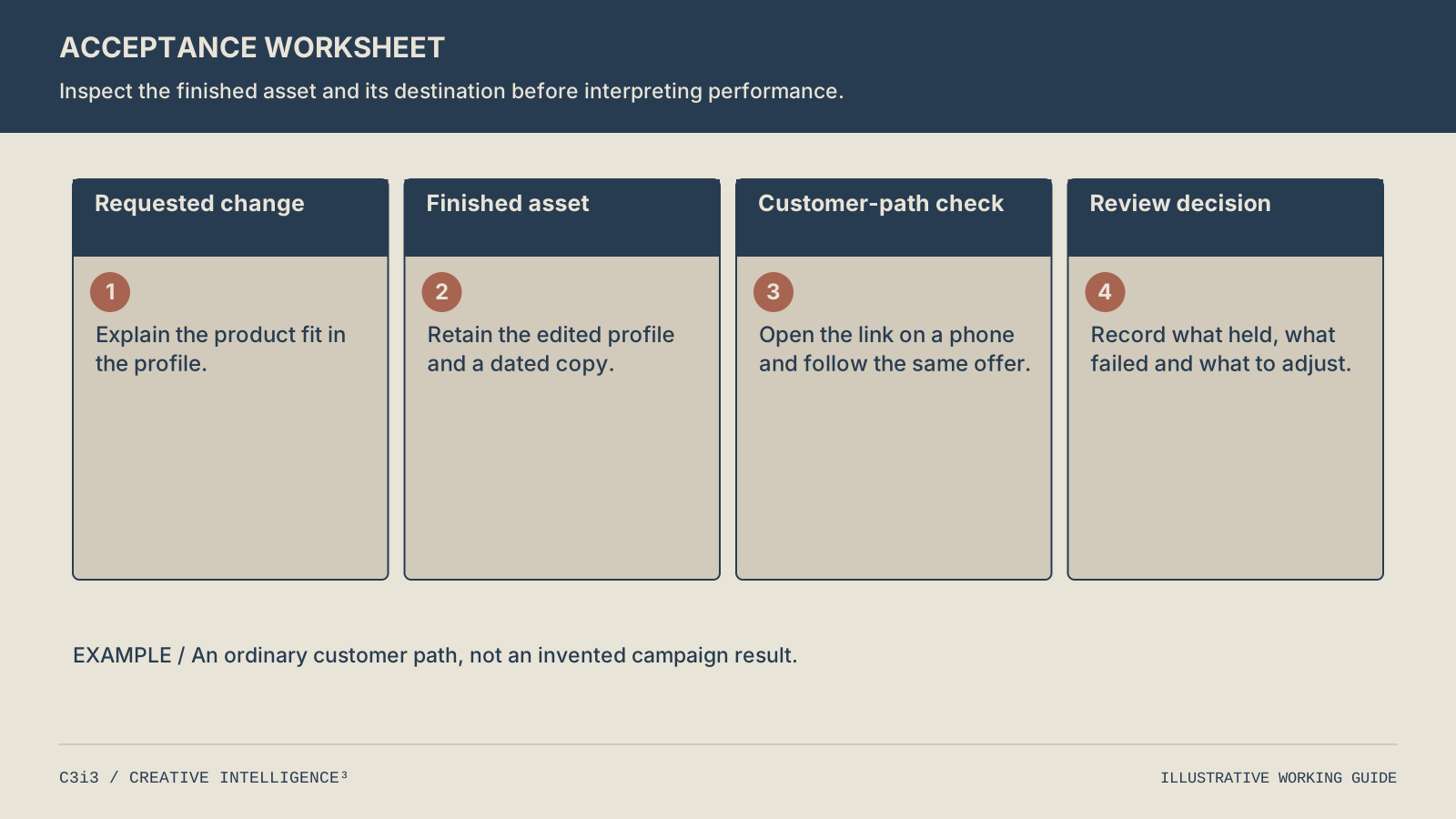
For each requested improvement, retain the final asset, check the customer path on a phone and record the next decision. Distinguish completed work from observed behavior and confirmed inquiries.
What should you prepare before speaking with an SMO agency?
Prepare one business objective, one audience and a small selection of existing material. Give the agency enough context to propose a useful first assignment without asking it to guess how your products are sold.
A practical brief includes the offer you want to explain, the buyer question you hear repeatedly, your current social profiles and the page that should help an interested visitor. Add examples of content the team believes is useful and content that creates confusion. Explain what original photographs, demonstrations or product information the business can provide.
Choose a manageable starting boundary. That could be one product family, one selected channel and one customer question. The purpose is to make the work assessable, not to limit future growth. Once the team can show how research becomes a useful asset and how that asset connects to the customer’s next step, expansion becomes a better-informed decision.
Before the first meeting, also choose one example the team can inspect together. Open the current post, the profile and its destination in sequence. Explain the question you hoped it would answer, then ask the agency what it observes. This makes the discussion concrete and gives you a way to compare recommendations. A provider may reasonably disagree with your first diagnosis. What matters is whether it explains the evidence, asks useful questions and proposes an improvement that the business can actually complete with the material available.
Which proposal details should be clear before work begins?
Identify the deliverables, dependencies, review points and records the business will receive. Ask how an unexpected website issue or missing product image will affect the sequence. Keep the discussion centered on work the parties can describe and inspect. A good first scope should leave you able to explain what will improve for a prospective customer and what evidence will be available at the next review.
What else should businesses ask about social media optimization services?
Does a business need a new social account before hiring an SMO agency?
No. Existing accounts can provide useful evidence about customer questions, recognizable content and weak destinations. An agency should first determine whether improving those accounts serves the intended audience. A new account is appropriate when it has a distinct role the business can sustain. Opening another profile solely to make the service look more comprehensive can divide useful material across channels without improving the customer journey.
Can an agency optimize content without filming everything again?
Yes, when the existing material contains the necessary detail and is suitable for reuse. An editor may improve the opening, reorganize a comparison or connect a demonstration to a clearer destination. The team should still inspect image quality, model identity and the context needed to understand the piece. Reusing a weak source without resolving its missing explanation can preserve the same problem in a newer format.
Should social media optimization and social media SEO be the same assignment?
They can overlap, but the scope should explain the distinction. Social media optimization concerns the usefulness of profiles, content and the customer path. Social media search work concentrates on how relevant material can be discovered inside platforms. The social media SEO guide covers that discovery task. A business may need both without requiring a duplicate set of pages or posts for each label.
How many posts should the service include?
The number should follow the chosen questions, usable source material and production capacity. It should not be the only measure of value. A focused comparison and a clear demonstration can answer a buying question that many generic posts leave unresolved. Ask the agency to show how the planned pieces work together, which are genuinely different and what useful material the business will be able to maintain.
Can an SMO agency guarantee inquiries from a content plan?
No agency can establish a dependable inquiry count from a content plan alone. Customer demand, product fit, distribution, the destination and follow-up all affect the result. The agency can commit to defined work, transparent records and a useful review process. Evaluate its ability to make improvements you can inspect and to interpret the available evidence without presenting assumptions as confirmed business outcomes.

How C3i3 Can Help
C3i3 can help connect social media strategy, original creative work and the website information that supports a buyer’s next decision. Bring one product family or service, the question customers keep asking and the channels you already use. We can review the existing path and define a focused improvement assignment with clear deliverables.
Explore C3i3’s social media optimization services or tell us what your social content needs to explain. The starting conversation should clarify the customer task, the available material and the work that will make the next step more useful.