









































In this article
San Jose B2B teams can disagree about lead quality even when a campaign produces relevant interest. Marketing may count a completed form while sales needs an identifiable application, a service fit and enough context to begin a useful conversation. A sales-accepted inquiry definition gives both teams a shared starting point.
Planning a project? Explore San Jose web design and marketing support and lead generation services.
What should count as a qualified B2B lead in San Jose?
Begin with the work the business can deliver. Useful fit criteria may include application, company type, geography, project stage and the service requested. The exact criteria should come from the offer and sales process rather than a generic scoring template.
Keep necessary information proportionate to the first conversation. A technical buyer may not know the final specification or purchasing date yet. Requiring every detail can reject useful early interest. Define which missing facts need follow-up and which conditions make the request outside your scope.
How do I find the best B2B lead generation agency near me?
Ask candidates to apply your acceptance rules to a small set of anonymized examples. Include a clear fit, a clear mismatch and an ambiguous case. Their questions and decisions reveal whether they understand your market and how they handle uncertainty.
Also ask how the provider will communicate those rules in campaigns and forms. A promise that attracts every inquiry can create work for sales without improving the pipeline. A nearby team should still demonstrate the process, not rely on a local address as proof of B2B competence.
Which fields belong in the first inquiry?
Collect the context needed for the next responsible action: what the person is trying to do, the relevant product or service and a way to respond. Add application constraints only when they materially change fit. Explain why a field is needed when its purpose is not obvious.
For technical inquiries, an optional supporting file may be useful, but the workflow must handle sensitive information appropriately. Tell prospects what they should provide and avoid requesting confidential documents unnecessarily. A better form is one your team can use, not simply a longer form.
For the connected decision, read San Jose B2B AI Lead Generation: How Do You Qualify and Follow Up with Prospects?.
How should sales accept or reject an inquiry?
Assign an owner and a review window that your team can meet. Use consistent reasons for rejection, such as outside service scope, duplicate or insufficient context after follow-up. Keep unresolved requests separate so missing information is not silently treated as a failed campaign.
Record the reasoning in a shared system. Marketing needs to know whether the issue is targeting, misleading copy, missing intake information or an operational delay. A rejection without a reason cannot tell the agency what to improve.
How do I avoid confusing acceptance with an opportunity?
Acceptance means the request deserves the agreed sales action. An opportunity usually requires more discovery about need, feasibility, timing and the buying process. Define those stages separately so an agency does not claim pipeline revenue from a form that sales has not evaluated.
For long-cycle San Jose B2B work, track stage movement over a sensible window. Early inquiries may mature later. Report the stage and observation date, and keep open items visible. The purpose is a faithful pipeline view, not an inflated total that makes every stage look complete.
What should change when the acceptance review finds a pattern?
Look for repeated reasons. If requests consistently seek a service you do not offer, adjust the campaign and destination. If suitable prospects omit one critical fact, improve the explanation or follow-up. If sales cannot respond, address capacity before asking for more volume.
C3i3 can help connect those findings with content, website structure and intake. Bring examples of good and unsuitable inquiries with unnecessary personal details removed. The goal is to make the customer’s next step and the sales team’s next action clearer.
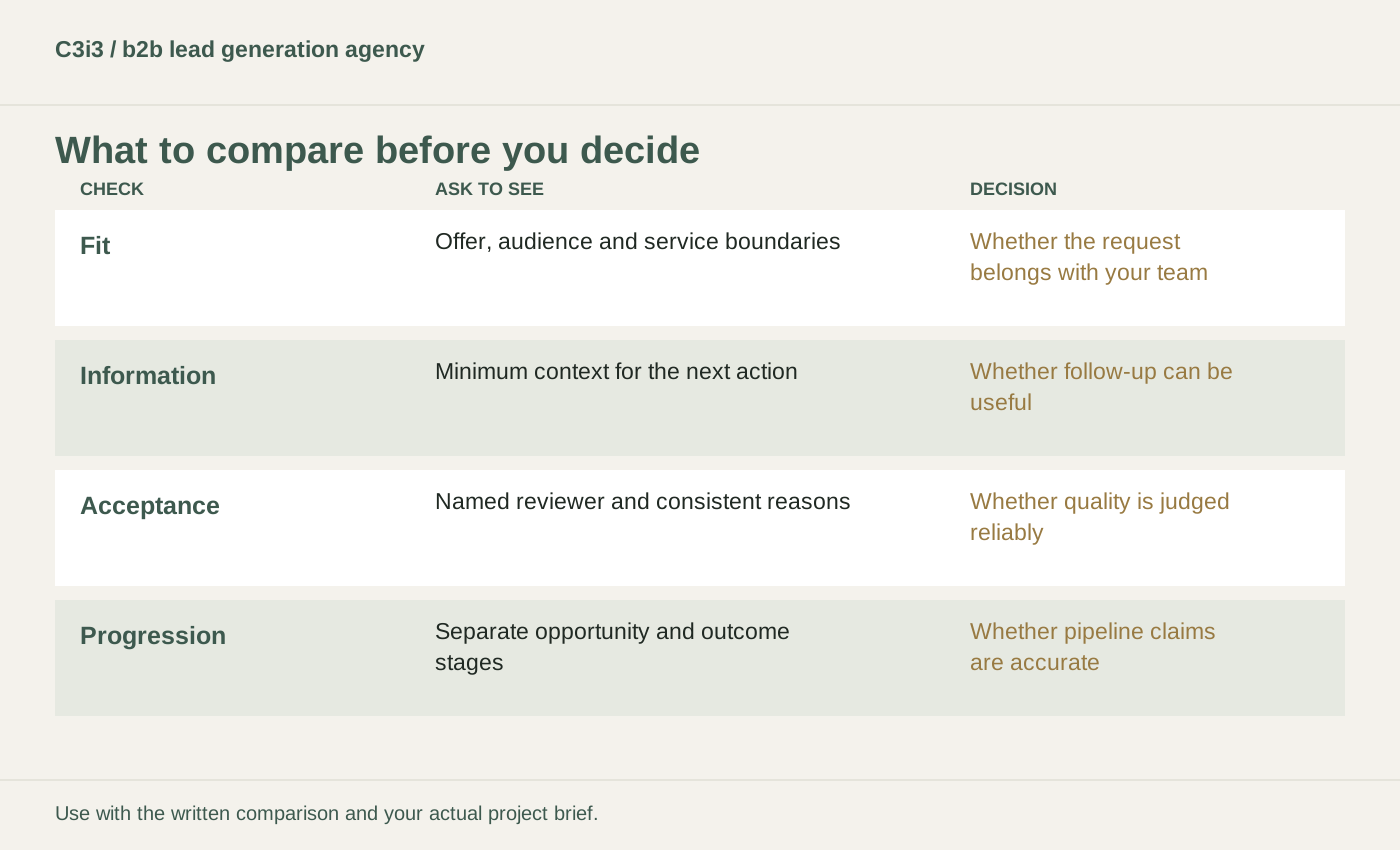
How do the key evaluation criteria compare?
| What to compare | Evidence to request | Decision it supports |
|---|---|---|
| Fit | Offer, audience and service boundaries | Whether the request belongs with your team |
| Information | Minimum context for the next action | Whether follow-up can be useful |
| Acceptance | Named reviewer and consistent reasons | Whether quality is judged reliably |
| Progression | Separate opportunity and outcome stages | Whether pipeline claims are accurate |
How could a San Jose technical team clarify acceptance?
Imagine a supplier receiving requests that mention a product but not the intended application. Sales initially rejects them all as unqualified. A review shows that several come from relevant companies whose engineers are still exploring options.
The team changes the process: relevant but incomplete requests receive a defined follow-up, while out-of-scope applications are rejected with a reason. It then reviews whether the additional context supports sales acceptance. This hypothetical example illustrates stage discipline, not an automated qualification system or a guaranteed increase in orders.
What should you remember before the next step?
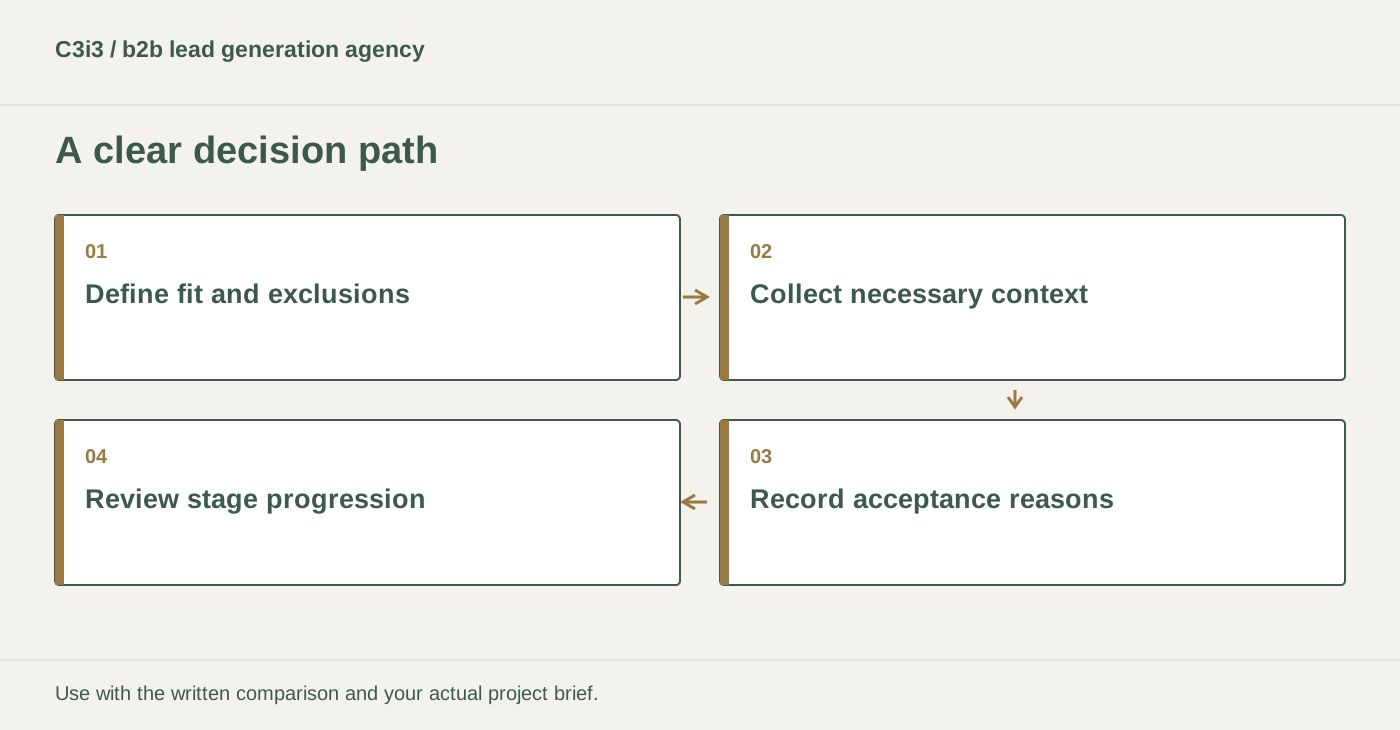
- Define fit and exclusions.
- Collect necessary context.
- Record acceptance reasons.
- Review stage progression.
What else do local business buyers ask?
Does a qualified lead need an approved budget?
That depends on your stage definition. Early B2B interest may be suitable before budget approval. State what sales needs at the particular stage.
Should AI decide whether sales accepts a lead?
Automated assistance can organize information, but the business should define the criteria and retain review for consequential or ambiguous decisions.
Can we change the acceptance definition during a campaign?
Yes, when documented. Record when and why it changed so earlier and later results are not compared as though the rules were identical.
Which sources can help you verify these decisions?
The frameworks and hypothetical examples are C3i3 editorial analysis. The linked primary sources provide platform, usability or disclosure context for the relevant decisions.
How can C3i3 help you plan the right next step?

Share your current website, the customers you want to reach and the work you want to improve. C3i3 brings design, content, technology and marketing into a coordinated project scope.
Review C3i3’s background, explore lead generation or tell us about your project.