



































In this article
Plan AI lead generation around qualified B2B inquiries. A San Jose guide to lead-fit criteria, accurate summaries, human follow-up and useful measurement.
What should AI lead generation mean for a growing B2B company?
Define the part of the customer journey you want to improve. Discovery, inquiry capture, qualification and follow-up are different tasks. A tool that drafts messages does not automatically solve all of them. Start with the offer, intended buyer and the information needed for a useful conversation.
For a hypothetical San Jose industrial-service business, a valuable inquiry may identify an application, project stage and contact who wants to discuss requirements. A large list of unrelated contacts may have little value. The plan should explain how the company recognizes a relevant opportunity and what happens after one arrives.
The AI consulting guide provides the readiness framework. This article concentrates on qualification and handoff, with AI as assistance to an accountable sales process rather than a substitute for knowing the customer and the work.
Which lead-fit criteria should you define before choosing a tool?
Use business requirements that relate to the offer: application, requested service, location where the work is needed, project stage and relevant technical questions. Distinguish a required condition from a helpful signal. If the company serves several markets, specify what changes between them instead of using one vague score for everyone.
| Question | Use submitted or verified information | Avoid assuming |
|---|---|---|
| What does the prospect need? | Requested task or application | A problem inferred from a job title |
| Does the offer fit? | Approved service scope | Capabilities the business has not confirmed |
| What is the project stage? | The prospect’s stated situation | An invented buying deadline |
| What needs clarification? | Missing requirement or dependency | A confident answer without evidence |
| Who should respond? | Named internal responsibility | That automation owns the sales decision |
Have sales and the relevant specialist agree the criteria. A marketing team may define the audience, while an engineer or service lead identifies an application constraint. AI can help organize the information; it should not quietly rewrite the business’s qualification rules.
What information should a website inquiry collect?
Collect enough to support the next conversation without turning the first contact into an exhaustive procurement questionnaire. Name the service or application, ask for the relevant project context and explain what happens after submission. Make optional details genuinely optional when they are not needed for an initial response.
Use the page to answer questions that do not require a salesperson. Clear product and service copy helps visitors decide whether to inquire. A form cannot compensate for an offer that remains difficult to understand. Our B2B SaaS product-page guide gives one example of connecting capability descriptions with an appropriate demo request.
Keep information handling aligned with the actual process. Do not invite confidential technical material into a general form unless the organization has a suitable arrangement for receiving it. The first response can establish the next secure or approved channel when the project requires a more detailed discussion.
How can AI produce an accurate sales handoff?
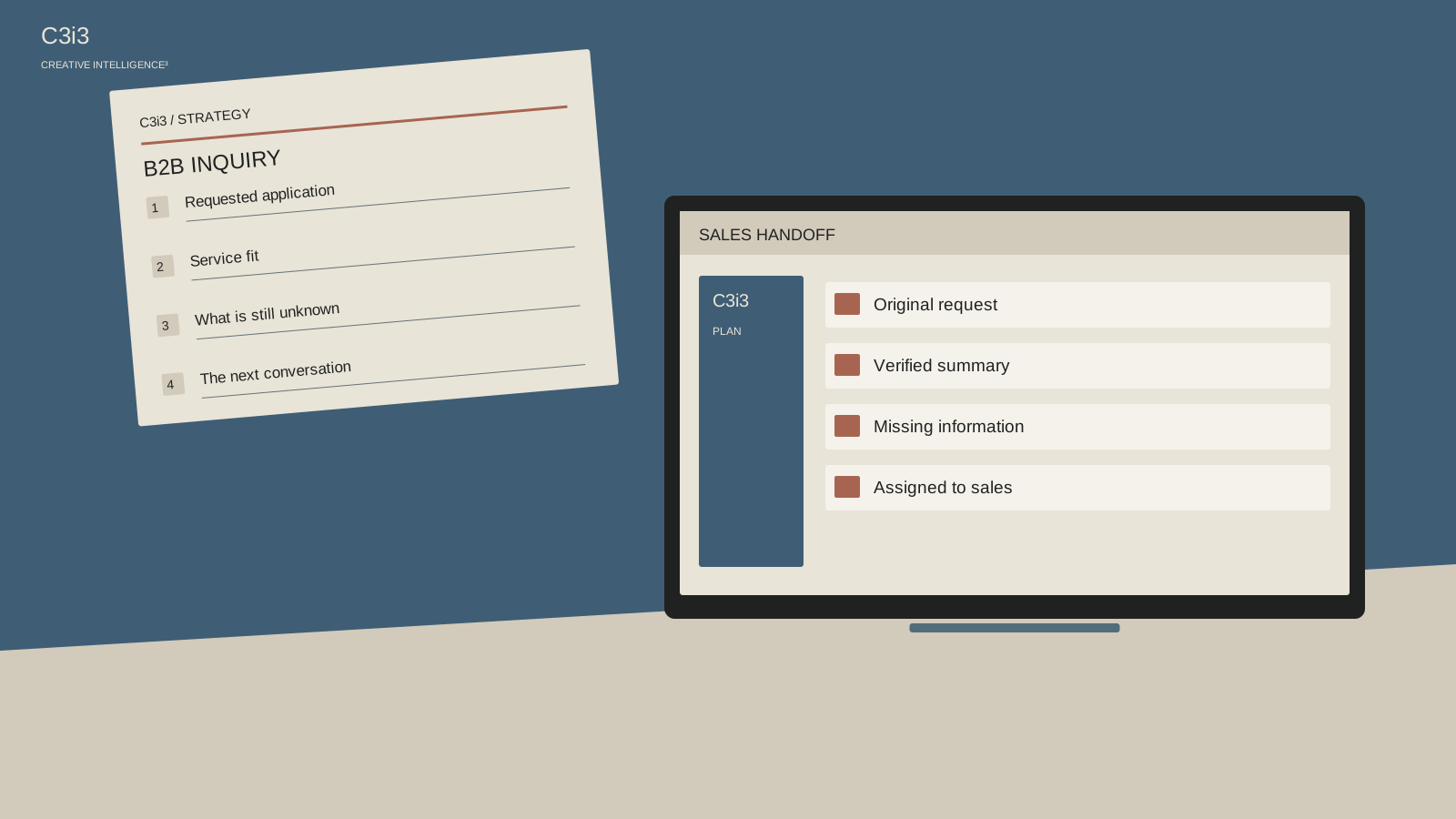
Give the assistant a bounded job: summarize the submitted request, retain important qualifications and list missing information. Require the summary to distinguish what the prospect said from what the system suggests asking next. The person receiving the handoff should be able to compare it with the source.
A useful summary might say that the prospect requests support for a particular application and has not yet supplied a required specification. It should not infer an available budget, confirmed purchasing authority or urgency from unrelated clues. Those are questions for the conversation when relevant, not facts for the system to invent.
Test with ambiguous and incomplete requests. Ask reviewers whether the summary changes the meaning, omits a limiting condition or routes the inquiry to the wrong team. Preserve the original submission alongside the reviewed summary. That gives sales a reliable reference when a concise generated account leaves out a detail they need.
What should an AI-assisted follow-up message accomplish?
A follow-up should acknowledge the request, provide an accurate next step and ask the smallest useful set of questions. Use approved descriptions of the offer and avoid implying that the business has already accepted a project or confirmed compatibility. The message should make the next human interaction easier.
For an illustrative software integration inquiry, a draft could acknowledge the systems the prospect named and ask which workflow they want to connect. It should not say the integration is supported until that has been verified. A reviewer can then decide whether to offer a discovery call, point to existing documentation or explain that the request is outside scope.
Keep the response connected to the context of the original page. Someone requesting a technical demonstration should receive a relevant demo process, not a generic promotional sequence. The SaaS explainer production guide shows how educational assets can prepare that conversation without replacing a detailed evaluation.
How does this fit a San Jose B2B go-to-market plan?
A company launching a new service needs agreement about the buyer, use case, evidence and next action before it scales lead handling. If those choices are unresolved, AI can accelerate inconsistent messages. A B2B go-to-market strategy gives qualification and follow-up a coherent starting point.
Use local context where it matters to the actual offer. Some San Jose companies sell nationally; others need an on-site evaluation or serve a defined Bay Area territory. State the real service area and delivery model rather than assuming that a city in the title limits every prospect. Local authority comes from understanding those distinctions.
The City of San Jose’s business opportunities resource is relevant when public-sector sales are part of the plan. Government procurement needs its own process and documentation; a general lead-scoring workflow should not imply eligibility, registration or readiness to submit a bid.
What should you measure besides lead volume?
Record whether inquiries match the intended applications, contain enough context for follow-up and reach the right person. Track missing information and the corrections required in AI summaries. A larger volume of unsuitable requests can increase work without improving the pipeline. Define quality before optimizing for quantity.
Separate observations from attribution. You may know that an inquiry arrived through a particular page or campaign, but that does not establish every influence on the buyer’s decision. Keep sales feedback beside available analytics so the team can understand whether the conversations are becoming more useful.
Do not assign a financial result to the pilot without the supporting information. A clearer handoff can be a useful operational observation on its own. Our B2B case-study evidence guide explains how to describe supported value when an ROI figure cannot be established or published.
What should the first lead-generation pilot include?
Choose one service line, one inquiry source and a small set of representative examples. Document the qualification rules, approved message patterns, reviewer and escalation path. Test whether the system preserves facts and asks for help when it lacks a basis for an answer. Keep outbound sending outside the pilot unless that specific use has been reviewed and approved.
Include examples that should not become sales opportunities: irrelevant requests, support messages and inquiries outside the business’s capability. A useful workflow recognizes those cases and routes them appropriately. It should not force every contact into a sales sequence simply because the software can create one.
Review the pilot with the people who actually respond. C3i3’s AI marketing consulting can help define the use case and acceptance criteria. The practical goal is a better conversation with a suitable prospect, with a process the team can explain and maintain.
What should you check before the next step?
More questions about ai lead generation.
Is AI lead generation the same as buying a contact list?
No. Contact sourcing is only one possible activity and does not establish relevance, permission or buying intent. This guide focuses on suitable discovery and inquiry paths, qualification and accurate follow-up using appropriate information.
Should AI decide whether a prospect is worth speaking to?
Use a clear business-fit framework and accountable human judgment. AI may organize relevant information or identify missing details, but a score should not hide unsupported assumptions or replace review of an unusual but potentially suitable request.
Can this work for a B2B company that sells outside San Jose?
Yes. Define the real market and delivery model. San Jose can be the company’s local context while the offer serves regional, national or international buyers. Keep the page and qualification criteria accurate about that coverage.
What decision does your business need to make next?
Bring us the audience, the business question and the material you already have. We can help define a useful scope and connect the content to the right next action.