



































In this article
Plan AI consulting around a real business goal. A Bay Area guide to useful workflows, readiness, consultant selection, human review and pilot measurement.
What does AI consulting for small business actually include?
AI consulting helps a business decide where artificial intelligence can be useful and what it would take to use it responsibly. Depending on the provider, an engagement can include opportunity discovery, workflow assessment, tool selection, pilot planning, implementation support and staff guidance. Ask which of those tasks are included. The label alone does not tell you whether you are buying strategic advice, software engineering or a training session.
For marketing and sales, useful assignments include organizing approved information, helping a team draft and review content, improving inquiry handoffs and examining recurring questions. A strategy consultant should explain the process that changes, the information required and the person who remains accountable. A list of popular tools is not a business plan.
C3i3’s AI marketing consulting focuses on use-case priorities, review steps and practical pilot planning. That scope is different from promising a custom foundation model, a replacement for an entire sales team or automated engineering judgments. Choose a provider whose actual service matches the problem you need to solve.
Why should a growing Bay Area business start with strategy rather than tools?
A growing company may already have more demand, content or customer conversations than its current process can handle. Before adding AI, find the constraint. Is the team responding slowly because inquiries go to the wrong person? Is the website attracting poorly matched requests? Are experienced staff repeatedly rewriting the same approved explanation? Each problem suggests a different intervention.
A business strategy sets priorities: which customers to serve, which offers to develop and which capabilities to strengthen. AI is one possible way to execute parts of that strategy. Buying a tool first can automate an unclear process or produce more material for an audience the company has not defined. Start by writing the decision or task that should improve.
The San Francisco Fed’s July 2026 research brief, drawing on the 2024 Small Business Credit Survey, describes varied small-business uses and barriers including implementation knowledge and staff capacity. It supports asking practical readiness questions; it is not evidence that a particular Bay Area business needs every available AI tool.
Which marketing and sales problems are sensible starting points?
Look for a repeated, bounded task whose inputs and output can be reviewed. An inquiry-routing assistant, an outline made from approved expert notes or a first draft of a follow-up message may be easier to evaluate than an unrestricted system asked to run the company’s marketing. The best starting task is not necessarily the most visible one.
| Business situation | Possible pilot | Evidence of a useful result |
|---|---|---|
| Repeated content questions | Draft from approved source notes | Reviewer confirms accuracy and usability |
| Inquiries arrive without context | Summarize submitted requirements | Sales receives a complete, accurate handoff |
| Project facts are scattered | Organize approved project evidence | Team can verify and reuse the material |
| Follow-up drafts vary widely | Assist with approved message structure | Staff can send accurate, relevant replies |
| Reports are hard to interpret | Summarize defined observations | Owner can trace conclusions to the source |
These are planning examples, not promised integrations or outcomes. First check whether a simpler form, shared template or routing rule resolves the problem. For a focused local workflow, see AI marketing automation for San Francisco small businesses.
When is ordinary automation a better choice than AI?
Use clear rules when the decision is already precise. Routing an inquiry selected as “existing client support” to a support queue may not require a language model. A reminder after an approved event or a standardized confirmation can often be handled through existing software. Adding AI to a deterministic step can introduce work without improving the experience.
AI assistance may be useful when the input varies and someone needs help interpreting, drafting or organizing it. Even then, the output may need a human decision. A model can summarize an inquiry, but a sales lead should confirm whether the request fits the business. A draft can suggest wording, but the organization still owns the claims it publishes.
Ask the consultant to mark each task as rule-based, AI-assisted or human-led. Include the reason and the consequence of an error. This simple classification helps the business compare a proposed AI workflow with a less complex alternative. It also makes clear which decisions should remain with the people who understand the customer and the offer.
How can you assess AI readiness without a large audit?
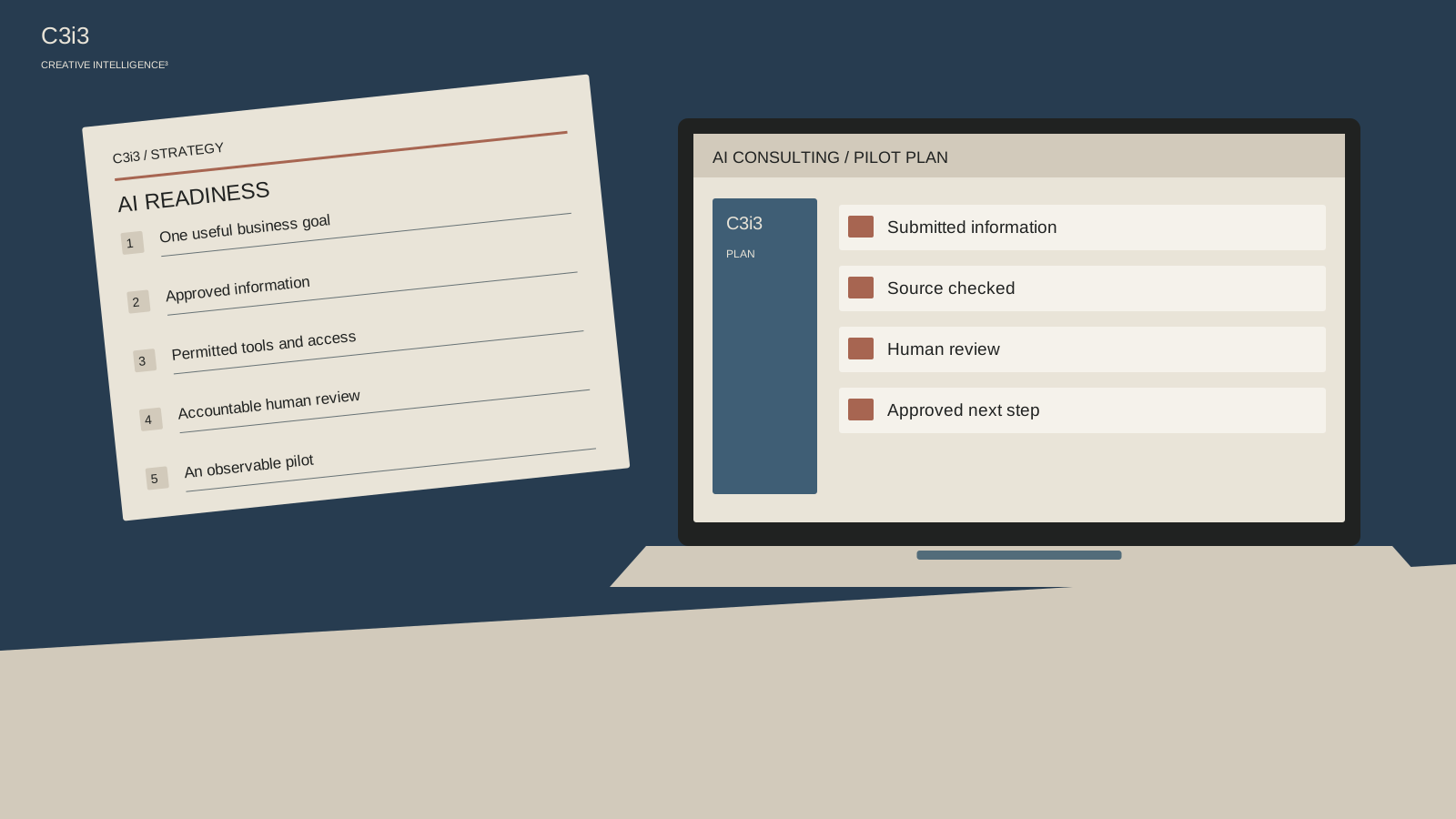
Start with one workflow and ask five questions: Is the goal clear? Are the source materials usable? Is access appropriate? Can someone review the result? Can the team observe whether the pilot helped? A missing answer is a planning task, not a reason to assign a flattering readiness score.
| Area | Ready enough to pilot? | If the answer is no |
|---|---|---|
| Business goal | One task and useful outcome are named | Clarify the problem first |
| Source material | Current, approved information is available | Collect and review the inputs |
| Access | The intended tools may use the material | Resolve access and data handling |
| Review | An accountable reviewer is available | Assign the owner and acceptance criteria |
| Observation | The team can compare the process before and after | Define what will be recorded |
Do not collapse these questions into a score that hides a serious gap. A clear goal does not compensate for missing permission to use the source material. A technically capable system does not compensate for having nobody available to review it. Keep unresolved requirements visible and narrow the pilot where necessary.
What should a useful AI consulting engagement deliver?
Request concrete outputs: a map of the current workflow, prioritized use cases, tool-selection criteria, a pilot brief, review responsibilities and a handoff plan. Implementation may be included or may require a separate scope. Either arrangement can work when the provider states the boundary clearly.
Ask how recommendations will be explained. The business should understand why a use case was selected, what alternatives were considered and what would make the pilot unsuitable. A proposal that recommends the same platform for every problem needs closer examination. Evaluate fit, access, maintainability and the work your team must perform alongside the tool.
The engagement should also identify what will remain outside the pilot. A content-planning assignment should not quietly expand into a complete CRM replacement. A sales-summary experiment should not begin sending messages autonomously without a separate decision. Keep the scope connected to a written marketing plan and to the business priorities behind it.
How should you compare AI consultants and implementation providers?
Ask for an explanation of a relevant workflow and the provider’s role in it. A polished demo can show what a tool can do under prepared conditions; it does not establish what the provider will deliver with your information and staff. Request an outline of discovery, testing, review and handoff for your assignment.
Clarify who handles configuration, integrations, access controls and ongoing support. A strategic advisor and a software implementation team can be complementary, but they offer different services. Ask what happens when the project exposes a need outside the provider’s expertise. The business should know which specialist owns the next decision.
Check for an honest account of limitations. A useful consultant can explain when a template or standard automation is sufficient, when input quality blocks progress and when a human should make the final judgment. Compare the proposed deliverables and responsibilities rather than relying on the number of tools named in the presentation.
How does the plan change for midsize and enterprise teams?
A small company may have one owner approving a pilot, while a larger organization may need business-unit, IT, security, product and regional reviewers. The task still needs a clear business purpose, but the approval map becomes more important. Name the decision each reviewer owns instead of sending every draft to an undefined committee.
For an illustrative manufacturer with several product lines, a marketing pilot might organize approved technical sources for one application category. The product owner checks facts, the marketing lead checks buyer relevance and the appropriate technology owner confirms the permitted workflow. The pilot does not become authority to generate specifications across the whole catalog.
A construction or engineering organization may have project-specific publication permissions and a separate reviewer for technical meaning. Its useful starting scope can be one sector or an approved project-evidence process. Start narrow within the larger organization, then assess what must change before another office, business unit or product family adopts the workflow.
The small-business search phrase in this guide describes a starting audience, not a limit on the scale of strategy work. Larger teams should preserve the same goal-first discipline while adding the governance their products, customers and information require. The manufacturing strategy guide develops that more complex buying and content context.
What could a 90-day AI marketing pilot look like?
Treat the following sequence as an illustrative planning framework, not a promise of results within a fixed period. The actual pace depends on the task, source material, access and reviewer availability. A pilot should be small enough that the team can understand a failure and decide what to change.
In the first stage, document the current process and collect approved inputs. In the second, test a bounded workflow on examples that include difficult cases, not only ideal ones. In the third, let the responsible staff use the reviewed process in a limited setting. In the final review, compare the observations with the original goal and decide whether to keep, revise or stop it.
For a hypothetical Bay Area professional-services firm, the pilot might summarize voluntarily submitted project requirements for a sales lead. The test would check whether the summary preserves the request, identifies missing information and routes it appropriately. It would not infer a prospect’s budget or invent facts about the company. The San Jose B2B lead-generation guide develops that handoff in more detail.
What should you check about data, permissions and factual accuracy?
Use information the business is authorized to process in the intended tools. Identify customer records, confidential project material and public marketing sources separately. Do not assume that replacing a customer’s name makes a document suitable for every tool. The owner of the information should approve the use and the relevant handling arrangements.
Keep source traceability for material that becomes public. A product claim, project detail or credential should have a reliable basis and an authorized reviewer. AI can produce fluent statements that do not follow from the inputs. NIST’s generative AI profile identifies confidently incorrect output among the risks organizations should consider.
Build review into the task rather than adding a vague instruction to check everything afterward. A reviewer should know which facts to verify, where the sources are and what happens when the output is uncertain. For specialized workflows, use the appropriate product, privacy, legal or technical reviewer instead of treating general marketing approval as sufficient.
How does the plan change for construction and government-facing businesses?
A contractor may have valuable project experience but limited permission to publish the underlying material. An AI-assisted workflow can help organize approved facts into potential project profiles or qualification content. It should preserve client permissions, the actual scope performed and the difference between a documented result and a proposed benefit. See AI planning for East Bay construction companies.
A government-facing supplier may need a concise capability statement tailored to an agency’s requirements. AI can assist with structure and wording, but identifiers, qualifications and past performance must come from verified records. Local and federal procurement processes should not be treated as interchangeable. The Bay Area capability-statement guide explains how to keep that work grounded.
These examples illustrate why sector-specific planning matters. They are not claims that C3i3 has delivered a particular client result or that a marketing document establishes procurement eligibility. The consultant’s useful role is to define the communication workflow and its review requirements, with specialist decisions assigned to the proper owner.
How should you measure a pilot before expanding it?
Record what the existing process requires and what a usable output looks like. Depending on the task, useful observations may include the completeness of a handoff, corrections required, reviewer effort and whether the output is used. Do not count the number of generated drafts as success when nobody can approve them.
Keep the comparison fair enough to inform a decision. Use similar task types, include exceptions and document changes to the process. If the pilot appears faster because difficult requests were excluded, state that limitation. Avoid converting a time observation into a financial ROI claim without the information and method needed to support it.
Expand only when the team understands the workflow, can maintain its inputs and can observe a useful result. A stop decision can be valuable if it prevents a poor fit from becoming a larger dependency. When the underlying issue is positioning or customer selection, return to the Bay Area marketing strategy consultant guide before adding another automation layer.
Which supporting guide answers your next question?
Use these focused guides to develop the parts of your brief that need more detail.
- AI Marketing Automation: What Should a San Francisco Small Business Automate First?
- How Should San Jose B2B Companies Use AI Lead Generation to Qualify and Follow Up with Prospects?
- AI for Construction Companies: How Can East Bay Contractors Plan Better Marketing and Business Development?
- Can AI Help Write a Capability Statement for a Bay Area Business Pursuing Government Contracts?
What should you check before the next step?
More questions about ai consulting for small business.
Do small businesses need custom AI software to get started?
Often they can begin by improving a process with existing tools or ordinary automation. A custom build should follow a defined requirement that standard options cannot meet. Assess the workflow and review needs before choosing the technology.
Is AI consulting the same as AI search optimization?
No. AI search optimization concerns how a business’s public information can be discovered and understood in search experiences. AI consulting may examine internal marketing or sales workflows, tool choices and adoption. Keep those scopes distinct even when they support the same business goal.
Should we automate all marketing after a successful pilot?
No. A useful result in one bounded task does not establish that every task is suitable. Evaluate each expansion for its inputs, reviewer, effect on customers and maintenance requirements. Preserve human judgment where the decision needs it.
What decision does your business need to make next?
Bring us the audience, the business question and the material you already have. We can help define a useful scope and connect the content to the right next action.