



































In this article
Choose AI marketing automation for a San Francisco business. Compare task priorities, ordinary automation, human review and a practical pilot workflow.
Which marketing task should a San Francisco small business automate first?
Choose the task that repeatedly creates avoidable work and can be checked reliably. A firm may spend time rewriting service explanations, sorting incomplete project requests or finding the latest approved description of its offer. Identify one of those tasks before deciding which AI tool to use. The first assignment should have a clear boundary and a person who can recognize a correct result.
For an illustrative San Francisco professional-services firm, inquiry summaries may be a better starting point than autonomous sales conversations. The summary can preserve what the prospect actually submitted and flag missing details for a staff member. It should not promise a service, deadline or result the firm has not approved.
The broader AI consulting for small business guide explains how to assess readiness. This article focuses on selecting a marketing workflow, not on assuming every company in the same city has the same automation needs.
How can you distinguish AI assistance from a simple routing rule?
Write down the decision in plain language. If it is a stable rule, ordinary automation may be sufficient. An inquiry selected as support can go to a support queue. A confirmation can repeat approved submission details. These steps do not necessarily need a model to interpret the request.
AI assistance may help when inputs vary: a free-text description needs summarizing, an expert interview needs organizing or an approved paragraph needs adapting for a defined audience. Keep the output subject to a review that fits the consequence of an error. The system should expose uncertainty rather than turn a missing detail into a confident guess.
| Task | Starting approach | Human responsibility |
|---|---|---|
| Route a selected inquiry type | A clear software rule | Maintain the routing destinations |
| Summarize a free-text request | Reviewed AI assistance | Confirm meaning and missing details |
| Publish a service claim | Human approval supported by sources | Own the statement and evidence |
| Send an approved confirmation | Standard template or rule | Keep the promise accurate |
This division helps the team avoid buying complexity for a task its current systems could already handle.
What does a practical inquiry-to-follow-up workflow look like?
Map the sequence from the public form to the person who responds. Identify which information the business needs, how it is received and what the customer expects. Many problems blamed on slow writing are actually unclear ownership or an incomplete handoff. AI should not conceal those gaps by generating a friendly but unhelpful reply.
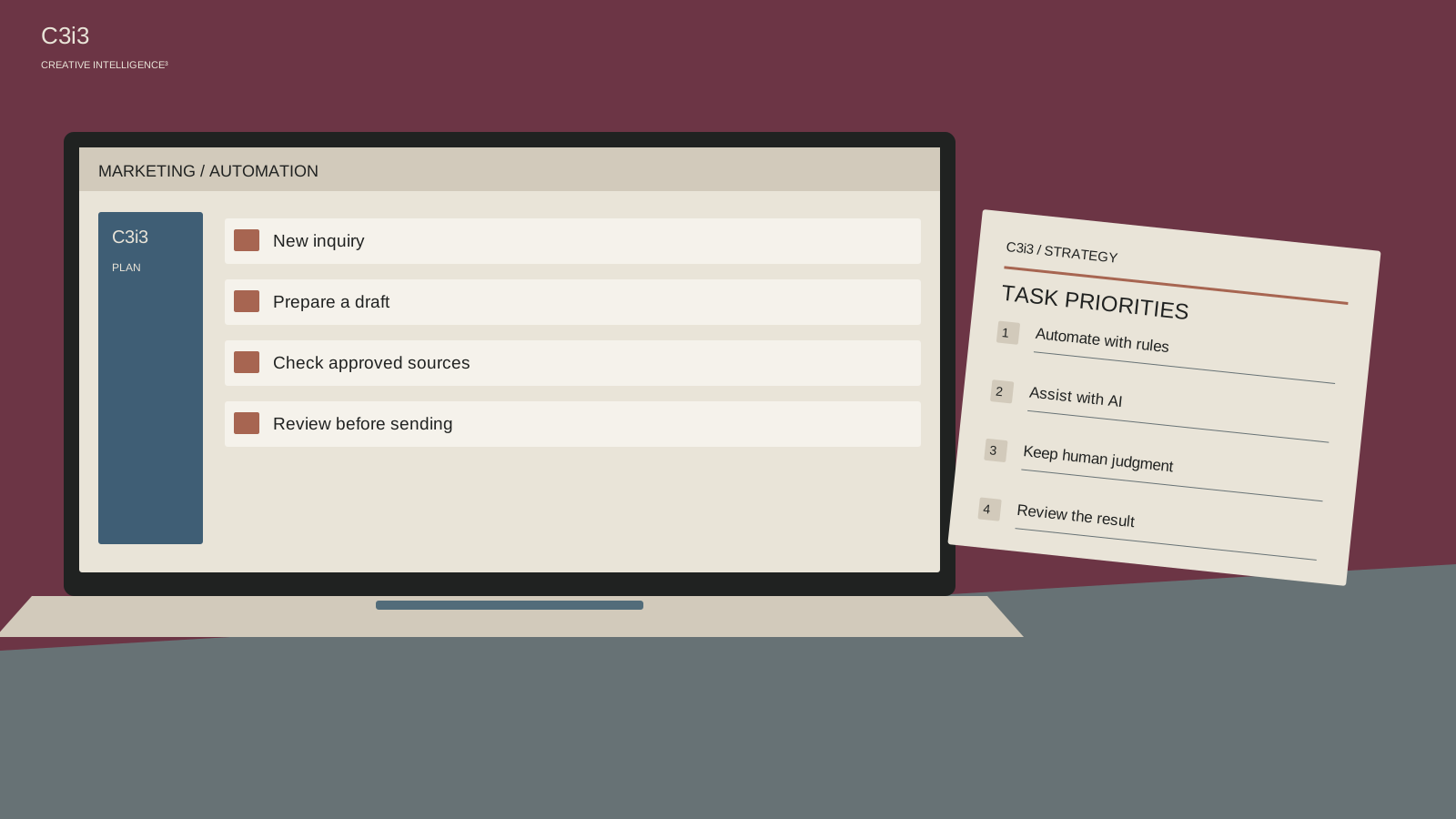
A bounded sequence might collect the submitted service need, summarize the stated constraints, identify questions for a human and prepare a draft from approved message patterns. A staff member verifies the summary and decides what to send. The response should acknowledge uncertainty where relevant instead of suggesting that a project is accepted before review.
Test the complete path with representative examples, including a request outside the firm’s service area or capability. The workflow should route those cases honestly. Our website inquiry copy guide helps align the form, confirmation and follow-up with the offer the visitor actually saw.
How can AI help with content without publishing generic material?
Use the company’s approved knowledge as the starting point: an expert explanation, a current service brief or an authorized project account. Ask the tool to organize or adapt that material for a defined purpose. A draft made from nothing but a broad keyword is less likely to contain the details that distinguish the business.
Assign the original contribution before drafting. The article might include a decision worksheet, a specific workflow or a reviewed explanation of a common customer question. The reviewer should check both the facts and whether the content adds something useful to the existing site. More variations of the same general advice are not necessarily more valuable.
Link the content to the services and evidence it explains. For a professional-services firm, a useful answer may support a customer-acquisition plan rather than a standalone publishing quota. See the San Francisco customer acquisition strategy guide for that wider context.
What local context should a San Francisco automation plan consider?
Local relevance comes from the actual business and customer journey. A firm serving clients across San Francisco and the wider Bay Area should distinguish where it works, how consultations happen and which inquiries require an on-site visit. Do not let a generated reply invent an office, neighborhood presence or local project history.
San Francisco’s professional-services business resource page provides a relevant local starting point for firms considering growth and support. Use official resources for the questions they address, while developing the marketing workflow around the company’s real offer. A resource link does not imply a partnership or an endorsement.
If the audience includes several languages or specialized industries, include appropriate review. Automated translation or a polished draft can still change a service promise. Confirm terminology, scope and the next action in each version. These choices make a local workflow useful without requiring separate near-identical articles for every neighborhood.
How do you protect the business’s voice and factual accuracy?
Create a short source pack containing approved service descriptions, terminology, examples of suitable replies and statements that require specialist review. Give the reviewer a way to trace an output to that material. A tone guide is helpful, but it does not replace a current account of what the company actually provides.
Separate style corrections from factual corrections. A draft can sound like the business while inventing a feature, timeline or qualification. Ask the reviewer to verify the statement first and refine the voice afterward. Keep frequently corrected errors in the test set so a later change is checked against the same problem.
For public content, review claims before publication. The FTC’s advertising guidance is a useful general reference for truthful promotion. For the workflow itself, name the person who approves consequential customer-facing statements and define what happens when the system cannot produce a reliable draft.
What should a first automation pilot record?
Record the task, source version, output, corrections and reviewer decision. Include how long the review actually takes and whether the result is used. The business should be able to distinguish a fast draft from a usable response. A workflow that creates more cleanup may not be an improvement even if generation is immediate.
Include ordinary and difficult examples. Test incomplete requests, conflicting instructions, outdated source material and topics outside the approved scope. Check whether the workflow asks for a human decision instead of filling the gap. Avoid evaluating only the carefully prepared example used in a sales demonstration.
Use the results to change the brief or stop the pilot when necessary. A small scope makes that decision easier. If the process becomes useful, document what another staff member needs to maintain it: sources, access, templates, review instructions and escalation contacts. The plan should survive the departure of the person who first configured it.
When should you ask for AI marketing consulting help?
Consider help when the team cannot agree which workflow matters, cannot compare tool proposals or lacks a clear review and handoff plan. A consultant should make those choices easier to assess. Ask for a prioritized use-case list, acceptance criteria and an explanation of the work your staff must do.
Keep the engagement connected to the business goal. If the offer is unclear or the website attracts unsuitable inquiries, more follow-up automation may amplify the wrong process. Resolve positioning and audience decisions with a marketing strategy assessment, then choose the task worth automating.
C3i3’s AI marketing consulting service can help define those priorities and review steps. Start with one useful assignment and a written measure of success, rather than a promise to automate everything the business publishes or sends.
What should you check before the next step?
More questions about ai marketing automation.
Should AI send replies without approval?
That depends on the task, approved content and consequences of an error. A tightly controlled confirmation is different from a negotiated project promise. Start with reviewed drafts for open-ended responses and make any later expansion an explicit business decision.
Can we use the same workflow for every service?
Only when the inputs, promises and review requirements are genuinely similar. Different service lines may need different questions or escalation rules. Keep the shared structure while checking the details that affect the customer.
Will automation alone bring more qualified customers?
No. It can support a useful process, but audience fit, offer clarity, evidence and follow-up still matter. Evaluate the customer journey and observed inquiry quality rather than assuming that faster message production creates demand.
What decision does your business need to make next?
Bring us the audience, the business question and the material you already have. We can help define a useful scope and connect the content to the right next action.