



































In this article
Plan an AI-assisted capability statement using verified business facts. Compare Bay Area agency context, past-performance evidence and human approval.
What is a capability statement, and what job should it do?
A capability statement is a concise introduction to a business’s relevant competencies, experience and differentiators for a potential buyer or partner. In government-facing work, it can help an agency or prime contractor understand what the company provides and how to continue the conversation. It is different from a full proposal responding to a specific solicitation.
The SBA’s capability-statement training description identifies competencies, relevant experience, qualifications and communication to agencies and prime contractors as central topics. Use those categories to collect real material rather than treating a template as a source of facts about the business.
An AI-assisted workflow can make the draft easier to organize, but strategy comes first: who is the intended reader and what relevant capability should they recognize? The AI consulting guide explains why a bounded assignment with reviewed inputs is a better starting point than asking a tool to create the whole story from scratch.
What verified information should you collect before using AI?
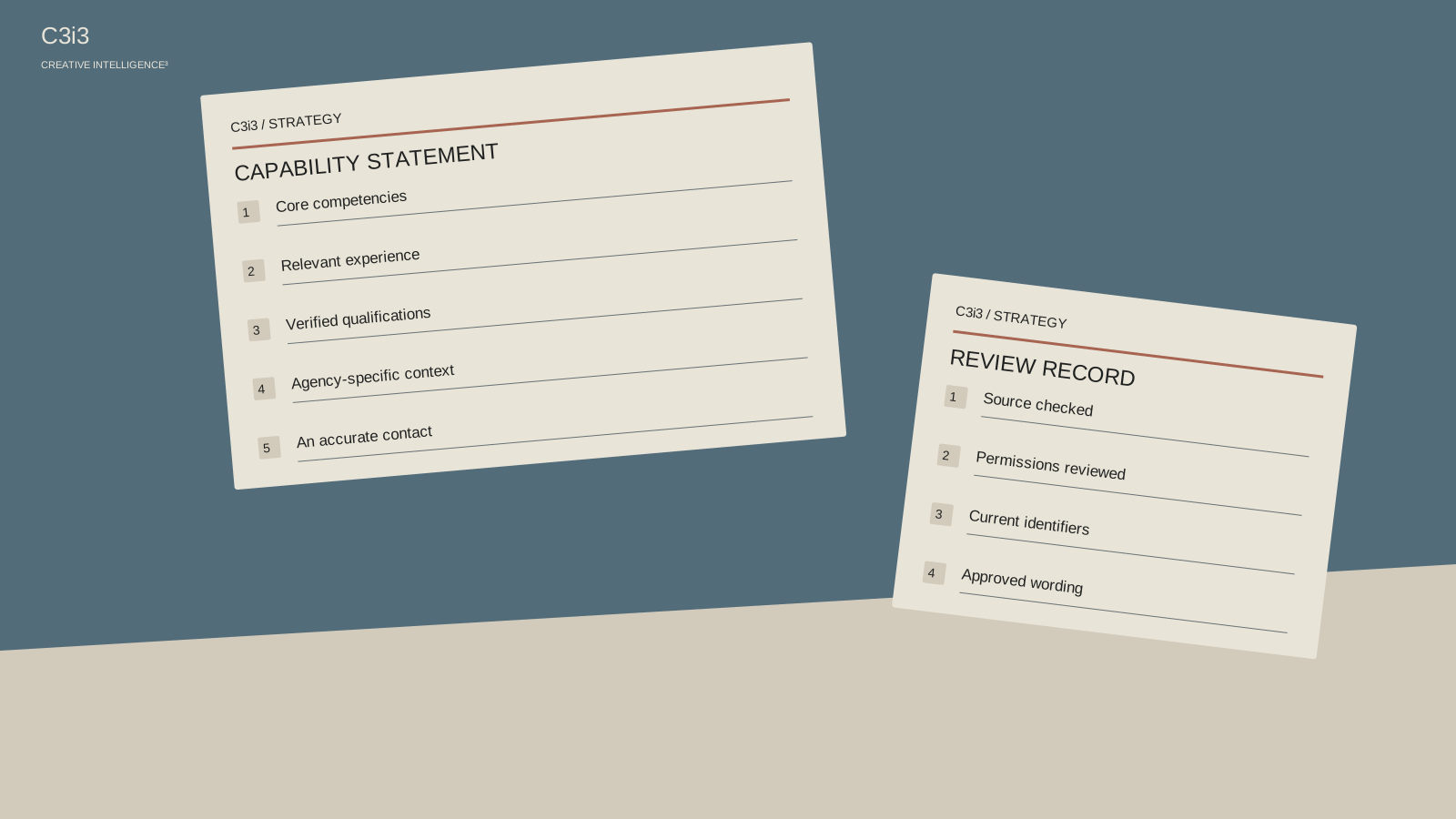
Assemble the approved company description, relevant services, authorized experience and contact details. Add current identifiers or certifications only when applicable to the intended context and supported by a reliable record. Keep a source and reviewer for each item. Do not let the model guess a code, credential or past contract.
| Content | Verification question |
|---|---|
| Core competencies | What can the business actually perform? |
| Relevant experience | What role and scope can be documented? |
| Differentiators | Which specific claims have support? |
| Applicable identifiers or status | Is the information current and relevant here? |
| Contact and next step | Who can discuss the opportunity accurately? |
Separate publishable information from private records. A project file may support a claim without being suitable for uploading to a general-purpose tool. Use approved excerpts or summaries when appropriate, and keep the responsible owner involved in deciding what may be processed and published.
How can AI help without inventing past performance?
Ask for structure, organization and clearer wording based on the supplied material. Require a visible distinction between sourced statements and questions that need an answer. An assistant can suggest where the description is vague; it should not fill the gap by inventing a client, award, certification or project result.
For an illustrative facilities-service supplier, AI might organize approved tasks into a concise competency section and suggest a place for a relevant project example. The business then checks whether those tasks reflect its current scope. A phrase such as “trusted by government agencies” needs evidence; it should not appear merely because similar statements occur in other capability statements.
Use a claim ledger through editing and design. Record the statement, source, approval and any restriction. The B2B case-study evidence guide offers a related method for handling confidential experience. A stronger-sounding sentence is not an improvement if it changes what the company can substantiate.
How should the document change for different Bay Area agencies?
Research the intended buyer’s actual process and terminology. San Francisco, San Jose and Alameda County have separate procurement resources. A company can use a shared source pack while tailoring the emphasis to the relevant category or opportunity. Do not create conflicting versions of its qualifications or copy one jurisdiction’s requirements into another.
| Intended market | Official starting resource | What to verify |
|---|---|---|
| San Francisco | City supplier qualification guidance | Requirements relevant to the actual supplier and contract |
| San Jose | City business opportunities and vendor resources | The current opportunity and registration instructions |
| Alameda County | County bidding and supplier resources | The applicable process and any relevant local-business program |
Use the official resources linked below, then read the instructions for the specific opportunity. The comparison is a research framework, not a legal or eligibility determination. Marketing preparation and procurement compliance are connected tasks, but approval of one does not automatically complete the other.
What should a San Francisco supplier verify?
Start with San Francisco’s supplier qualification guidance. It distinguishes applicable requirements and describes the Local Business Enterprise program as an optional step in that overview. The relevance of a particular program or requirement still needs to be checked for the business and opportunity.
For the capability statement, use current, verified status rather than aspirational language. If a certification is pending, do not describe it as completed. If a credential applies to a particular entity or scope, preserve that distinction. The person approving the document should understand what a buyer could infer from the wording and any logo treatment.
Keep the contact path practical. A supplier introduction should direct the reader to someone who can discuss the offered work and obtain the appropriate details. A general marketing form may be useful for first contact, but a formal procurement submission must follow the agency’s own instructions.
How do San Jose and Alameda County sources help you tailor the statement?
The City of San Jose’s business opportunities page points businesses toward bids, contracts and related resources. Use the relevant material to understand what the buyer is seeking. Do not imply that an attractive capability statement replaces any required registration or submission process.
Alameda County’s How to Bid guidance describes County-specific steps and links to vendor and local-business resources. Check the current instructions when a County opportunity is the target. A local program’s name or status should not be generalized into a federal credential or a promise of a contract.
Tailor the content to the actual service category and buyer question. A contractor, consultant and product supplier may need different examples of relevant capability. Keep the facts consistent across versions and use the official opportunity, not the AI model’s assumptions, to decide what deserves emphasis.
What should the writer, designer and business owner review?
The writer checks whether the document explains the offer clearly. The designer checks hierarchy, readability and whether important context stays with the claim. The business owner or authorized specialist checks qualifications, experience and permissions. Name these roles before drafting so responsibility does not disappear between handoffs.
Review the final layout, including the headline, selected examples, identifiers and contact information. A qualification that was clear in a draft can become misleading if the design gives one phrase disproportionate emphasis or removes a limiting sentence. Keep text editable so verified corrections can be made without rebuilding the whole document.
Do not fabricate customer endorsements or fill unused space with unsupported metrics. A focused statement of relevant capability can be useful without a large result number. Keep an approved version and the source ledger so future tailoring does not gradually change the company’s claims.
How should a capability statement support a broader growth strategy?
Use it as one asset in a defined business-development process. Decide which buyers or partners the company wants to reach, what work fits and which evidence supports the offer. A document shared without that context can become another file with no clear use. The Bay Area growth-strategy guide helps connect those choices.
If construction is the company’s market, align the statement with its project-fit and sector priorities. Our East Bay construction strategy guide distinguishes several buyer journeys. The same factual discipline applies to professional services and suppliers pursuing public-sector relationships.
C3i3’s brand positioning and sales copy services can support the communication brief and content structure. Keep any procurement-specific review with the people qualified to perform it, and evaluate the statement by whether it helps the right reader understand the business’s documented capability.
What should you check before the next step?
More questions about capability statement.
Is a capability statement the same as a bid proposal?
No. It is an introductory capability document. A proposal responds to a particular solicitation and must follow its instructions. A capability statement may support business development without satisfying the requirements of a formal submission.
Can AI supply our industry codes or certifications?
It can help identify questions to research, but use authoritative records and qualified review for the actual information. Never publish an inferred identifier, unearned certification or outdated status as a fact.
Should we make a new capability statement for every city?
Create tailored versions when the buyer, service category or agency context genuinely changes. Keep a shared verified source of truth. Avoid producing near-identical public pages solely to target city-name variations.
What decision does your business need to make next?
Bring us the audience, the business question and the material you already have. We can help define a useful scope and connect the content to the right next action.