









































In this article
A first lead generation pilot should answer a decision, not merely create a campaign dashboard. A Bay Area business needs to know whether the offer, source, destination and sales handoff work together well enough to continue. A bounded pilot can expose those conditions before a larger commitment.
Planning a project? Explore Bay Area web design and marketing support and lead generation services.
What should a first local lead generation pilot prove?
Choose the uncertainty that matters most. You may need to learn whether prospects understand the offer, whether a channel reaches the right audience or whether sales can use the intake information. A pilot designed to answer all three without enough volume may leave every question unresolved.
Write a decision statement before launch. For example, the pilot will determine whether a defined service offer produces requests that sales can evaluate under agreed rules. Name the evidence required and the actions available after review: continue, revise or stop.
How do I choose the best lead generation agency for a pilot?
Ask the agency to explain a limited first phase and the assumptions it tests. It should identify the required creative, landing page, tracking and sales work. Compare how candidates handle limited evidence rather than rewarding a confident forecast unsupported by your business history.
For local collaboration, clarify whether interviews or production require a Bay Area team on site. Also verify who owns the accounts and assets. A pilot should leave the business with understandable records and a practical next decision, even when it does not justify expansion.
How should I define the pilot’s audience and offer?
Choose one service or product family and the customer situation it solves. State exclusions, actual coverage and what a prospect can reasonably expect after responding. A clear offer makes the campaign easier to interpret and the resulting inquiries easier to assess.
Avoid changing several major inputs at once unless the test explicitly compares them. If audience, offer and destination all change during the pilot, you may be unable to explain why results differ. Keep a change log and record the period associated with each version.
For the connected decision, read Lead Generation Landing Pages: How Do You Turn Service Searches into Relevant Requests?.
What should be tested before the campaign goes live?
Complete the inquiry path from the actual destination. Check mobile use, required fields, confirmation, routing and the responsible team’s receipt of the request. Test relevant tracking under the conditions it is expected to work, including consent-related limits.
Agree what happens when a request fails delivery or contains insufficient context. A pilot can waste its learning window on an operational defect that should have been found first. The launch check should have named owners and evidence rather than a general statement that the form looks fine.
Which numbers should I review during the pilot?
Review spend, inquiries, duplicates, accepted inquiries, follow-up completion and opportunity movement where observable. Include rejection reasons and unresolved items. Counts show the amount of evidence; rates show how stages relate. Neither should be used alone.
For an illustrative pilot, six accepted inquiries out of twenty is a 30% acceptance rate. That small sample can support a conversation about fit, but it does not establish a stable future rate. Explain uncertainty and avoid presenting a short test as an enduring channel benchmark.
When should I continue, revise or stop the campaign?
Continue when the evidence supports the agreed next step and the business can handle the work. Revise when a specific fixable problem is identified, such as unclear scope or missing intake context. Stop when the offer or source does not fit the business, or when operational constraints prevent a useful test.
C3i3 can help define that decision before production and connect the website, content and campaign work needed for the pilot. Bring your capacity, service priorities and current inquiry process. A sensible first phase creates learning your team can use, not a requirement to keep spending indefinitely.
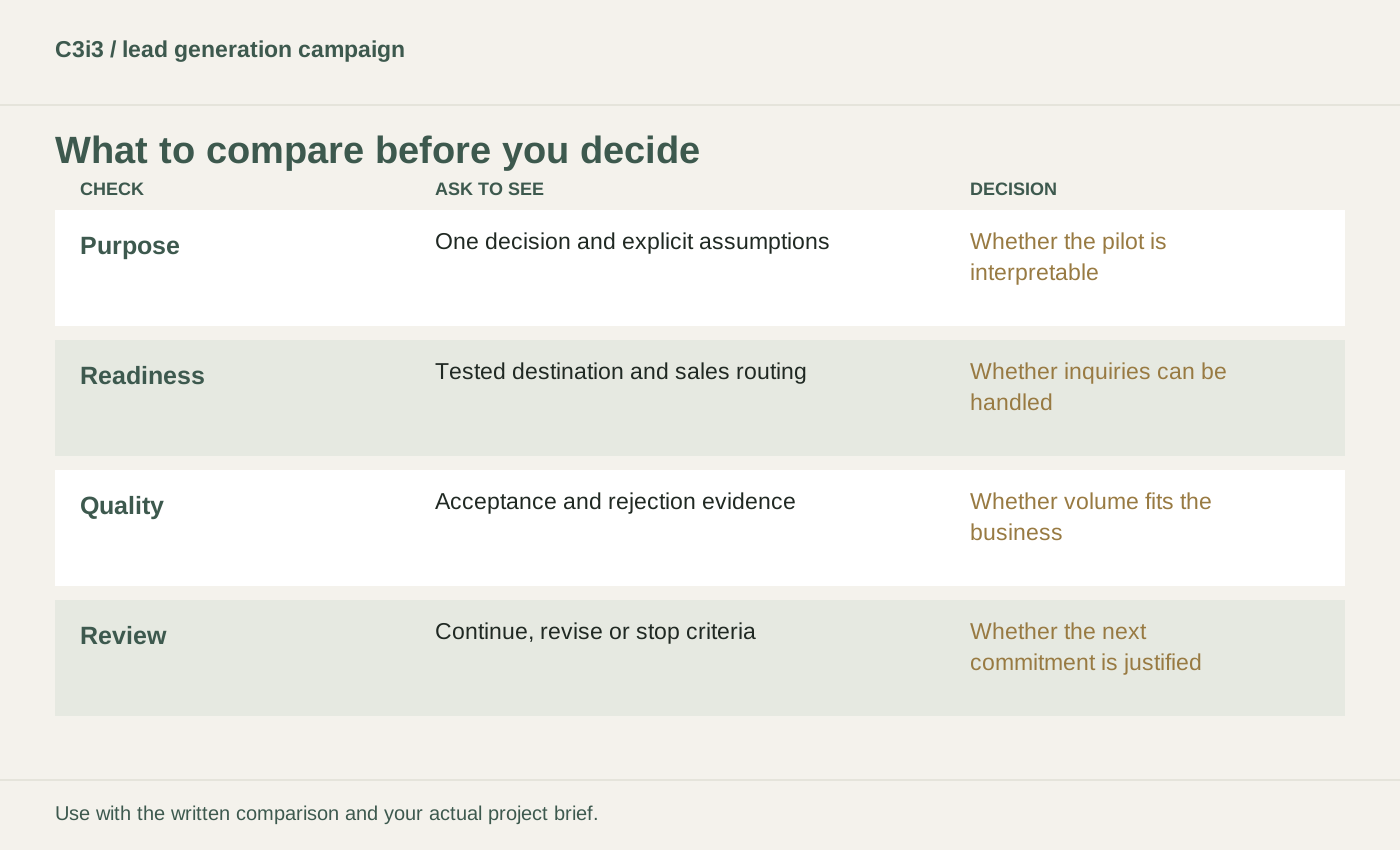
How do the key evaluation criteria compare?
| What to compare | Evidence to request | Decision it supports |
|---|---|---|
| Purpose | One decision and explicit assumptions | Whether the pilot is interpretable |
| Readiness | Tested destination and sales routing | Whether inquiries can be handled |
| Quality | Acceptance and rejection evidence | Whether volume fits the business |
| Review | Continue, revise or stop criteria | Whether the next commitment is justified |
How could a Bay Area pilot produce a useful decision?
Imagine a business testing one specialist service. It receives twenty requests, six accepted by sales and several asking for an excluded service. The team reviews the campaign promise and sees that the exclusion was unclear on the landing page.
It can revise that explanation and run a further bounded test rather than immediately increasing spend or declaring the whole channel ineffective. The hypothetical 30% acceptance calculation describes the sample only. The useful outcome is an identified issue and an agreed next decision.
What should you remember before the next step?
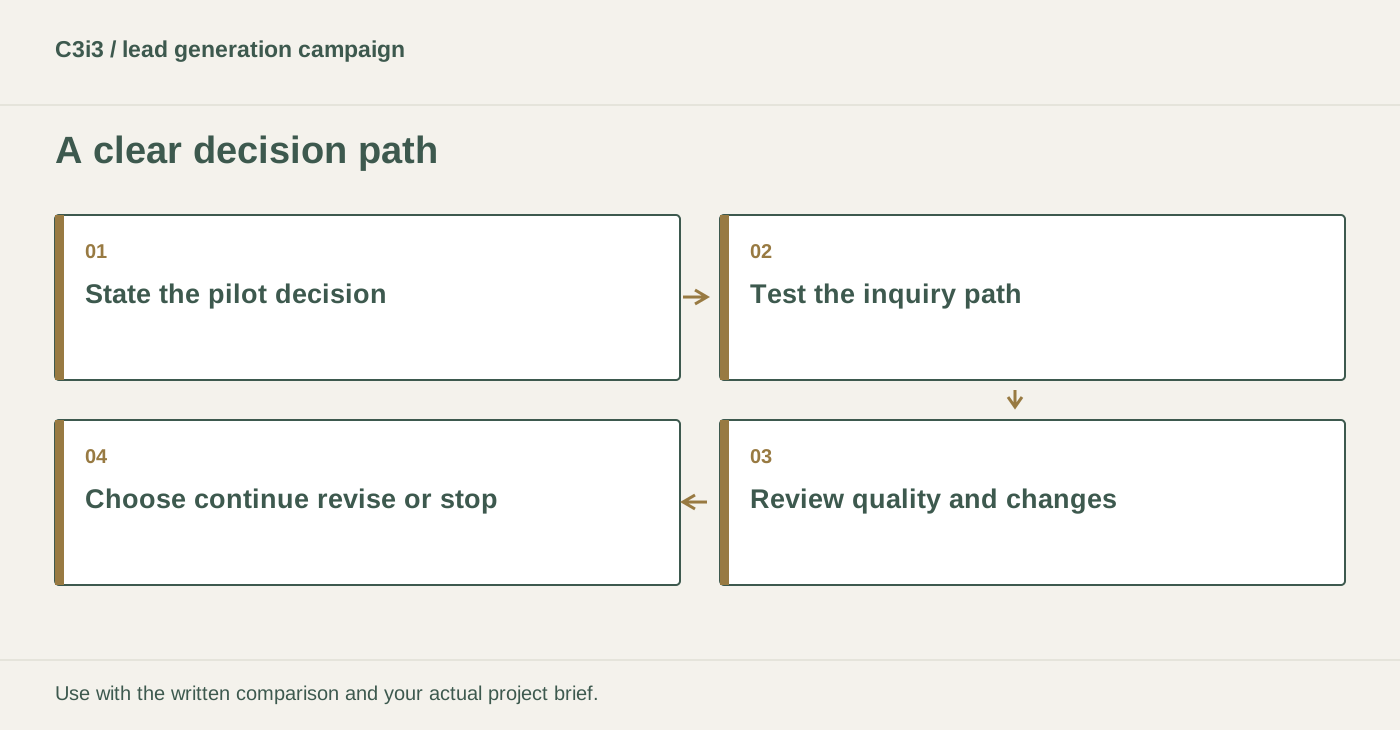
- State the pilot decision.
- Test the inquiry path.
- Review quality and changes.
- Choose continue revise or stop.
What else do local business buyers ask?
How long should a lead generation pilot run?
Choose a period that can produce useful evidence for the offer and sales cycle. A fixed duration without enough relevant observations may not answer the decision.
Should the pilot test several services at once?
Only if the design and reporting can distinguish them. A focused offer often makes an initial test easier to interpret.
Does a failed pilot mean the agency failed?
Not automatically. Review whether the work was delivered correctly and what the evidence shows about demand, fit and operations.
Which sources can help you verify these decisions?
The frameworks and hypothetical examples are C3i3 editorial analysis. The linked primary sources provide platform, usability or disclosure context for the relevant decisions.
How can C3i3 help you plan the right next step?

Share your current website, the customers you want to reach and the work you want to improve. C3i3 brings design, content, technology and marketing into a coordinated project scope.
Review C3i3’s background, explore lead generation or tell us about your project.