









































In this article
San Francisco professional and service firms often face a practical growth choice: pay a provider for immediate inquiries or invest in a website and content that attract demand over time. The decision is less about declaring one model superior and more about capacity, ownership, economics and the kind of prospect your business needs.
Planning a project? Explore San Francisco web design and marketing support and lead generation services.
Should a San Francisco business buy leads or build its own demand?
Start with the time horizon and available capacity. A firm with immediate availability may want to test a defined external inquiry source. A business building a durable position around a specialist offer may prioritize its own service content and customer journey. The two approaches can coexist when their roles are clear.
Ask what the business will retain if spending stops. Purchased access to inquiries is different from owning a website, content and campaign history. Ownership has value only when the assets are useful and maintainable; it is not a guarantee that a site will attract suitable customers.
How do I find a local lead generation agency that explains the trade-offs?
Give candidates the same service and accepted-inquiry definition. Ask them to compare a purchased source, an owned campaign and a limited combination. A useful response names the assumptions and the information needed to choose, instead of presenting its preferred model as universally correct.
For San Francisco service businesses, include the actual coverage and the kind of engagement you can handle. A provider should distinguish a local appointment from a regional or remote professional engagement. The wording of the campaign and the intake questions should follow that distinction.
What should I check before paying for shared leads?
Ask how the inquiry is generated, whether it is shared, how quickly it is delivered and what happens with duplicates or requests outside the agreed scope. Clarify what the person was told and how your business may follow up. These facts affect both the customer experience and your sales workload.
Review sample records without requesting unnecessary personal information. You need to understand the context and quality of a request, not accumulate unrelated data. The agreement should make review and dispute procedures clear before your staff begins relying on the source.
For the connected decision, read San Francisco Customer Acquisition Strategy: How Do You Attract Professional Services Clients?.
What does an owned lead generation investment need?
It needs an understandable offer, useful service information, a working inquiry route and a plan to reach relevant people. SEO, paid campaigns and supporting content may contribute, but each activity should have a purpose within the customer journey.
Budget for maintenance and follow-up as well as creation. A site becomes less useful when service facts are stale, forms fail or nobody responds. The business should know who owns those tasks and how the work will be reviewed after launch.
How do I compare acquisition costs without guessing lifetime value?
Start with observable costs and stages. Record fees, media, accepted inquiries and opportunities for the same period. If the sales cycle is long, report open opportunities separately. Avoid assigning speculative future revenue to every contact simply to justify the campaign.
For an illustrative calculation, a $3,000 test producing 15 accepted inquiries has a $200 cost per accepted inquiry. Whether that is worthwhile depends on opportunity progression, margins, capacity and the work required from sales. The number is a decision input, not an industry benchmark.
When does a combined approach make sense?
A business can use a bounded purchased source while improving its own pages and inquiry process. Keep the sources distinguishable so you can review quality and avoid counting the same person twice. State which system is authoritative for deduplication and acceptance.
C3i3 can help plan the owned part of that journey and clarify how sources connect to the business’s sales process. Bring the existing providers, current website and the work you want to attract. The scope should make the comparison easier rather than add another disconnected reporting system.
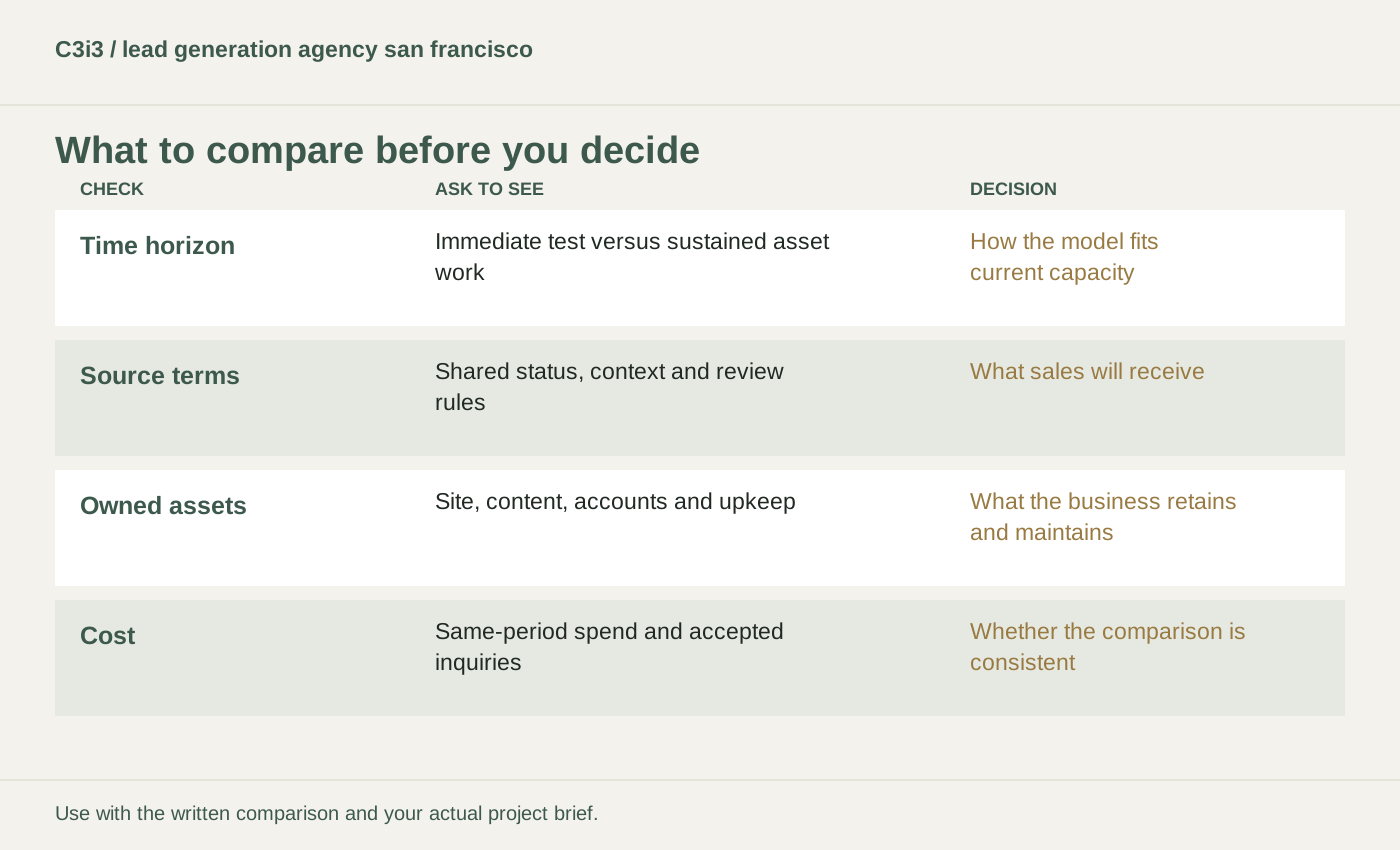
How do the key evaluation criteria compare?
| What to compare | Evidence to request | Decision it supports |
|---|---|---|
| Time horizon | Immediate test versus sustained asset work | How the model fits current capacity |
| Source terms | Shared status, context and review rules | What sales will receive |
| Owned assets | Site, content, accounts and upkeep | What the business retains and maintains |
| Cost | Same-period spend and accepted inquiries | Whether the comparison is consistent |
How could a San Francisco firm test a mixed approach?
Imagine a service firm with room for several additional engagements. It runs a limited external inquiry test while improving a core service page and contact process. Each source receives a separate identifier, and sales reviews all requests against the same fit rules.
After the agreed window, the firm compares accepted inquiries, opportunities and workload rather than declaring a winner from raw volume. The hypothetical $3,000 divided by 15 calculation illustrates one metric; it does not predict what either channel will cost or return for another business.
What should you remember before the next step?
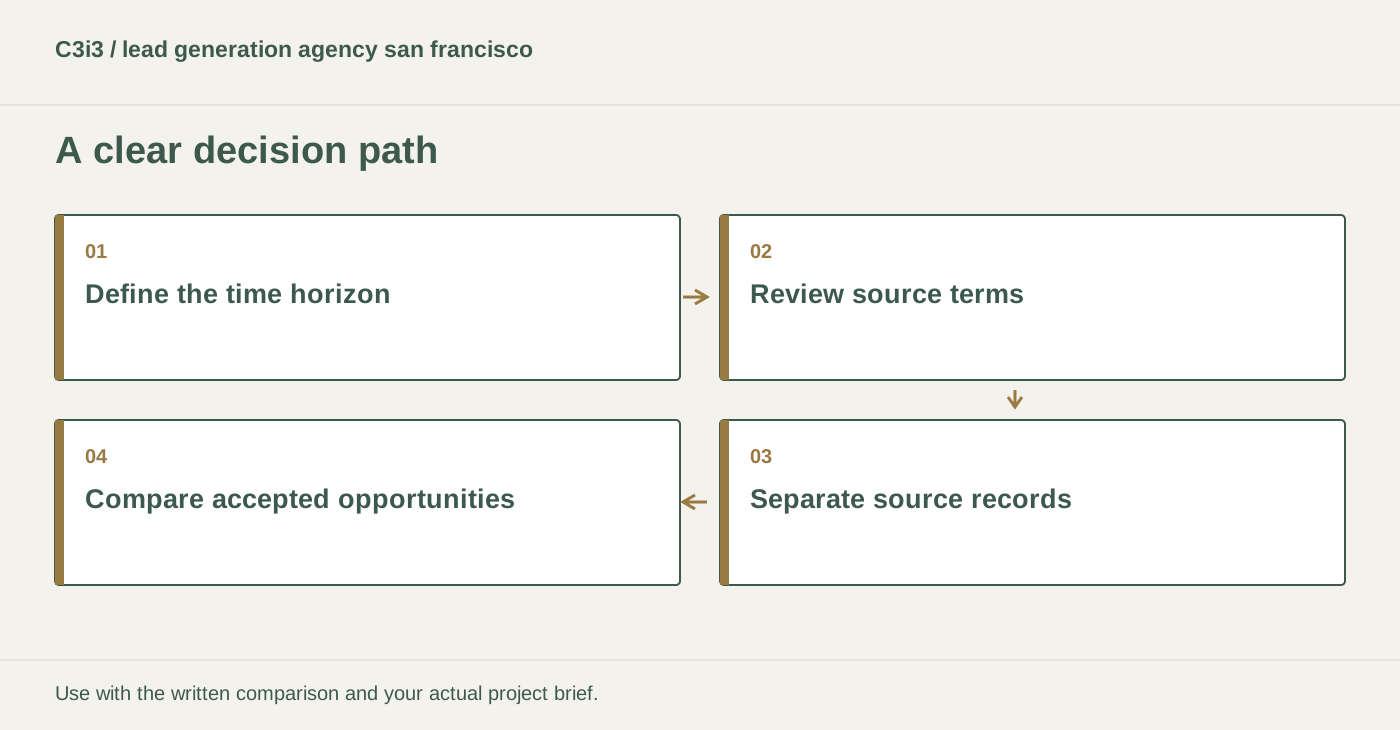
- Define the time horizon.
- Review source terms.
- Separate source records.
- Compare accepted opportunities.
What else do local business buyers ask?
Will owned demand eliminate marketing costs?
No. A website and content still require creation, distribution, maintenance and review.
Are shared leads always unsuitable?
No. Evaluate the source, context, competition, terms and fit for your sales process. A shared model needs clear expectations.
Should I add both channels to one lead total?
You can report a combined total after deduplication, but retain source-level records so quality and costs remain interpretable.
Which sources can help you verify these decisions?
The frameworks and hypothetical examples are C3i3 editorial analysis. The linked primary sources provide platform, usability or disclosure context for the relevant decisions.
How can C3i3 help you plan the right next step?

Share your current website, the customers you want to reach and the work you want to improve. C3i3 brings design, content, technology and marketing into a coordinated project scope.
Review C3i3’s background, explore lead generation or tell us about your project.