






































In this article
You open a job listing and it asks for a writer, editor, strategist, designer and someone who knows the latest AI tools. You open your social feed and someone says you should become a creator instead. Neither tells you who will actually pay for your work.
That tension is a useful place to begin a conversation about the creator economy. The question is not simply whether people can publish content. It is whether they can connect something they know, make or explain with an audience that values it. AI changes the cost and speed of production. It does not remove the need to find that connection.
For a business owner, the same question appears from the other side: if content is easier to generate, what makes one creator, agency or employee worth choosing? The answer needs to be more concrete than a claim of creativity.
What does the creator economy actually pay people to do?
A creator may earn through commissioned work, advertising, memberships, licensed material, affiliate referrals or a product they own. Those are different business arrangements. They involve different customers and different obligations. A brand buying a product demonstration is not buying the same thing as a viewer subscribing to a tutorial library.
Separate the audience from the customer. Your videos might help independent restaurant owners, while a software company wants to sponsor a demonstration for that audience. Alternatively, the restaurant owner may be the customer because you produce the video for their business. Both can be legitimate arrangements. Neither becomes viable just because a video receives attention.
Write a one-sentence offer: I help this person make this decision or complete this task. Then name what the customer receives. A series of usable product videos is a deliverable. More exposure is a hope until you define how it will be measured.
Does AI exposure mean your job is disappearing?
The International Labour Organization distinguishes potential exposure to generative AI from actual job loss. Its 2025 assessment finds substantial exposure across occupations while emphasizing that many jobs combine tasks that still need human input. That is a reason to examine your work in detail, rather than treating an occupational label as a verdict.
Anthropic’s March 2026 labor-market study also separates theoretical capability from observed use. It did not find a systematic unemployment increase among highly exposed workers in the period studied, although it identified tentative evidence of slower hiring for younger workers in exposed occupations. Those findings do not prove that every worker is safe, or that every company is replacing staff.
A useful personal audit is smaller: list the tasks you perform in a week. Mark which can be drafted, which require verification, which depend on customer context and which carry consequences when they go wrong. You can then discuss a changing role using actual work, rather than debating whether an entire profession has disappeared.

Which creative skills remain visible when everyone has the same tools?
A prospective customer can see judgment in the choices you make. Why did you remove that sentence? Why does the demonstration show this angle? What did you ask the customer before proposing a campaign? An attractive final image is useful, but the reasoning behind it can reveal whether you understand the assignment.
Build examples that show the original problem, the decisions and the finished work. If you are starting without clients, label a self-directed project as a concept. Do not invent a customer, campaign result or testimonial. A clear hypothetical brief is more credible than a fabricated success story.
Domain knowledge matters because it changes what you notice. Someone who understands industrial equipment can catch a misleading product demonstration. Someone who knows a creator’s audience can identify an awkward brand fit. AI literacy can support both. It does not automatically give someone the product knowledge, relationships or accountability behind those decisions.
Do you need a huge following to start doing useful work?
An audience business and a service business do not start in exactly the same way. A publisher depends on attracting and retaining readers or viewers. A service provider can begin with a defined deliverable for a specific customer. A creator may operate both, but confusing them makes it difficult to know what to improve.
If your audience is small, show whether your work is relevant and usable. A careful demonstration of a complex product may be more informative to a particular buyer than a broad lifestyle post. That is a statement about fit, not a promise that small accounts always perform better.
Before accepting a commission, agree on the brief, revisions, usage rights, delivery formats and approval responsibilities. Before recommending an affiliate product, understand the program and the disclosure requirements. Followers do not replace those basics. Having fewer followers does not remove those obligations either.
How can you explore a creator career without betting everything on it?
Choose a bounded experiment that you can complete alongside your existing responsibilities. For example, explain one recurring customer question in a short video, an illustrated guide and a practical worksheet. This tests whether you can translate the same expertise into different useful formats. It does not require declaring yourself a full-time publisher.
Ask a small number of people in the intended audience to evaluate the work. Did it answer a real question? What remained unclear? Would they use the worksheet? Feedback about usefulness is different from a friend saying the design looks nice. Keep the original feedback so your next version addresses something specific.
Track the evidence without inventing momentum. Completion, repeat questions, relevant enquiries and requests for a defined service can inform the next step. Likes may be interesting, but they do not establish a dependable business. Do not make an employment decision on the assumption that an affiliate link or a new social account will produce income.
What should brands look for when hiring creators in an AI-heavy market?
Ask for examples that show subject understanding, not merely familiarity with a tool. A creator who can explain an audience, identify an unsupported claim and deliver an organized handover is easier to evaluate than someone who only promises a volume of content. Check whether the person can distinguish a generated illustration from evidence of a real product or event.
A good brief also makes the buyer’s responsibility visible. Provide accurate product information, clarify approval authority and identify restrictions before production begins. If the company cannot explain what is true about its product, a creator should not be expected to guess.
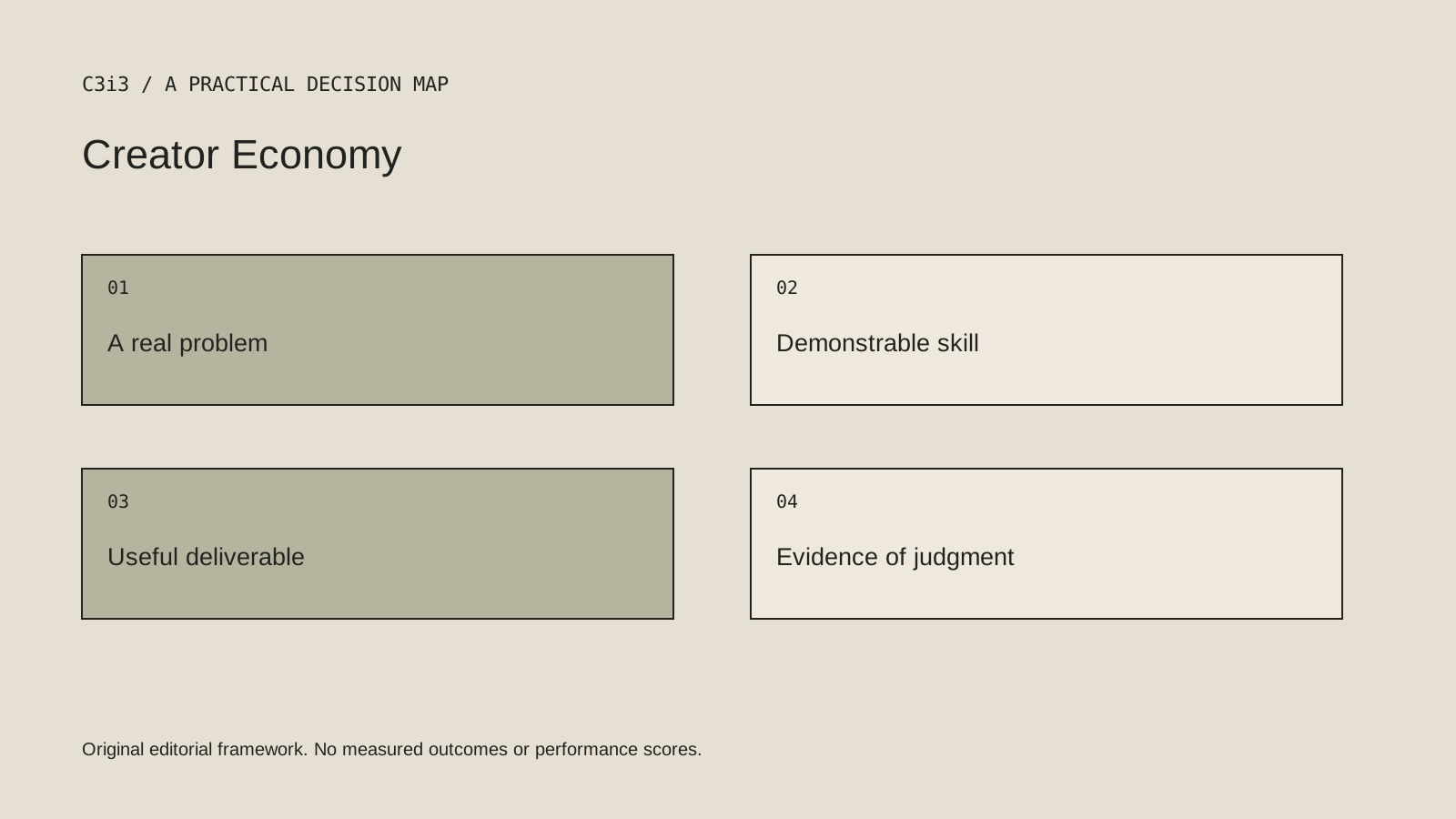
The constructive response to anxiety about AI is not to pretend that work will stay the same. It is to make the value of the work more explicit. For creators, that means a skill, a useful deliverable and evidence of judgment. For employers and brands, it means evaluating the contribution that remains after generating a first draft becomes easier.
Put the decision into practice
- Define one audience and one problem you understand.
- Separate a service offer from an audience-based publishing business.
- Label concept projects and AI-generated illustrations honestly.
- Show the decisions behind a finished example.
- Test usefulness before making a major career commitment.
Sources and editorial method
Reviewed November 6, 2026. Linked announcements retain their original dates. Product documentation establishes described capabilities; it does not establish that a subject is currently a search breakout. Examples and decision frameworks are editorial analysis.
Questions readers ask
Is becoming a creator a reliable replacement for a job?
No. It involves demand, customer acquisition, delivery and uncertainty. You can investigate it through a bounded project without assuming it will replace employment income.
Should creators avoid AI to stand out?
The important question is whether the work is useful, accurate and responsibly produced. Explain how tools supported the process where that information matters, and keep responsibility for the result.
Can a business owner participate without becoming an influencer?
Yes. Publishing practical expertise can support an existing service business. A useful demonstration or guide does not require presenting yourself as a lifestyle personality.
How C3i3 can help
C3i3 helps businesses turn a clear customer question into useful content, a coherent digital experience and a manageable production process. Bring the product, page or workflow you are reviewing so we can discuss the work it needs.