






































In this article
A business owner can describe an idea and receive a website draft quickly. That changes an important part of web production: it can make a starting point easier to obtain. It also makes the remaining work easier to overlook.
The business still needs to know whether the content is accurate, whether the enquiry reaches the right person and whether someone can maintain the site after launch. Those are the questions to use when deciding what a designer or development team should contribute.
What has become easier to create?
Website builders can help produce layouts and draft content. That can be useful for exploring an idea or starting a simpler site. The resulting design still needs to be evaluated against a real business and its intended customers.
Check the assumptions in the draft. Has the system invented services, testimonials, locations or promises? Has it used a generic page structure where the business needs a different buying journey? An attractive first version is material to review, not evidence that those decisions were correct.
What is the designer responsible for now?
A useful designer can help determine what the page needs to accomplish, which information belongs first and how a buyer reaches the next step. The work includes judgment about hierarchy, content, interactions and the limitations of the chosen platform.
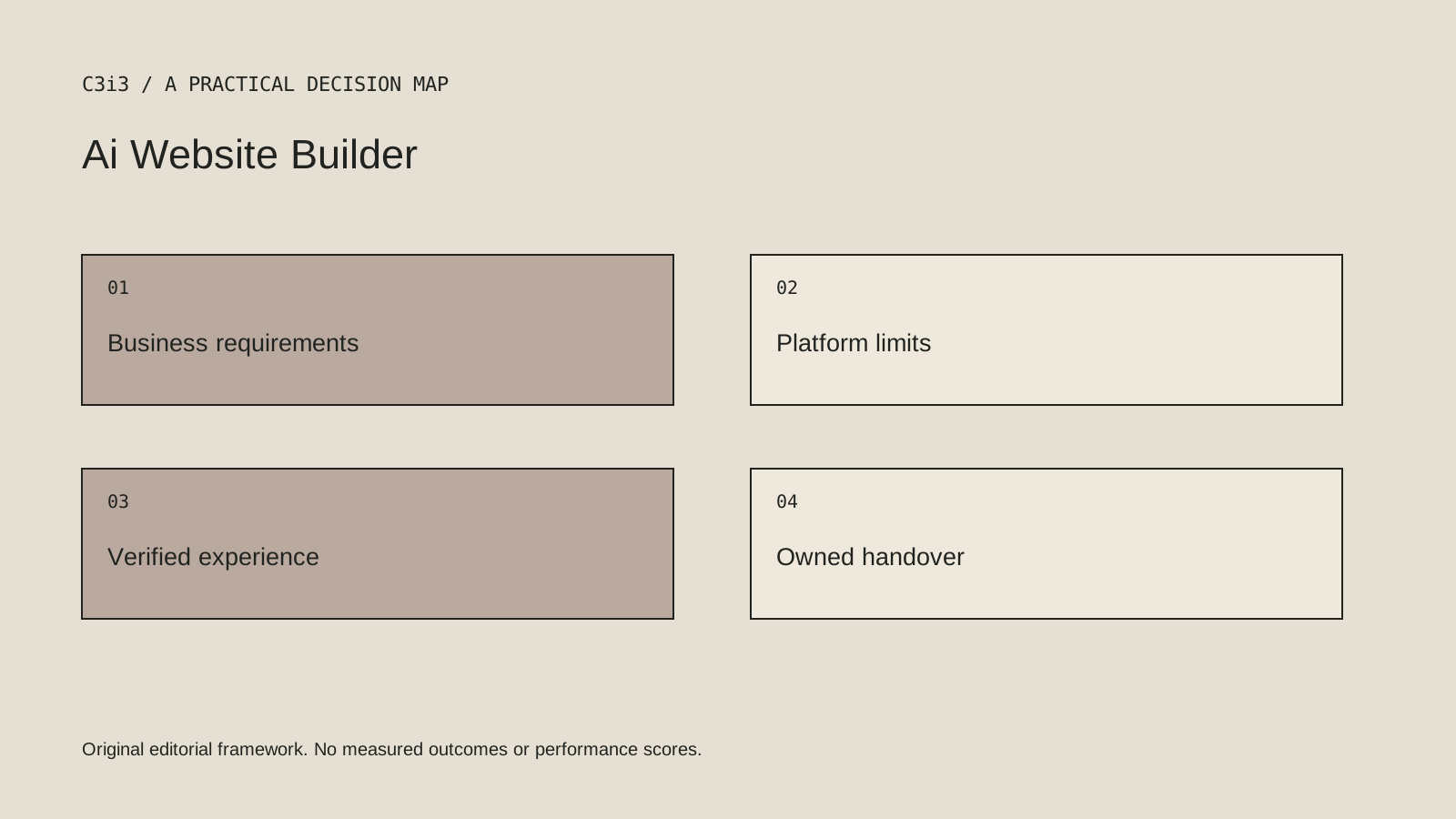
Ask for decisions you can evaluate. Why does this form ask these questions? Which pages should be separate? What happens when a product is unavailable? These conversations reveal more about the service than a comparison of how quickly two tools generate a homepage.

Who owns and controls the finished website?
Separate ownership of content from portability of the complete system. A platform may let you own your material while keeping hosting or certain functionality within its environment. Webflow’s export guidance, for example, distinguishes exported code from hosted CMS, ecommerce and form functions.
Ask about domains, accounts, source files, content export, integrations and handover. Write down what can move, what must be rebuilt and who can access each part. Ownership is more useful when it is described operationally.
What should be tested before launch?
Test forms, navigation, mobile layouts, readable content and important integrations. Check indexing instructions, titles and the information that appears when a page is shared. Verify the actual destination of enquiries rather than assuming a success message proves delivery.
Include accessibility and performance in the review. A generated page is not automatically unusable, but neither is it automatically ready. Test the implementation that will be published, with realistic content and an appropriate range of devices.
How should a business choose between doing it internally and hiring help?
Match the arrangement to the complexity, the team’s skills and the consequences of failure. A limited informational page and a customer portal have different requirements. Keep those differences visible when comparing proposals or tools.
If you hire help, define the contribution beyond initial assembly: content decisions, integrations, verification, training and maintenance. If you build internally, assign those same responsibilities. The tools can change; the business still needs someone accountable for a working site.
Put the decision into practice
- Check generated content for invented business facts.
- Evaluate the customer journey beyond the homepage.
- Separate ownership from platform portability.
- Test actual form delivery and integrations.
- Assign maintenance and account responsibilities.
Sources and editorial method
Reviewed November 6, 2026. Linked announcements retain their original dates. Product documentation establishes described capabilities; it does not establish that a subject is currently a search breakout. Examples and decision frameworks are editorial analysis.
Questions readers ask
Can an AI website builder be appropriate for a business?
Yes, depending on the requirements and implementation. Evaluate the actual site, platform constraints and maintenance arrangement.
Does owning the content mean the whole site can move anywhere?
Not necessarily. Hosting-dependent functionality, databases and integrations can have separate portability limits.
How C3i3 can help
C3i3 helps businesses turn a clear customer question into useful content, a coherent digital experience and a manageable production process. Bring the product, page or workflow you are reviewing so we can discuss the work it needs.