






































In this article
The headline says AI is replacing jobs. The person reading it has a more specific concern: will someone still need the work I do next month? That deserves a better answer than either a promise that everything is fine or a prediction that everyone will be replaced.
For creative and marketing teams, the pressure is visible in everyday assignments. A first draft can be generated quickly. A rough visual can appear before a designer joins a meeting. An employer may expect one person to handle tasks that previously crossed several roles. Those changes matter, but they are not identical to measured job losses across an industry.
What does the research measure when it says a job is exposed?
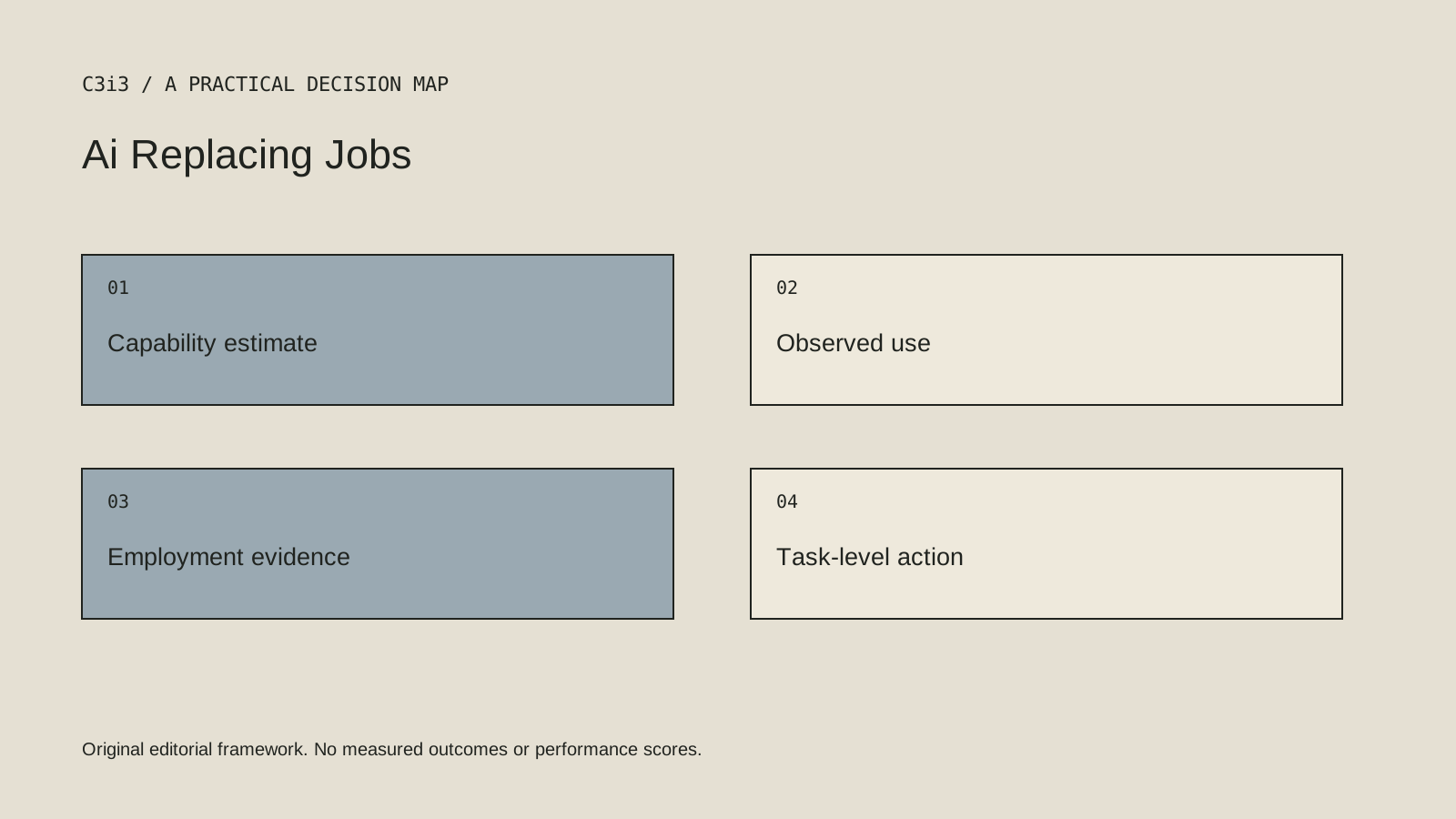
Exposure estimates ask how much of an occupation’s work a technology could affect. They do not count dismissal notices. The ILO’s refined occupational index evaluates tasks and explicitly warns against treating exposure as an estimate of jobs eliminated. A role can include highly exposed drafting tasks alongside coordination, physical work or decisions that are harder to delegate.
That distinction matters to both employees and owners. A company deciding whether to reorganize a team needs to know what remains after a task is automated. An employee deciding what to learn needs to identify a specific gap. The label exposed gives neither person a complete operating plan.
When you see a dramatic percentage, look for the denominator. Is it a share of tasks, occupations, workers, survey respondents or actual payroll positions? A percentage without that explanation can sound much more conclusive than the study behind it.
What do we know about actual employment effects?
Anthropic’s March 2026 study reports no systematic increase in unemployment for highly exposed workers over its study period, alongside tentative evidence of slower hiring among younger workers in exposed occupations. This is an early finding from a particular measurement approach, not proof that displacement cannot happen.
The World Economic Forum’s Future of Jobs report is useful for a different question: what surveyed employers expect to change. Its forecasts should be described as expectations, rather than a census of jobs already created or eliminated. You can learn from a forecast without presenting it as an accomplished fact.
Read dates and methods before repeating a conclusion. A company announcement about one department, an employer survey and a labor-market study each reveal something different. Combining them into one confident claim can conceal the uncertainty that a reader needs to make a decision.

How should a creative worker audit their role?
Take an actual recent assignment and break it into steps: receiving the brief, researching, drafting, checking, revising, obtaining approval and delivering the files. Note where a tool can help and where a mistake would affect a customer. This shows what your role contributes beyond producing the first visible output.
Keep examples of decisions that improved the assignment. Perhaps you identified that a product claim lacked support, noticed that the proposed page did not answer the buyer’s question or prevented a video from using material without suitable permission. Describe the decision and the evidence. Do not turn a private project into a public portfolio without permission.
Choose learning that connects to this map. Training in an editing tool is more useful when you can explain which bottleneck it addresses. Learning every newly announced platform is not a substitute for improving how you interpret a brief and deliver a dependable result.
What should an owner measure before replacing a workflow?
A faster draft does not prove a better total process. Compare the time required for briefing, review, corrections, approval and maintenance. Include the person who must verify the output. If that responsibility simply moves to an already overloaded manager, the new arrangement may have transferred work rather than removed it.
Use a controlled trial with a clear owner and a reversible scope. A draft social caption is different from an unsupervised reply that commits the business to a customer. Decide which actions require approval before connecting automation to public channels or client records.
Discuss expectations with the people doing the work. They can often identify exceptions that a demonstration misses. Their knowledge of a customer, an old system or an approval rule is part of the workflow. Treating it as incidental makes it difficult to understand what the trial actually changed.
What is a practical next step when the uncertainty feels overwhelming?
Build one small piece of evidence. An employee can document a task they improved while retaining an appropriate review step. A freelancer can produce a clearly labeled concept that demonstrates subject knowledge. An owner can map one repetitive process and measure the complete workload before and after a trial.
Keep the claim proportional. A successful experiment shows that one arrangement worked under certain conditions. It does not prove that an entire department can be eliminated or that a new creative career will be dependable. Revisit the evidence as the work and tools change.
The useful conversation is about what people do, what businesses need and who remains accountable. Fear may bring a reader to the subject. Careful distinctions and a concrete next action are what make the article worth reading.
Put the decision into practice
- Identify whether a claim describes exposure, forecasts or actual employment outcomes.
- Check the study date, population and method.
- Map one real assignment into tasks and decisions.
- Include review and correction work in an automation trial.
- Keep public promises and consequential actions under an identified person’s control.
Sources and editorial method
Reviewed November 6, 2026. Linked announcements retain their original dates. Product documentation establishes described capabilities; it does not establish that a subject is currently a search breakout. Examples and decision frameworks are editorial analysis.
Questions readers ask
Does an AI exposure score predict that I will lose my job?
No. It describes potential effects on tasks or occupations under a study’s method. It is not an individual prediction or a count of dismissals.
Can an AI tool help a team without replacing its members?
Yes. Some uses assist people with parts of their work. Whether a particular arrangement changes staffing depends on the organization, demand, implementation and decisions beyond the tool itself.
Should a business automate every task that is technically possible?
Technical capability alone is insufficient. Evaluate accuracy, accountability, customer consequences and the complete workload, including review and correction.
How C3i3 can help
C3i3 helps businesses turn a clear customer question into useful content, a coherent digital experience and a manageable production process. Bring the product, page or workflow you are reviewing so we can discuss the work it needs.