






































In this article
Your technician knows the question customers ask before an installation. Your support specialist knows the instruction people misunderstand. Your designer knows why a small interface change matters. Those details can be difficult to recover from a generic content brief.
Employee generated content starts with that existing knowledge. It should not start by ordering everyone to become an influencer or treating a personal account as company property.
Why is first-hand knowledge useful here?
An employee can identify what actually happens in a process, including the exception the brochure omits. That creates material for a useful explanation, provided the information is accurate and suitable to share.
Ask for a specific example of a question or misunderstanding rather than a broad request for thought leadership. An explanation of why a product needs a particular connection is easier to evaluate than a general statement that the company is innovative.
Does everyone need to appear in a video?
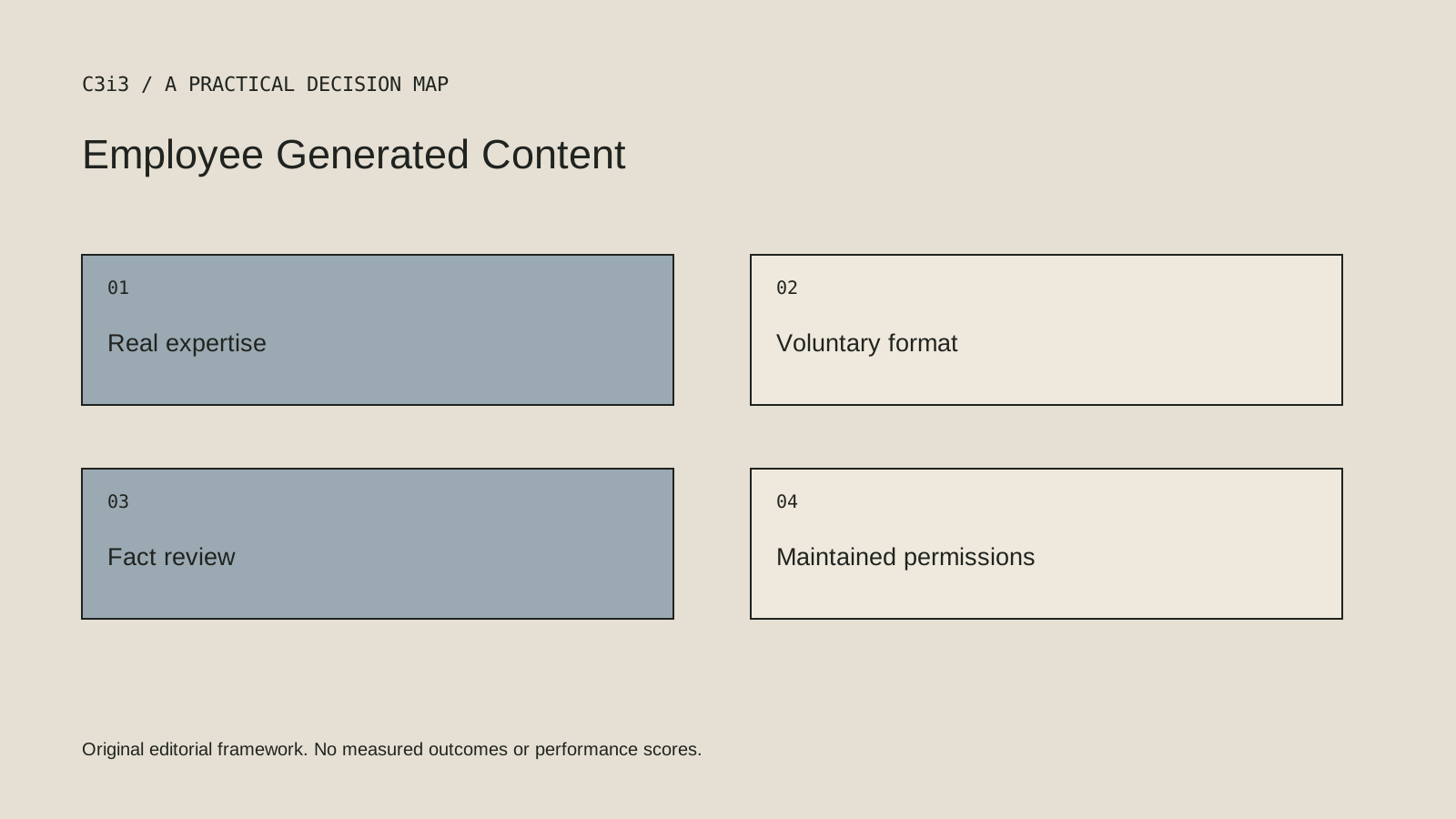
No. A person can contribute a diagram, an annotated screenshot, a written explanation or an audio note that a producer turns into an approved article. The relevant asset is their knowledge, not necessarily their face.
Give people a genuine choice about public identification and presentation. A capable employee may have no interest in building a personal audience. The content process should not make that preference look like a lack of commitment.

What boundaries should the business set?
Explain what may be shared, who reviews technical claims and what requires customer permission. Keep confidential information, private customer details and unsupported statements out of public examples. Use a labeled hypothetical where the real case cannot be shared.
Clarify the relationship when an employee recommends the company or its products. The FTC identifies employment as a connection that can matter to an audience. A personal presentation style does not make the commercial relationship disappear.
How do you make participation manageable?
Fit the contribution into the person’s actual workload. A short recorded explanation reviewed by an editor may be more realistic than asking the expert to plan, record, edit and distribute a complete campaign alone.
Keep a simple handoff: subject, intended reader, key facts, restrictions and reviewer. Make corrections easy. If contributing to the program creates repeated unpaid coordination or unclear expectations, the workflow needs attention before the content schedule expands.
What happens when someone changes roles or leaves?
Agree in advance on the ownership and permitted use of recordings, finished content and company accounts. Decide how material will be reviewed when an employee is no longer the appropriate contact or a process changes.
Avoid building the entire program around one person’s personal login. The durable value lies in a responsible knowledge process. That process should remain understandable to the employee, the audience and the next person managing publication.
Put the decision into practice
- Invite a specific piece of subject knowledge.
- Provide alternatives to appearing on camera.
- Make participation and permissions clear.
- Review factual and confidentiality concerns.
- Plan ownership and updates after role changes.
Sources and editorial method
Reviewed November 6, 2026. Linked announcements retain their original dates. Product documentation establishes described capabilities; it does not establish that a subject is currently a search breakout. Examples and decision frameworks are editorial analysis.
Questions readers ask
Should every employee post company content on a personal account?
No. Separate company publishing responsibilities from personal participation and agree on expectations without assuming access to someone’s private audience.
Should we use older employee-advocacy platform instructions?
Check current documentation. Platform features and account tools change, so an old tutorial may describe a workflow that no longer exists.
How C3i3 can help
C3i3 helps businesses turn a clear customer question into useful content, a coherent digital experience and a manageable production process. Bring the product, page or workflow you are reviewing so we can discuss the work it needs.