








































In this article
A San Jose technical website can stall when the project brief lists features without explaining the information those features must handle. Product families, application boundaries, document versions and RFQ requirements shape both the design and the implementation. A strong brief lets agencies propose a workable system instead of guessing from a page count.
Planning a project? Explore San Jose web design and marketing support and web design services.
How do I find a San Jose web design agency that understands technical content?
Ask candidates to explain one complex offering in their own words after reviewing approved material. They do not need to become your engineers, but they should recognize which facts require expert confirmation and which customer questions the current site leaves unanswered.
Look for a process that makes expert review manageable. A technical website often requires input from product, sales, IT and engineering. The agency should identify those responsibilities early and show how unresolved claims are tracked, rather than assuming one marketing contact can approve every detail.
What should the website brief say about the buying team?
Describe who researches, evaluates, approves and uses the offer. An engineer may need operating conditions, procurement may need supply information and a business sponsor may need a clear application explanation. These needs can share a coherent page structure without forcing every visitor through identical content.
Add the decision each audience must reach before contacting your team. This helps distinguish a technical reference page from a commercial capability page. It also gives the designer a reason for the hierarchy instead of treating every PDF, testimonial and product image as equally important.
Which sample content should I give a web design company?
Provide one typical example and one difficult example for each important page type. Include approved product or service facts, document names, image conditions and the way variants are distinguished. Remove confidential material that is unnecessary for the evaluation.
The difficult example is valuable because it exposes assumptions. A layout that works for a short title may fail for a long part number. A product card may not explain whether several downloads apply to the same version. Asking the agency to address those conditions improves the estimate and the design review.
For the connected decision, read San Jose Manufacturing Website Design: What Should You Plan Before a Redesign?.
How should the brief describe integrations and product data?
List the systems involved and what information each owns. Identify whether the website receives a feed, uses manual updates or sends inquiries to another system. Note known restrictions, update frequency requirements and the person who can confirm the technical details.
Ask agencies to state which integrations are included, what must be investigated and what sample data they need. Do not accept an unqualified promise that everything will sync. The brief should make room for a discovery task when the current system’s behavior has not yet been verified.
What should a San Jose B2B website prototype prove?
Test a buyer locating an application, finding the correct technical evidence and submitting a meaningful inquiry. Include a case where the product is unsuitable so the prototype must explain a boundary rather than encourage every visitor to request a quote.
Also test a staff member updating an important fact or replacing a document. The business needs to maintain the system after launch. A prototype review should capture both the customer journey and the editorial workflow, with defects recorded against agreed requirements.
How do I turn the technical brief into comparable proposals?
Ask candidates to respond to the same page types, sample content and acceptance tasks. Require assumptions, exclusions and dependencies on your team. If one proposal uses a custom integration and another begins with manual updates, compare the operational trade-off rather than assuming the more automated option is always better.
At C3i3, this planning can connect technical writing, original web design and a clearer inquiry process. Start with the information problem and the customer decision. The appropriate build follows the brief, including any existing pages that can be retained and improved.
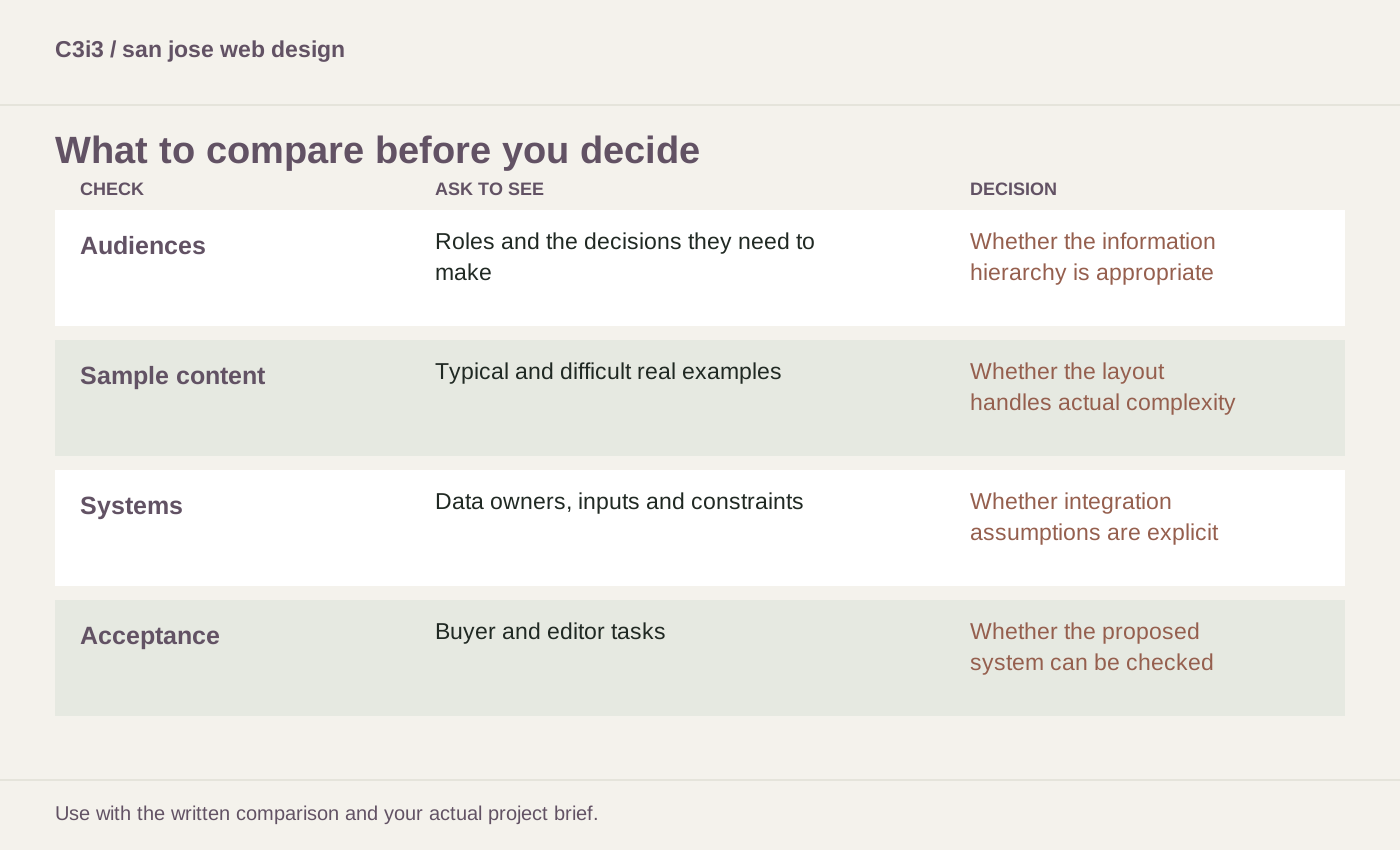
How do the key evaluation criteria compare?
| What to compare | Evidence to request | Decision it supports |
|---|---|---|
| Audiences | Roles and the decisions they need to make | Whether the information hierarchy is appropriate |
| Sample content | Typical and difficult real examples | Whether the layout handles actual complexity |
| Systems | Data owners, inputs and constraints | Whether integration assumptions are explicit |
| Acceptance | Buyer and editor tasks | Whether the proposed system can be checked |
How could a San Jose component supplier improve its brief?
Imagine a supplier planning a product-family redesign. Its first brief requests a catalog and an RFQ form. It then adds a sample with several variants, a document that applies to only one revision and an inquiry that needs application conditions before engineering can respond.
Those examples change the proposal discussion. Agencies can explain data modeling, document handling and the customer journey in concrete terms. The supplier can compare what each quote includes and decide which unknowns need discovery. This hypothetical example demonstrates a briefing method, not a claim about a specific supplier’s systems.
What should you remember before the next step?
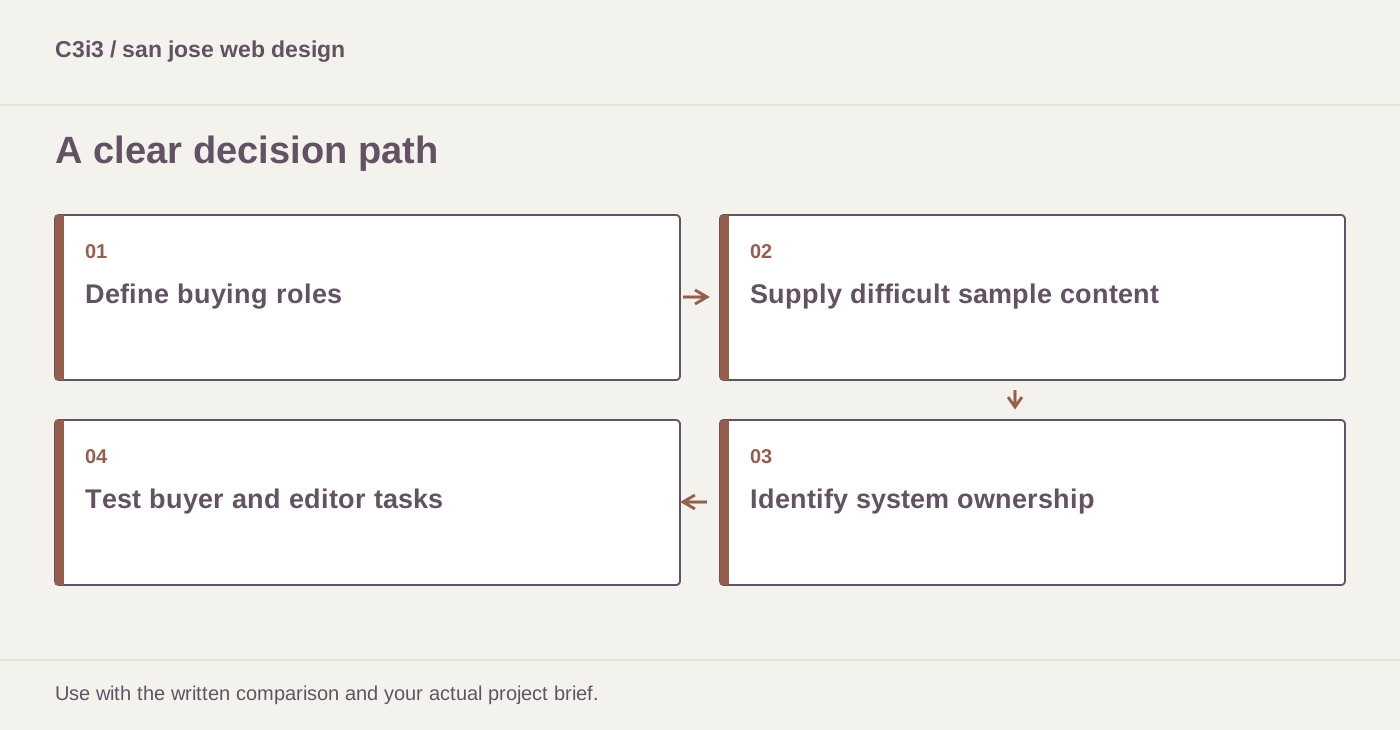
- Define buying roles.
- Supply difficult sample content.
- Identify system ownership.
- Test buyer and editor tasks.
What else do local business buyers ask?
Should the agency decide our technical claims?
It can help organize and explain them, but responsible specialists should approve product facts, performance statements and limitations.
Do we need a custom product database?
Not automatically. Compare actual content, update needs and integrations before selecting a technical approach.
Can we start before all product data is ready?
A bounded planning phase can identify gaps. Agree which production work depends on approved data and avoid treating incomplete inputs as launch-ready.
Which sources can help you verify these decisions?
The frameworks and hypothetical examples are C3i3 editorial analysis. The linked primary sources provide platform, usability or disclosure context for the relevant decisions.
How can C3i3 help you plan the right next step?

Share your current website, the customers you want to reach and the work you want to improve. C3i3 brings design, content, technology and marketing into a coordinated project scope.
Review C3i3’s background, explore web design or tell us about your project.