









































In this article
Website redesign costs are difficult to compare when proposals make different assumptions about content, integrations and launch work. A Bay Area business may receive a low page-build quote beside a wider strategy and production engagement. Before deciding which is better value, establish whether the providers are pricing the same job.
Planning a project? Explore Bay Area web design and marketing support and web design services.
What determines the cost of a Bay Area website redesign?
Important drivers include the variety of page types, the condition of existing content, original design, development and the systems the site must connect with. Ten pages using two well-defined templates can require different work from ten pages with distinct interactions and approval paths.
Content readiness also changes the effort. Existing copy may need a light edit, a complete rewrite or technical fact checking. Images may be usable, require original production or need product-data cleanup. Ask providers to price those responsibilities explicitly rather than leaving them inside a vague content allowance.
How do I find the best web design company near me for my budget?
Define a necessary first release and the activities that can wait. Share the same requirements and budget context with shortlisted providers. A good conversation should explain which trade-offs preserve the most important customer tasks and which reductions would create operational problems.
Compare value against your business’s ability to use the result. A site with features your team cannot maintain may create continuing expense. A smaller release with clear editing and a reliable inquiry path can be a reasonable starting point when it addresses the priority need.
Which costs should be included in the initial quote?
Ask about planning, page design, writing, development, content entry, testing, redirects and launch support. Record the quantities or boundaries that matter: page templates, product imports, review rounds and integrations. Ask what happens when an assumption changes.
Compare the same scope across providers before comparing totals. If a quote excludes a task your project requires, obtain an estimate or define who will perform it internally. A clear exclusion can be managed; an assumed inclusion usually becomes a disagreement later.
For the connected decision, read Website Redesign: 5 Things to Fix Before Rebuilding Your Site.
What recurring costs should I understand before choosing a designer?
List hosting, platform subscriptions, paid apps, licensing, maintenance and ongoing content or marketing support. Confirm who owns each subscription and how the business can continue operating if the relationship changes. Recurring costs should be visible in the same comparison period.
Also budget for internal work such as approvals and product updates. A platform that is inexpensive to host may still require specialist support for routine changes. Ask a staff member to test the expected editing tasks before assuming that maintenance will be effortless.
How can I compare change requests without losing control of the budget?
Agree how requests are classified, estimated and approved. A correction to accepted scope is different from a new feature. The change record should name the business reason, affected work, timing and fee effect, with an approval owner.
Use the first-release brief to evaluate additions. A request may be attractive without being necessary for launch. Deferring it can protect the agreed customer journey and give the team time to learn from the initial release before committing to more complexity.
What should the redesign budget review decide?
The review should confirm what will be delivered, who supplies the inputs and what evidence supports acceptance. Compare the total commitment and the important uncertainties. If a significant integration is unverified, a discovery phase may be a better procurement step than pretending it can be fixed-price accurately.
C3i3 can help turn the current website and business priorities into that scope. Discuss what is working as well as what needs improvement. The appropriate budget may support a focused upgrade, a staged redesign or a fuller build depending on the evidence.
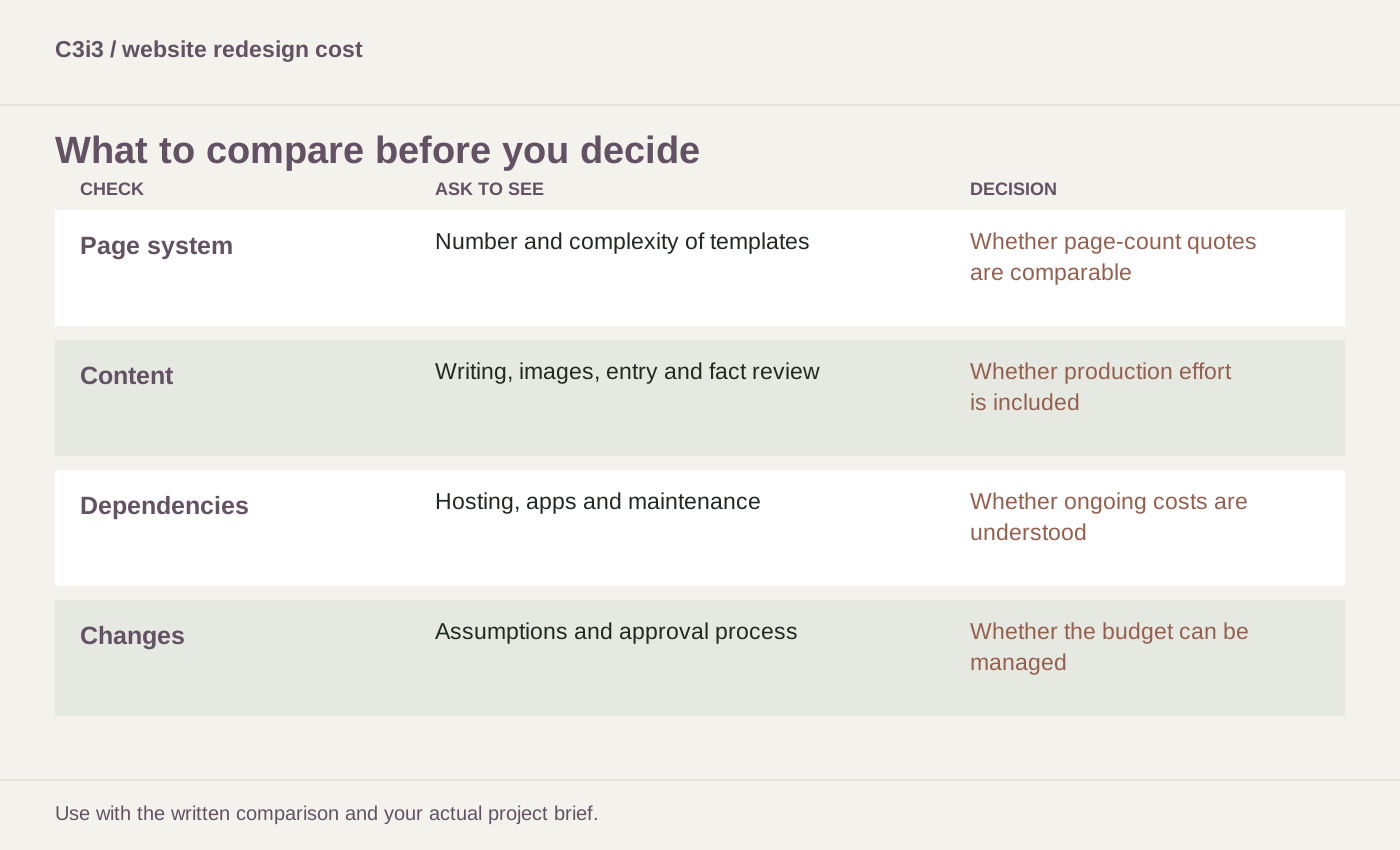
How do the key evaluation criteria compare?
| What to compare | Evidence to request | Decision it supports |
|---|---|---|
| Page system | Number and complexity of templates | Whether page-count quotes are comparable |
| Content | Writing, images, entry and fact review | Whether production effort is included |
| Dependencies | Hosting, apps and maintenance | Whether ongoing costs are understood |
| Changes | Assumptions and approval process | Whether the budget can be managed |
How could a business compare two redesign quotes?
In a hypothetical comparison, one quote includes page layouts and development while the business supplies approved copy and enters all content. Another includes interviews, writing and content entry. The second total is higher, but the first requires substantial internal time.
The buyer records both delivery fees and expected staff responsibilities. It can then ask for a reduced first release or choose the model its team can support. This is a scope comparison, not a market-price survey or a claim that one fee level guarantees better results.
What should you remember before the next step?
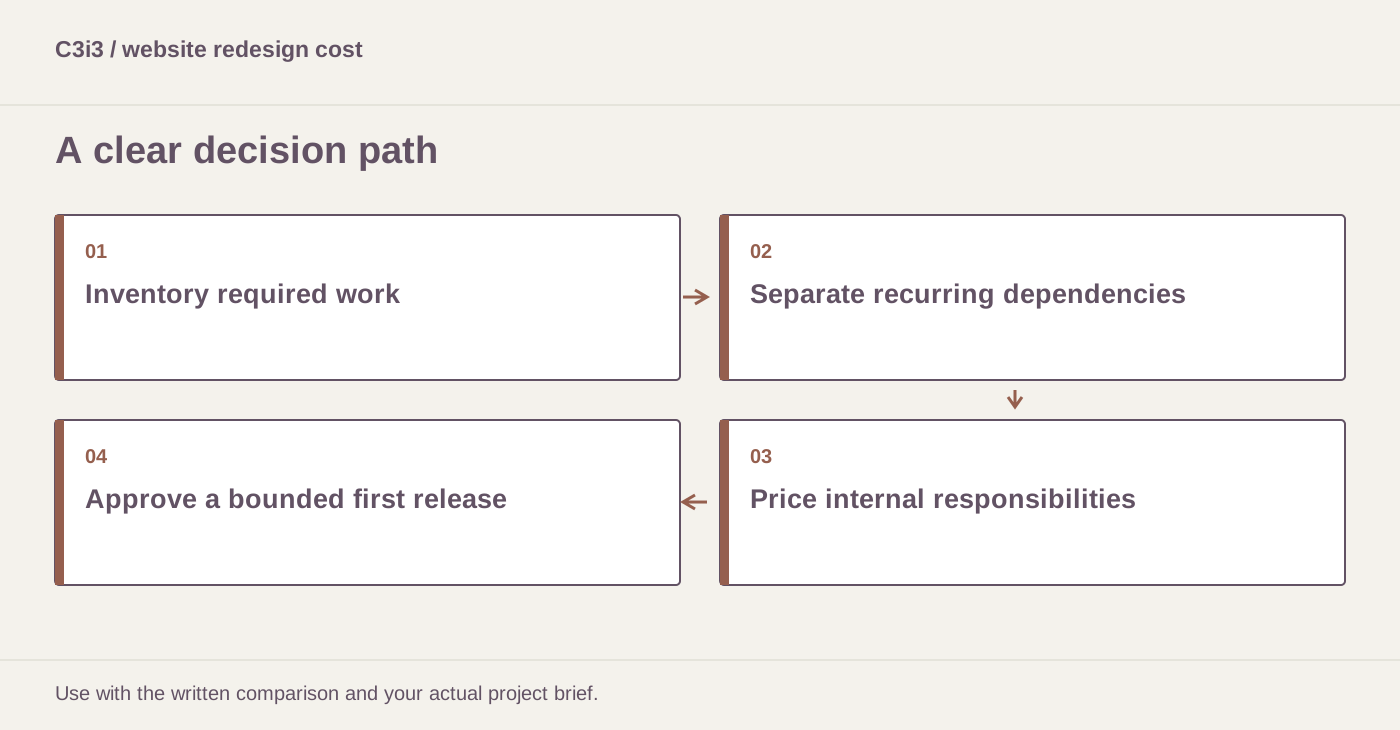
- Inventory required work.
- Separate recurring dependencies.
- Price internal responsibilities.
- Approve a bounded first release.
What else do local business buyers ask?
Can you give a reliable redesign price from page count alone?
Usually not. Page types, content readiness, integrations and acceptance requirements materially affect the scope.
Is a custom design always necessary?
No. Compare the experience and maintenance requirements with the available approaches. The proposal should explain what is original and what uses an existing system.
Should maintenance be bundled with the redesign?
It can be convenient, but its responsibilities, fees and term should remain clear. Compare what happens after launch and if the provider changes.
Which sources can help you verify these decisions?
The frameworks and hypothetical examples are C3i3 editorial analysis. The linked primary sources provide platform, usability or disclosure context for the relevant decisions.
How can C3i3 help you plan the right next step?

Share your current website, the customers you want to reach and the work you want to improve. C3i3 brings design, content, technology and marketing into a coordinated project scope.
Review C3i3’s background, explore web design or tell us about your project.