



































In this article
Plan a manufacturing website redesign around product discovery, application pages, technical resources and RFQ handoff. A San Jose strategy checklist.
What should a manufacturer resolve before reviewing website designs?
Begin with the buyer tasks and information problems the redesign should address. A visitor may need to find a product family, understand an application, download a current document or ask a technical question. List those tasks before selecting a visual reference. A modern appearance does not automatically make a catalog easier to evaluate.
Ask sales, product and support teams which questions are difficult to answer through the current site. Identify whether the problem is missing information, confusing structure, outdated material or a weak contact path. Each suggests a different design and content requirement.
The Bay Area manufacturing strategy pillar connects those choices to market priorities. This guide focuses on redesign planning, with San Jose as a local context rather than an invented claim about the manufacturer’s offices, customer base or delivery territory.
How should product families and applications be organized?
Create a map of the current product structure and the applications the business can discuss accurately. Keep a product family distinct from an application, industry or internal department. The navigation should help the buyer understand those relationships without requiring knowledge of the company’s organization chart.
Decide which paths need separate pages. A product-family page can introduce the category and help someone narrow the selection. An application page can explain the relevant problem and link to approved product information. Avoid generating an application page simply because a product could be mentioned there without adding useful context.
Use a shared source for facts repeated across pages. Product names, variants and current documents should not drift as several teams edit different sections. The industrial product-line strategy guide explains similar ownership questions for organizations with multiple brands and categories.
Which page types should a manufacturing redesign include?
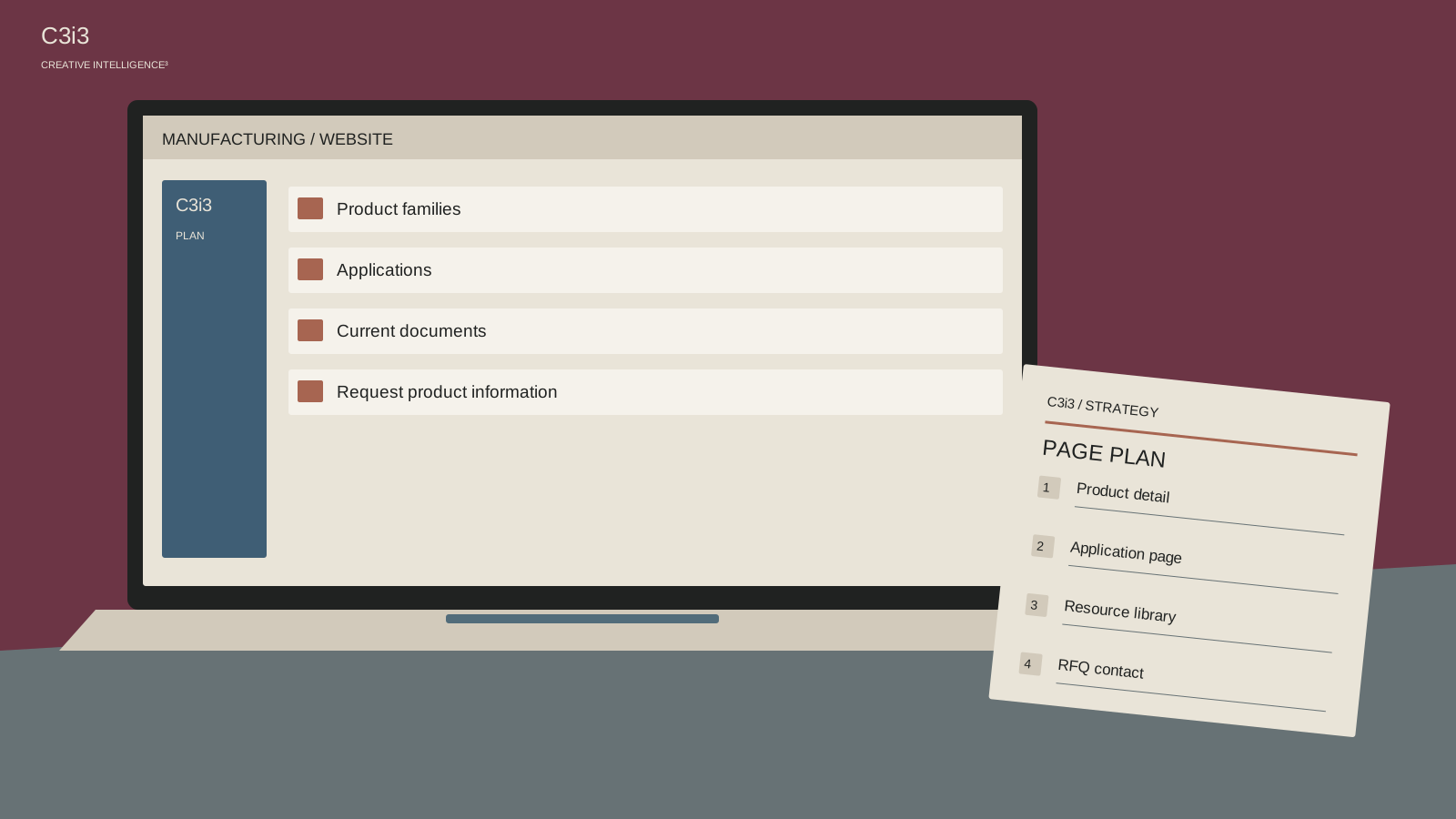
Choose page types by function, then define the information each one needs. A generic page template can support consistent design, but a product detail and an application explanation should not be forced to carry identical content. The distinction should be visible in the outline and the content model.
| Page type | Buyer task | Content responsibility |
|---|---|---|
| Product family | Understand and narrow a category | Product and marketing owners |
| Product detail | Evaluate a specific item or variant | Verified product source owner |
| Application page | Understand relevance and conditions | Application expert and editor |
| Technical resource | Find current supporting information | Document owner |
| Inquiry page | Request the appropriate next conversation | Sales or technical response owner |
This plan is illustrative. Add only the page types the business can populate and maintain. A resource center with outdated files or many empty categories can be less helpful than a smaller, well-organized collection with clear ownership.
How do you plan specifications, downloads and product variants?
Inventory current documents and identify which product or version each covers. Confirm which source is authoritative when files conflict. Keep the version and applicability understandable so a buyer does not download a document for a similar-looking but different product.
Decide what should be visible in the page and what belongs in a detailed document. A concise explanation can guide evaluation, while a download provides the approved detail. Do not retype technical values into several unrelated pages without a plan for updating them consistently.
Have product specialists review tables, units, diagrams and labels as well as prose. A correct paragraph can sit beside an incorrect visual or a mismatched document link. Our technical writing guide provides a source-and-review approach that can support the redesign’s content work.
When are product filters or selectors worth building?
Use a selector when the business has reliable attributes, meaningful decision criteria and a plan to maintain the data. A filter is only useful if its categories and results help the intended buyer. Do not build an elaborate interface around inconsistent source records or assume the system can establish technical compatibility from a few marketing fields.
Ask what the visitor can conclude from the result. A narrowed list of products is different from a recommendation that a product is suitable for a particular application. Keep that boundary clear and provide an appropriate route to technical review where needed.
Test the proposed taxonomy with actual tasks before implementation. A product specialist may navigate confidently using internal codes, while a new evaluator may begin with an application term. The design should support the relevant starting points without making unsupported promises about what the selector verifies.
What should the RFQ path and sales handoff look like?
Define whether the visitor is asking for product information, application support or a quotation. The same form can offer routing options when that helps, but the business should know who receives each type of request. Explain what happens after submission and what information is needed for the first response.
Keep the request proportionate to its purpose. A buyer should not have to complete a detailed engineering assessment merely to ask which conversation is appropriate. At the same time, a completely context-free contact form may create unnecessary back-and-forth. Review the balance with the team that handles inquiries.
Test the end-to-end route, including confirmation and internal ownership. The B2B lead handoff guide explains how a reviewed summary can support that process. AI assistance should preserve the submitted facts rather than inventing product fit, urgency or a promised response the business cannot provide.
How should local, national and distributor coverage appear?
State the actual commercial and support model. A San Jose manufacturer may serve a wider market or work through channel partners. The website should help a buyer find the appropriate contact without implying a local office, distributor relationship or service territory that has not been confirmed.
Separate corporate location information from product availability and support arrangements. They answer different questions. If a channel or territory affects how the buyer should proceed, explain that distinction in the relevant place rather than burying it in general company copy.
For broader manufacturing resources, NIST’s MEP resource can be a useful primary starting point. The redesign should nevertheless rely on the business’s own approved facts for its public claims. A regional identity and national reach can coexist when both are described accurately.
What should the redesign handoff and launch review include?
Assign owners for product facts, documents, application content, contact routing and technical maintenance. The redesign is not complete when the new layout launches if nobody knows how to update the information. Provide a usable content structure and a record of decisions that future editors can follow.
Review representative buyer tasks in the finished site: locate a family, compare the relevant details, find a current document and make an appropriate inquiry. Check links, readable tables, mobile presentation and accessible controls. A successful build alone does not establish that the buyer can complete those tasks.
C3i3’s research, content planning and design services can support the connected assignment. Define the strategy and source responsibilities before choosing a redesign scope so the new site improves evaluation rather than only changing appearance.
What should you check before the next step?
More questions about manufacturing website design.
Should the redesign start with a new homepage?
Start with the buyer tasks, product structure and information needs. The homepage is one part of that system. A clearer homepage cannot compensate for inaccurate product details or an inquiry path with no owner.
Do we need a selector for every product family?
No. Use selectors where reliable data and meaningful criteria support them. A clear category page and technical contact may be more useful when the decision requires expert context or the source data is not ready.
Can AI rewrite all product specifications during migration?
Do not treat generated wording as a new technical source. Preserve verified values and conditions, review any transformation and keep product ownership clear. Use AI only within a controlled, reviewed content workflow.
What decision does your business need to make next?
Bring us the audience, the business question and the material you already have. We can help define a useful scope and connect the content to the right next action.