






































In this article
You have a product ready to launch and a spreadsheet of creators who seem relevant. Some have impressive followings. Others make polished videos. Yet you still cannot explain which people your campaign should reach, why those people would care or what the creator would actually show. Sending products at this stage creates activity without a sound selection process.
The useful question is not simply how to find influencers for your brand. It is how to identify a creator whose existing content, reachable audience and working approach fit a specific business task. A skincare launch, an app demonstration and a hotel campaign need different evidence. This guide gives brand teams a repeatable process for moving from an idea to a defensible shortlist.
What should you decide before searching for influencers?
Write the campaign in one sentence: we want this audience, in this market, to understand this offer and take this action. Specify the product or service, the reason it matters now and the destination customers would use. A brand selling only in the United States needs different audience evidence from a brand recruiting distributors in several countries.
Then separate the business objective from the creative format. A short product demonstration may support discovery, while a longer tutorial can answer practical questions. Neither format automatically produces a purchase. Decide what the creator must explain before deciding whether you need a Reel, a YouTube integration, an article or material for your own channels.
Make the brief narrow enough to screen against. For an online booking service, the useful task might be showing how customers choose an appointment and receive confirmation. A creator who regularly explains digital tools could fit better than a broadly popular account with no reason to demonstrate booking software. This is an editorial fit decision, not a judgment about the creator's general quality.
For a service brand, specify where the service can be delivered and who can authorize the purchase. A local appointment, a subscription tool and a professional consultation require different decisions. A creator who can explain the problem is not automatically able to supply the specialist advice the service requires. Keep the educational task and the business's own professional responsibilities distinct.
Give the team a stop condition too. If the destination is not ready, product availability is uncertain or there is no one to review essential facts, resolve that issue before recruiting a campaign. A creator cannot repair an offer that the business itself has not defined.
Where can brands find creators beyond a generic influencer list?
Search the way your customers describe the task. Combine a product category with a routine, problem or use case: packing for a trip, choosing a moisturizer, organizing a small apartment or preparing a restaurant visit. Explore several recent results rather than taking the first list as a complete market map.
Look at actual publishing channels, topic playlists and the creators already appearing in relevant conversations. A searchable written guide and a video may expose different creators. Search in the languages your intended customers use. If you need English-language communication about Korean products, cultural context and the language of the content both matter.
Save the direct source address beside every candidate. Note the specific post that made the person relevant. Discovery tools can suggest names, but your record should lead back to a real channel or website. A profile in an old directory is a lead to investigate, not proof of current activity, location, audience or contact details. Avoid filling empty fields with assumptions.
Build a discovery record that another person can review: creator name, official channel, relevant example, task match, date checked and unanswered question. Keep unverified contact details out of the working outreach list. This prevents research from becoming a large collection of names that nobody can confidently use.
How do you check audience fit without guessing?
A creator's identity does not tell you where their viewers live. Their filming location does not prove that most viewers can buy your product. Public comments can reveal useful questions, but they do not replace a recent first-party audience report.
Ask for a clearly dated reporting window and the information relevant to your decision. For a local service, geographic reach may be essential. For a product with limited distribution, eligible markets matter. Ask how the figures were captured and whether they describe the whole channel, a particular format or a selected campaign.
YouTube's channel performance guidance distinguishes views, watch time and subscribers. That distinction helps explain why one headline total cannot answer every campaign question. Request the relevant evidence rather than demanding unrestricted account access.
| Question | Useful evidence | Keep marked unknown |
|---|---|---|
| Can viewers buy? | Dated market breakdown plus your shipping coverage | Unreported markets |
| Does the format fit? | Recent comparable posts | Performance for a format not yet tested |
| What does the audience ask? | Relevant comment examples | How representative those comments are |
| Is the work current? | Recent publishing sample | Future campaign availability |
Which posts should you examine before approaching a creator?
Review a consistent sample of recent work and identify comparable content separately. Do not compare a creator's best-ever viral video with another person's ordinary weekly upload. Distinguish short-form and long-form material, paid and unsponsored work when clearly identified, and topical videos from unrelated entertainment.
Watch the opening, the product explanation and the next step. Does the creator explain the useful detail, show it clearly and preserve a recognizable voice? Could your product appear naturally in that context? A well-made campaign can still be unsuitable when the brand needs claims or demonstrations the creator cannot honestly support.
Write observations instead of vague scores. For example: clearly shows setup steps, answers repeated audience questions and has room for a demonstrable product benefit. Do not label a creator's audience fake because a single post has low engagement. A genuine concern needs evidence and discussion, while ordinary variation should remain ordinary variation.

How should you compare a shortlist fairly?
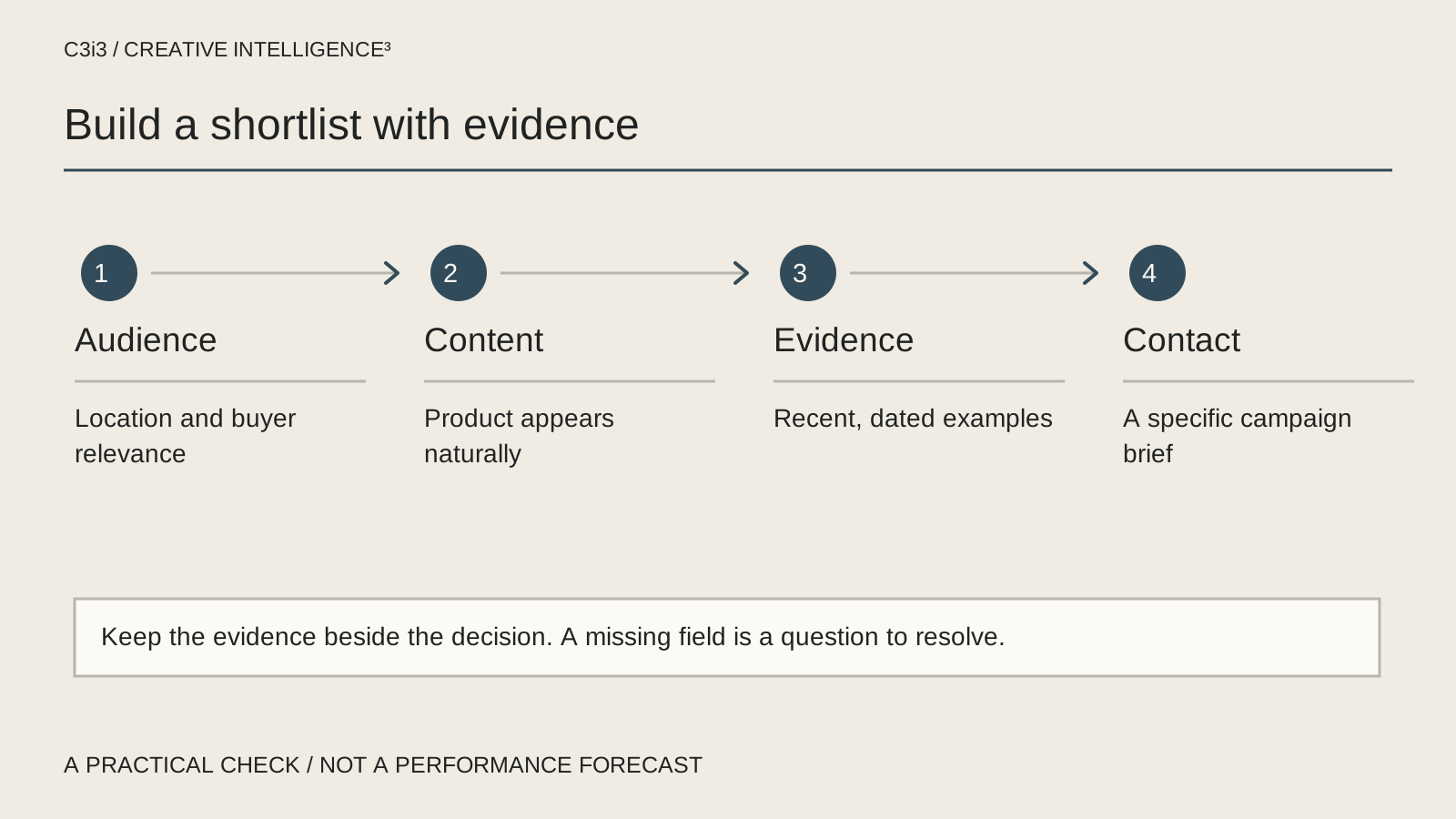
Use the same criteria for each candidate. Start with requirements that cannot be negotiated: target market, suitable content, product eligibility and the ability to perform the proposed task. A large audience should not cancel a failed requirement. Keep preferences such as visual mood separate from those basic conditions.
Next record strengths, questions and the specific reason to contact each creator. This creates a shortlist a colleague can understand without watching every saved video. Avoid giving precise numerical scores to uncertain information; a score of 8.7 is not meaningful if the underlying audience figures are unknown.
A useful shortlist may contain different approaches rather than interchangeable names. One person may explain a product carefully, another may create strong lifestyle context and another may produce material for a brand's own channel. Describe those roles openly. Ask for a conversation about fit instead of treating the list as a public league table of talent.
For example, a brand comparing an explanatory channel with a lifestyle channel should write two possible assignments, not silently expect identical content. The explanatory route may focus on a sequence. The lifestyle route may focus on the moment the customer encounters a problem. Compare each against the same business objective while recognizing that their creative roles differ.
What should a brand send in its first influencer outreach message?
Explain why this particular creator is relevant. Refer to a real example and connect it to the proposed task. Include the brand, product, intended market, campaign purpose, possible format and timing. State what is decided and what remains open. A short, specific message is more useful than a large presentation with no clear request.
Use the business contact published by the creator or an authorized representative. If an unsolicited message requests payment, credentials or confidential documents, verify the sender through a separately confirmed channel. A familiar profile photograph is not authentication.
Separate an invitation to discuss a partnership from a product shipment. Do not assume that sending an item creates a duty to post. Clarify expectations and permissions before content is made. Brand collaborations also need clear relationship disclosures; the FTC's influencer guidance is a primary reference for the team preparing that part of the brief.
How do you plan measurement before a campaign goes live?
Choose a practical destination and a realistic measurement plan before requesting content. A campaign link should lead to a page that matches the message, works on a phone and explains the next step. A hotel booking link, a product page and a consultation form serve different tasks.
Record the tracking method and its limits. Links may identify visits, codes may identify particular orders and platform reports may show engagement, but those numbers do not always describe the same people or time window. Avoid adding incompatible totals and calling the result unique customers.
Agree how you will learn from the campaign if immediate sales are not measurable. Relevant questions, completion of a demonstration and qualified enquiries can inform later decisions, provided the report labels them accurately. Define the reporting window in advance so the team does not keep changing the success measure after seeing the numbers. Measurement should support a decision, not decorate a presentation.
What should happen after you find a suitable creator?
Confirm scope, responsibilities, review boundaries and how content may be used. A brand's right to review factual statements is different from permission to rewrite the creator's voice. Reposting an approved video is different from using it in paid advertising. Capture those distinctions before production starts.
Keep a shared campaign record with the approved brief, verified contacts, deliverables, deadlines, source material and reporting notes. Limit access to the people who need it. Save the final public URLs and any approved adaptations so future team members do not have to reconstruct the project from messages.
Review what actually happened. Which questions were answered well? Where did the handoff slow down? Did the destination explain the offer? A thoughtful follow-up can improve the next brief even when the campaign does not produce the result you hoped for. Finding influencers is the beginning of a working relationship, not the final deliverable.
Document what the team learned about the offer, too. If every creator asks the same clarification, the brief or product page may be unclear. If an otherwise suitable person declines because the task conflicts with their content, preserve that feedback rather than simply replacing the name. A useful process becomes more specific with each conversation.
Keep this checklist beside you
Questions before the next step
Should a brand start with the creator who has the most followers?
Not automatically. A follower total is a useful description of an account, but it does not prove geographic fit, current attention or the ability to explain your offer. Start with the task and evidence that matter to the campaign, then compare suitable candidates.
Can a small business work with a creator who has a large audience?
Possibly, if the proposed task and working arrangement make sense for both parties. Audience size alone does not establish suitability or availability. Describe the project clearly and ask whether the creator is interested instead of assuming that one category of creator is always inaccessible.
How many creators should be on the initial shortlist?
Use a number your team can research properly. A concise list with specific evidence and unresolved questions is more useful than hundreds of unverified names. Keep alternatives available, but avoid contacting people solely to meet a spreadsheet target.

How C3i3 Can Help
C3i3 helps brands turn a product or service objective into a creator brief, a researched shortlist and a campaign destination. We can coordinate content, landing pages and measurement around an agreed scope. Bring the offer, intended customer and the decisions your team needs help making.