






































In this article
The creator's post attracted attention. People commented, clicked and asked questions. Yet the sales report does not look like the campaign dashboard. Your team wants to know whether the campaign failed, tracking broke or the audience was never likely to buy.
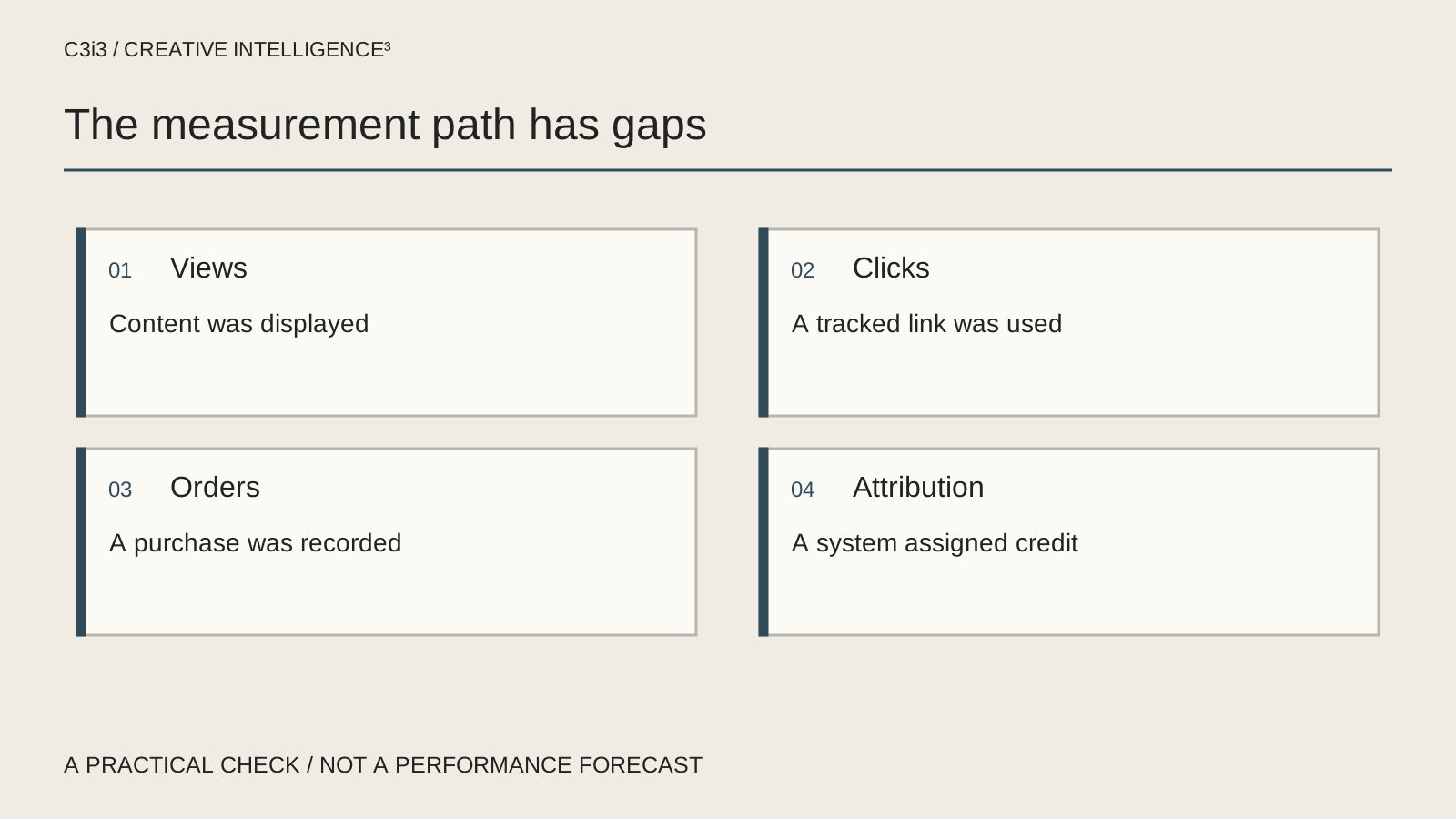
Influencer marketing ROI is difficult to interpret when the reports describe different parts of the journey. Views are not visits, visits are not orders and recorded orders are not automatically incremental sales. Start by defining the business question, then compare evidence under consistent rules. A campaign can be reviewed honestly without forcing every number into a success story.
What result was the campaign supposed to support?
Write down the intended customer action in plain language. You may want people to understand a product, visit a specific page, submit a relevant inquiry or complete a purchase. These goals can be connected, but they are not interchangeable. A campaign designed to introduce an unfamiliar service should not be judged as if every viewer arrived ready to order.
Agree on the primary question before publication. Include the person responsible for the website or store, because they know what can be measured. If a retailer controls the purchase, your team may have less information than it would on its own checkout.
Keep commercial evaluation separate from attention reporting. ROI requires a defined return and a complete account of relevant costs. If those inputs are unavailable or the return cannot be attributed reliably, do not publish a confident ROI percentage. Describe the evidence you do have and the decision it can support.
Where does the viewer journey stop?
Map the route from the content to the intended action. Can a viewer identify the product, find the destination and understand the page? Does the page explain availability, suitability and the next step? A creator may generate curiosity that the destination fails to address.
Review the journey on a phone using the actual published link or tag. Check redirects, missing variants, sign-in requirements and broken forms. A campaign link pointing at a general homepage may force visitors to search again for the item they just saw.
Distinguish behavior from interpretation. A person leaving a page may have found the answer, been interrupted or discovered the product was unsuitable. It is not automatically proof of weak content. Use page questions, actual inquiries and available analytics together to identify the most useful improvement. Fix a clear obstacle before asking the creator to repeat a stronger sales message.
Do the links and website events identify the campaign correctly?
Give each placement a consistent identity. Record the creator, channel, content and destination so your team can distinguish one link from another. Google's campaign URL documentation explains how campaign parameters identify referring traffic. These labels help organize reporting; they do not establish that a purchase occurred.
Test the event representing the outcome. A button click and a successfully delivered inquiry are different events. A checkout start and a completed purchase are also different. Ask the person maintaining the implementation to verify that the event fires at the intended point.
Avoid placing private customer information in links or campaign labels. Keep a simple naming dictionary and a test log instead. If several people generate links with different spellings, the report may split one campaign into multiple rows. Good measurement often begins with consistent operational details rather than a more complicated dashboard.
Why do creator, website and affiliate reports disagree?
Each system may use a different definition, date range or credit rule. A platform reports activity on its own surface. Website analytics describes the visits and events it can observe. An affiliate system may apply its own eligibility, attribution and validation rules. Those reports should be reconciled, not added together as separate sales.
| Report | Check first | Common interpretation mistake |
|---|---|---|
| Creator platform | Format, date range and metric definition | Treating views as website visitors |
| Website analytics | Event setup, source labels and available observation | Treating every visit as a qualified lead |
| Affiliate dashboard | Attribution window and order validation | Treating pending orders as finalized results |
| Commerce records | Order identifiers, cancellations and returns | Counting the same order more than once |
Ask whether the reports use the same timezone and cutoff. A late order can appear in a different day or reporting cycle. Document each definition beside the number so a later reviewer can understand the difference.

How should attribution uncertainty affect an ROI claim?
Attribution assigns credit under a defined model; it does not provide a complete explanation of why a person bought. Google Analytics describes reporting models and lookback settings in its attribution settings guide. Those choices affect how recorded interactions receive credit.
A viewer might return through search, use another device or hear about the product from someone else. You may not be able to connect those actions to the creator. The opposite problem also exists: a recorded referral can receive credit for a purchase that was already likely. Avoid treating either possibility as a proven result without supporting evidence.
Use clear labels: recorded website actions, attributed eligible orders and outcomes not directly observed. If your organization needs an incremental impact assessment, plan an appropriate research design before launch. Do not retroactively invent a control group or use a convenient sales increase as proof that one creator caused it.
What should change before the next campaign?
Hold a review organized around decisions. First resolve implementation problems that would invalidate comparisons. Then examine audience fit, creative clarity and the destination. Keep the creator's delivery separate from issues outside their control, such as unavailable products or an inquiry form that did not work.
Write the next experiment as a specific question. For example, does a demonstration explaining product dimensions help visitors understand fit better than a broad lifestyle mention? Keep the scope manageable and avoid changing every part of the journey simultaneously if you want to learn from the difference.
Record what will remain uncertain. Not every campaign can support a precise sales conclusion, especially when purchase data belongs to another organization. Honest reporting can still guide useful work: improving the brief, preparing a better page, choosing a different creator or deciding not to repeat the approach. The strongest review is one that explains the next action and the evidence behind it.
Keep this checklist beside you
Questions before the next step
Can a campaign have useful results without tracked sales?
It can provide evidence about audience interest, product questions or a customer journey, but that does not automatically establish a financial return. Report those outcomes under their own labels. If sales are the primary goal, identify why the purchase evidence is missing before deciding whether to repeat the campaign.
Should coupon orders be added to affiliate orders?
Not without checking for overlap and understanding each system's rules. One purchase may appear in both reports. Reconcile order identifiers where permitted and use consistent validation status. A coupon code also does not prove that every person using it encountered the original creator content.
Does a high click count prove the creator selected the right audience?
It shows recorded link activity under the relevant system's definitions. It does not establish product suitability or purchase intent. Review the destination experience, relevant questions and subsequent actions. Use several forms of evidence before concluding that the audience or creative approach was responsible for the outcome.

How C3i3 Can Help
C3i3 can help plan campaign links, useful landing pages and a reporting structure that separates observed activity from assumptions. Bring your creator reports and the actual customer journey. We can help identify measurement gaps and turn the findings into practical improvements.