









































In this article
Bay Area SEO proposals often use the same words while describing very different commitments. An audit may mean a tool export or a reviewed implementation queue. Content may mean new articles, service-page improvements or edits you must publish yourself. A comparable proposal makes those differences visible before you choose a monthly fee.
Planning a project? Explore Bay Area web design and marketing support and seo agency services.
What should an SEO proposal include for a Bay Area business?
It should describe the business objective, pages in scope and the reason for the first priorities. Ask which findings have been confirmed and which depend on access or further review. A proposal can acknowledge uncertainty while still explaining the work it commits to perform.
Convert each promise into an observable output. For example, service-page improvement should identify the pages, who supplies facts, who writes, who implements and how the result is checked. A monthly activity label by itself does not tell you what your team will receive or how much internal effort it requires.
How do I compare the best SEO agencies near me fairly?
Give shortlisted providers the same brief, service priorities and known constraints. Ask each to explain its first phase against that brief. If one offers a redesign and another offers content edits, compare their reasoning before comparing their totals. They may be solving different problems.
Use a worksheet with one row per responsibility and a column for each provider. Write included, excluded or not specified. Do not interpret a blank as included. A short clarification conversation can prevent an apparent bargain from becoming a project where your staff must handle the unpriced work.
Which deliverables need acceptance criteria?
Attach acceptance evidence to important implementation work. A redirect task needs an agreed URL map and tested destinations. A content task needs approved facts and published pages. A tracking task needs a test showing the agreed action reaches the intended report, subject to the measurement setup and consent conditions.
The acceptance test should match the responsibility. An agency cannot accept responsibility for revenue that depends on pricing, sales follow-up and customer demand simply because it installs a conversion event. It can show that the event was tested and explain what the resulting report does and does not establish.
For the connected decision, read Bay Area SEO: How Do You Choose an SEO Company?.
What costs and dependencies should I separate from the retainer?
Ask about development, hosting, paid media, creative production, software subscriptions and internal review time. Some may be included; others may be separate. Record who approves additional work and whether a recurring dependency can continue if you change agencies.
Compare the total commitment across the same period, including setup fees and minimum terms. Also compare the cost of your own time. A proposal that requires frequent interviews, legal review or product-data cleanup may be reasonable, but those responsibilities should be scheduled rather than discovered after kickoff.
How should an SEO proposal connect San Francisco and San Jose content?
It should explain which existing regional, city and service pages own each intent. A San Francisco buying guide and a San Jose technical example may support different customer decisions. A provider should be able to name those differences without promising a city-by-service page matrix.
Ask for a sample link map showing a useful route from article to service and from the service page to supporting evidence. The map is a navigation plan, not a quota of links. Existing strong pages should remain central when they already answer the question well.
What should happen when the proposed scope changes?
Agree a change process with the reason, affected deliverable, fee or timing effect and approval owner. Distinguish a correction to agreed work from an additional feature or a new audience. This keeps the project review focused on decisions rather than an expanding list of informal requests.
Before signing, ask the provider to walk through one plausible change. If you add a product line or discover a platform limitation, who reassesses the plan and when? An understandable answer gives you a practical way to manage uncertainty after the sales conversation ends.
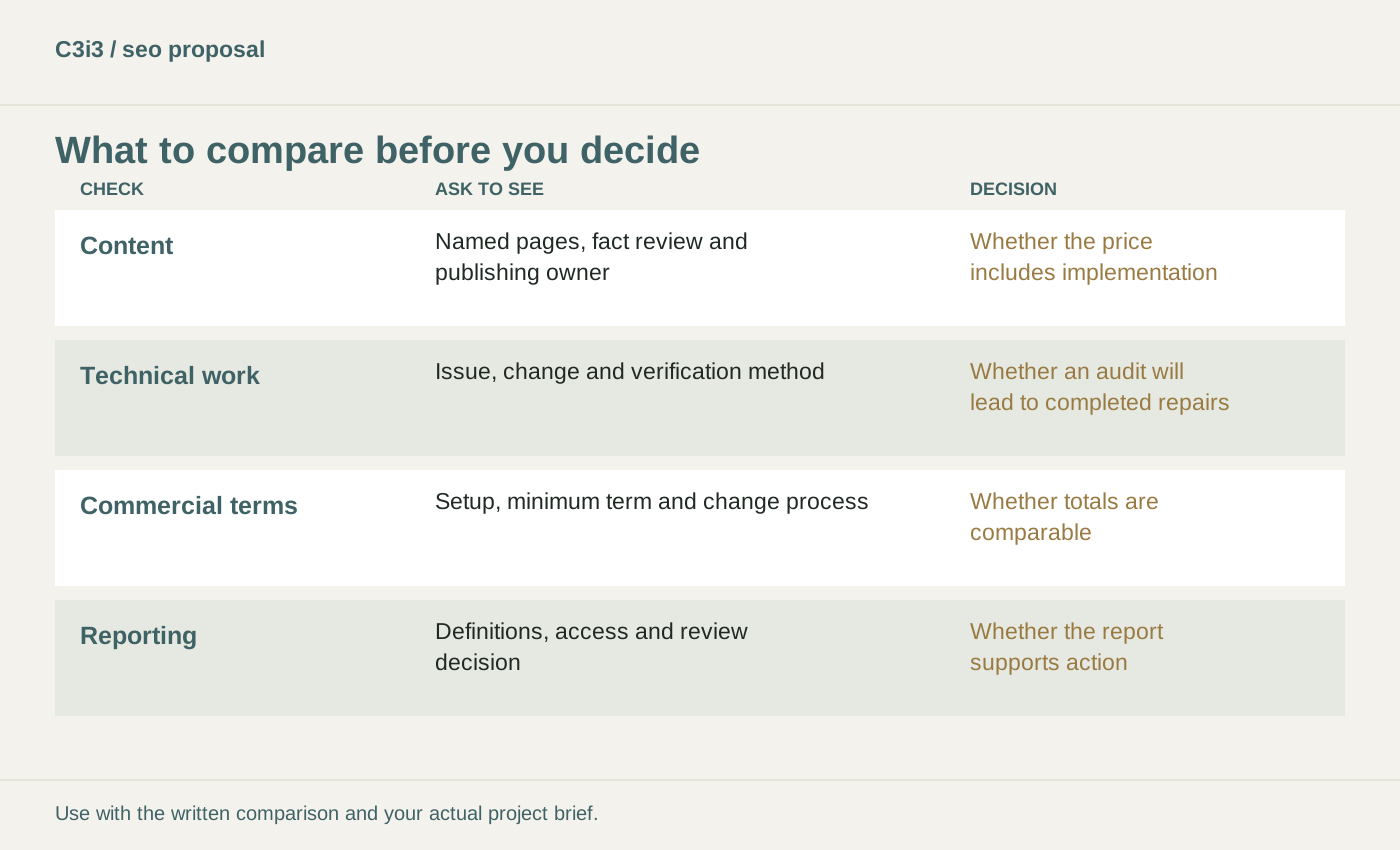
How do the key evaluation criteria compare?
| What to compare | Evidence to request | Decision it supports |
|---|---|---|
| Content | Named pages, fact review and publishing owner | Whether the price includes implementation |
| Technical work | Issue, change and verification method | Whether an audit will lead to completed repairs |
| Commercial terms | Setup, minimum term and change process | Whether totals are comparable |
| Reporting | Definitions, access and review decision | Whether the report supports action |
How can two similar monthly fees conceal different work?
In a hypothetical comparison, Provider A includes recommendations and draft copy while the client publishes and fixes the site. Provider B includes publishing and agreed technical changes. Both quote the same monthly fee. A comparison based only on the fee would miss the internal workload and delivery responsibility.
The buyer records each activity, asks both providers to clarify exclusions and compares the same first-phase outcome. The decision may still favor either firm, depending on internal capability. The worksheet makes the trade-off explicit without assuming the more extensive proposal is automatically the better fit.
What should you remember before the next step?
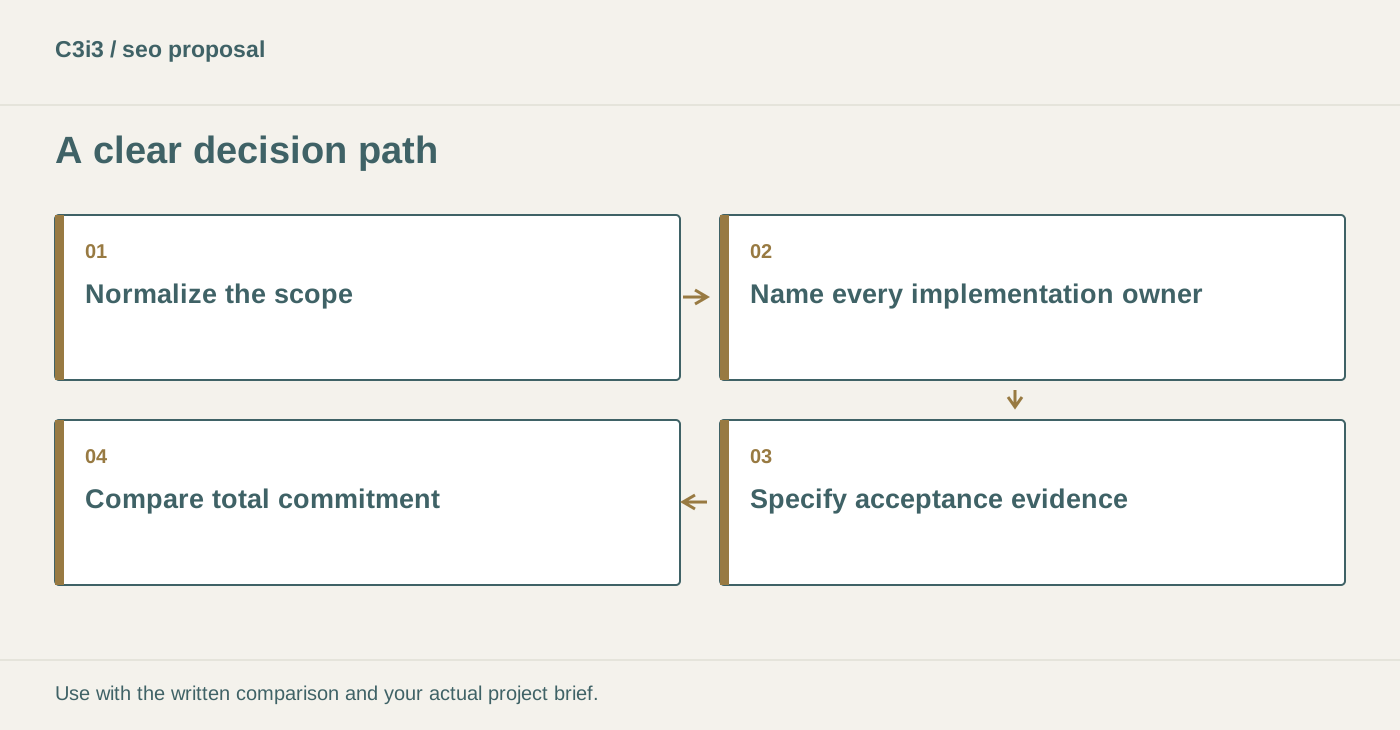
- Normalize the scope.
- Name every implementation owner.
- Specify acceptance evidence.
- Compare total commitment.
What else do local business buyers ask?
Should every SEO proposal include a fixed number of articles?
No. Article production is useful when distinct questions need content. The scope should also consider existing service pages, technical issues and implementation priorities.
Can I use the same brief for several agencies?
Yes. A common brief improves comparison. Allow each agency to explain a different approach, but ask it to make assumptions and exclusions clear.
What if the cheapest proposal excludes development?
Price the required implementation separately and compare the combined responsibility and cost. An exclusion is not inherently a problem when it is understood.
Which sources can help you verify these decisions?
The frameworks and hypothetical examples are C3i3 editorial analysis. The linked primary sources provide platform, usability or disclosure context for the relevant decisions.
How can C3i3 help you plan the right next step?

Share your current website, the customers you want to reach and the work you want to improve. C3i3 brings design, content, technology and marketing into a coordinated project scope.
Review C3i3’s background, explore seo agency or tell us about your project.