









































In this article
A San Francisco business planning a website redesign may receive separate proposals for design, development, copy and SEO. One integrated agency can reduce handoff friction, while specialist teams can provide deeper expertise in a defined area. The useful question is who takes responsibility for the complete customer journey and the launch decisions between disciplines.
Planning a project? Explore San Francisco web design and marketing support and seo agency services.
How do I find a web design and SEO company near me in San Francisco?
Start with the outcome you need: a clearer offer, a new site, better service discovery or a more useful inquiry process. Ask potential providers to show relevant design and search work separately. A strong visual portfolio does not automatically establish technical SEO capability, and search experience does not establish design quality.
Explain whether the project needs in-person interviews, photography or production. Nearby collaboration can be useful for those tasks, while many planning and review activities can happen remotely. Confirm the working arrangement rather than treating a city address as proof that the right team will be assigned.
When does one agency make design and SEO easier to coordinate?
An integrated team can resolve a page’s purpose, information hierarchy, copy and technical requirements within one work queue. That can help when a redesign changes navigation or merges content. Ask how disagreements are resolved and who owns the final decision when visual simplicity conflicts with information a buyer needs.
The advantage depends on the actual delivery team. Ask who performs each discipline and how specialists review each other’s work. One invoice can still hide disconnected subcontractors. A single agency is useful when it coordinates accountable work, not merely when it bundles labels in a proposal.
When should I use a separate SEO consultant or design specialist?
Separate specialists can fit a project with an established internal product owner or a narrow technical need. For example, an existing design team may need an independent migration review, or an SEO team may need a designer to improve a specific inquiry journey.
Name the coordinator and budget for coordination time. Give each specialist the same page inventory, business priorities and acceptance criteria. Without a common brief, a designer may remove useful pages while an SEO provider continues planning links to them. The business should own the resolution of that conflict.
For the connected decision, read Bay Area SEO: Why Did Traffic Drop After My Website Redesign?.
Which SEO decisions belong before the design is approved?
Review important URLs, page purposes, content that should be retained and proposed navigation before finalizing layouts. Ask how service explanations, supporting evidence and inquiry routes will fit the design. A page that looks clean because essential information was removed may create a different problem after launch.
Agree how URL changes will be mapped and checked, who reviews indexing settings and who verifies internal links. These are project responsibilities rather than decorative design options. Google’s site-move guidance provides useful migration considerations when URLs change; apply them to the actual scope.
What should the launch acceptance checklist prove?
Use representative customer tasks on mobile and desktop. A visitor should be able to understand a priority service, find supporting evidence and complete the agreed inquiry route. Your team should be able to update the content it is expected to maintain.
Add the technical checks relevant to the project: redirect destinations, canonical URLs, crawl access, forms and measurement tests. Record defects with owners and severity. A launch sign-off should show what was tested and what remains open rather than turning a design approval into acceptance of every unseen system behavior.
How can C3i3 coordinate web design, content and search?
Bring C3i3 the current website and the services you want the next site to explain. The planning discussion can identify which pages should remain, what content needs expert input and where design or development changes are necessary. The scope should make implementation and approval responsibilities explicit.
For a San Francisco service business, the first useful phase may be a targeted improvement rather than a full redesign. Ask how the recommended work connects with local coverage, SEO and the inquiry process. Review the evidence from that phase before expanding to unrelated features or additional content.
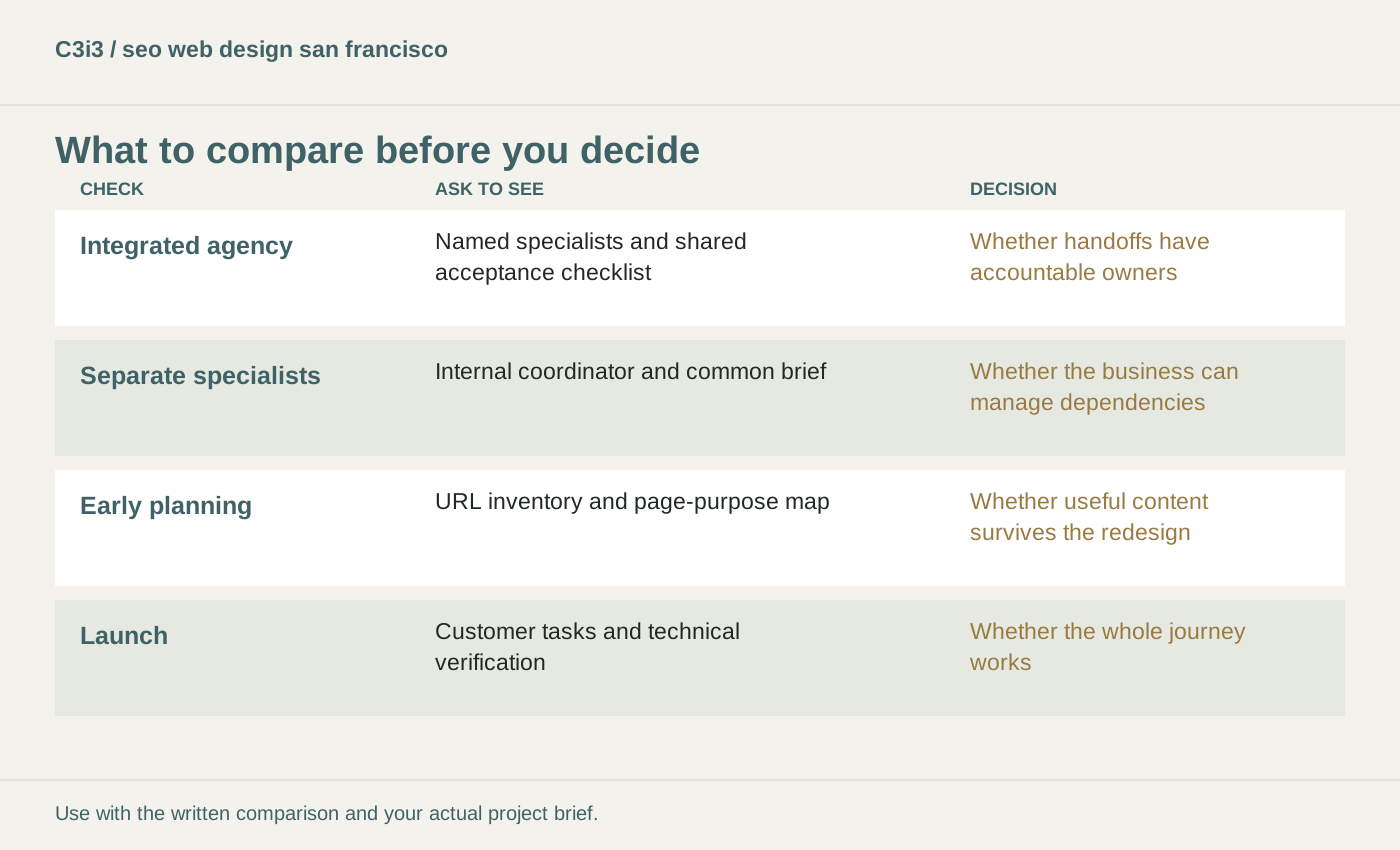
How do the key evaluation criteria compare?
| What to compare | Evidence to request | Decision it supports |
|---|---|---|
| Integrated agency | Named specialists and shared acceptance checklist | Whether handoffs have accountable owners |
| Separate specialists | Internal coordinator and common brief | Whether the business can manage dependencies |
| Early planning | URL inventory and page-purpose map | Whether useful content survives the redesign |
| Launch | Customer tasks and technical verification | Whether the whole journey works |
How could a San Francisco professional firm choose the delivery model?
Imagine a firm with strong service expertise but no internal website project manager. Its redesign involves new copy, revised navigation and an inquiry form. An integrated team may fit if it can show who owns each part and how the work is reviewed together.
A different firm with an experienced internal digital team may prefer separate specialists for design and a technical migration review. Neither model is automatically superior. The decision follows the coordination work, relevant capability and evidence required for the particular project. These are hypothetical procurement situations, not claims about measured outcomes.
What should you remember before the next step?
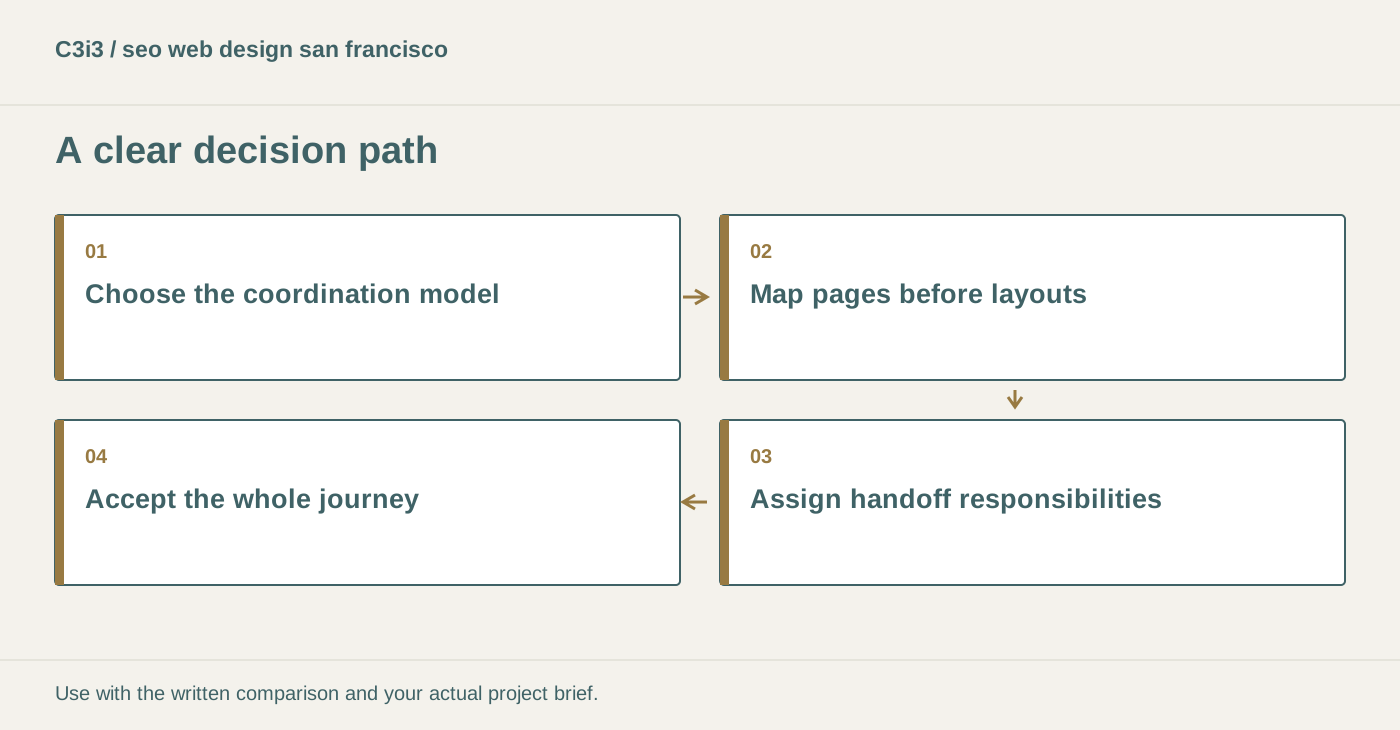
- Choose the coordination model.
- Map pages before layouts.
- Assign handoff responsibilities.
- Accept the whole journey.
What else do local business buyers ask?
Does web design automatically include ongoing SEO?
No. Agree which search foundations are included in the build and which ongoing research, content and review activities are separate.
Can an SEO-friendly redesign guarantee no traffic change?
No. A careful process can preserve useful inputs and identify problems, but search performance can change for several reasons.
Should I approve design before the URL plan?
Settle important page purposes and URL decisions early enough to inform the design. Otherwise the team may have to reverse approved work later.
Which sources can help you verify these decisions?
The frameworks and hypothetical examples are C3i3 editorial analysis. The linked primary sources provide platform, usability or disclosure context for the relevant decisions.
How can C3i3 help you plan the right next step?

Share your current website, the customers you want to reach and the work you want to improve. C3i3 brings design, content, technology and marketing into a coordinated project scope.
Review C3i3’s background, explore seo agency or tell us about your project.