









































In this article
A Bay Area brand can buy affiliate software and still lack a workable partner program. An agency should help connect the offer, partner mix, operating rules and customer journey, while making clear which responsibilities remain with the brand or network. Choosing a provider begins with identifying that actual work.
Planning a project? Explore Bay Area web design and marketing support and affiliate marketing services.
How do I find the best affiliate marketing agency near me?
Define whether you are launching a program, repairing an existing one or seeking a different partner mix. Those stages need different work. A nearby agency can make planning and production easier when your team needs local collaboration, but program capability should lead the selection.
Ask candidates for a relevant process example. They should explain the brand’s starting condition, the work they performed and the evidence used to review it. A list of network logos or partner counts does not establish that the provider can solve the particular problem your business has.
What is the difference between an affiliate agency, a network and software?
An agency provides agreed services such as planning, recruitment and program management. A network or platform supplies a particular environment, tools or partner access. Some businesses combine roles, so ask each provider to describe what it operates and which relationships or subscriptions you must maintain separately.
Clarify who owns program decisions and records. Your brand should know where terms, partner communication, tracking settings and payment information are maintained. A provider’s commercial relationship with a platform should be understandable when it affects the recommendation or the available choices.
Which questions should a top affiliate agency ask about our brand?
It should ask about products, customers, margins, existing demand, stock reliability and the experience after a referral. A program can attract partner interest while losing customers on confusing product pages or unavailable items. The agency needs to understand those constraints before recommending more recruitment.
Also discuss returns, cancellations and the work required to approve and pay partners. The operating model must fit your team’s capacity. A proposal that focuses only on finding more affiliates may leave the brand with an unmanaged queue and inconsistent partner communication.
For the connected decision, read How to Start an Affiliate Program: What Should Your Brand Prepare Before Launch?.
How should I compare partner recruitment strategies?
Ask why each proposed partner type belongs in the program. Content publishers, creators, specialist communities and promotion-focused partners can play different roles. The rationale should connect the audience and customer decision with your offer, not simply maximize the number of applications.
Request a method for screening fit and reviewing overlap with existing demand. A smaller, relevant partner mix can be a sensible first phase. Large recruitment totals are difficult to interpret without activation, customer quality and the resources needed to support those relationships.
What should an affiliate agency proposal include?
It should identify the initial review, program responsibilities, recruitment work, communications, reporting and the brand’s required inputs. Separate agency fees, platform costs, production and partner payouts. State which work is included and how additional activity is approved.
Ask who reviews tracking issues and disputed transactions. The agency should be able to explain the workflow and the evidence used, while recognizing that a platform record does not automatically prove incremental demand. A clear operating process matters as much as the launch presentation.
How can C3i3 help connect affiliate marketing with our ecommerce business?
C3i3 can help plan the program’s content, product destinations and marketing handoffs within an agreed scope. Bring your current store, program terms, available reports and the partner types you want to work with. The first recommendation should follow the gaps found in that review.
Compare the relevant service and the existing affiliate launch and management guides before choosing the next phase. The goal is a program the brand can operate and evaluate, with an understandable relationship between partner activity, customer experience and the resulting business.
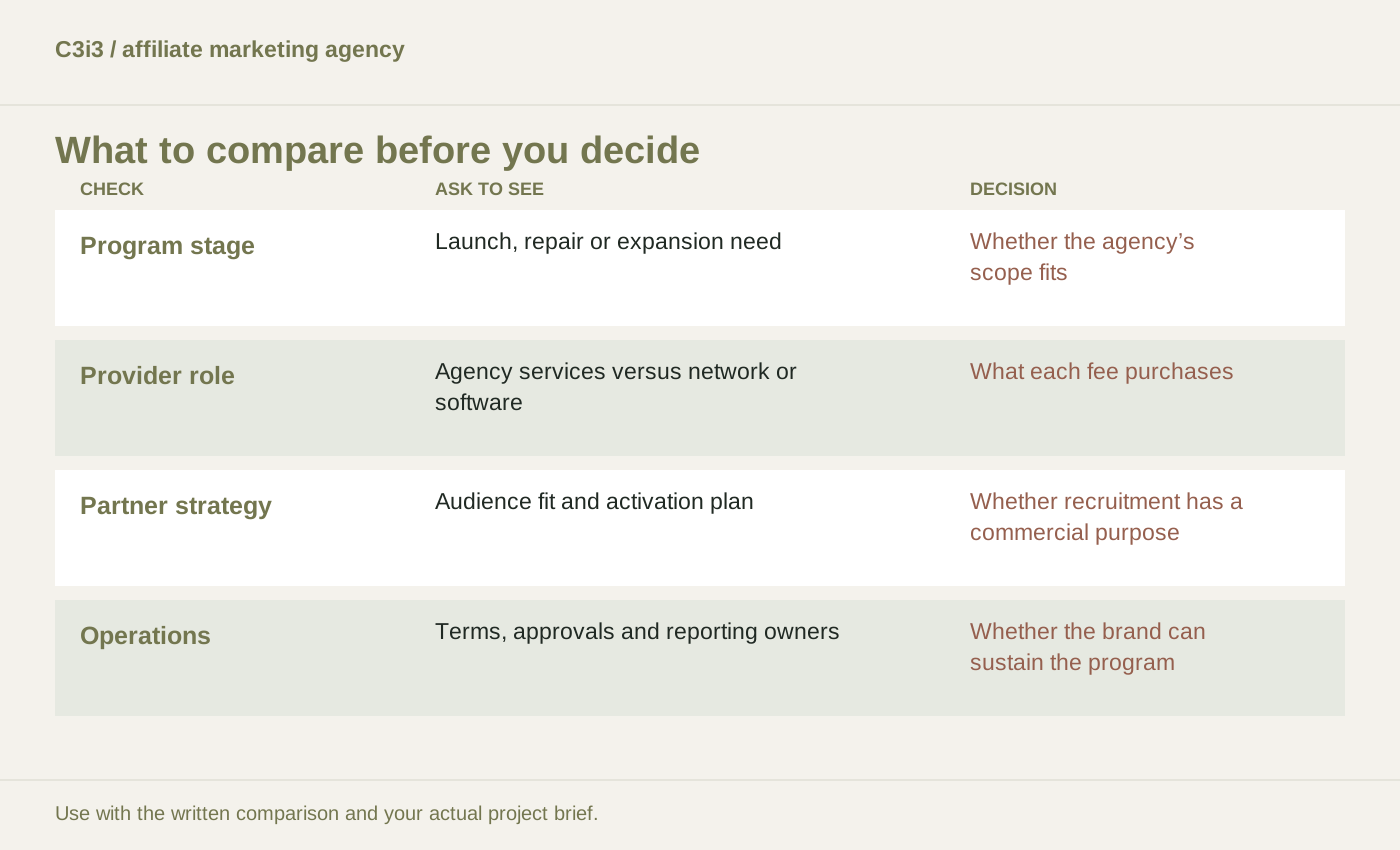
How do the key evaluation criteria compare?
| What to compare | Evidence to request | Decision it supports |
|---|---|---|
| Program stage | Launch, repair or expansion need | Whether the agency’s scope fits |
| Provider role | Agency services versus network or software | What each fee purchases |
| Partner strategy | Audience fit and activation plan | Whether recruitment has a commercial purpose |
| Operations | Terms, approvals and reporting owners | Whether the brand can sustain the program |
How could a Bay Area brand compare two affiliate partners?
Imagine a brand with an existing tracking platform but few active publishers. One proposal recommends changing software immediately. Another reviews partner fit, creative materials and the product destination before recommending a technology change.
The brand asks both providers to explain which evidence supports their priorities. It can then commission a defined review or activation phase and compare the work against that need. This hypothetical example does not establish that existing software should always remain; it shows why a platform switch should follow a diagnosed problem.
What should you remember before the next step?
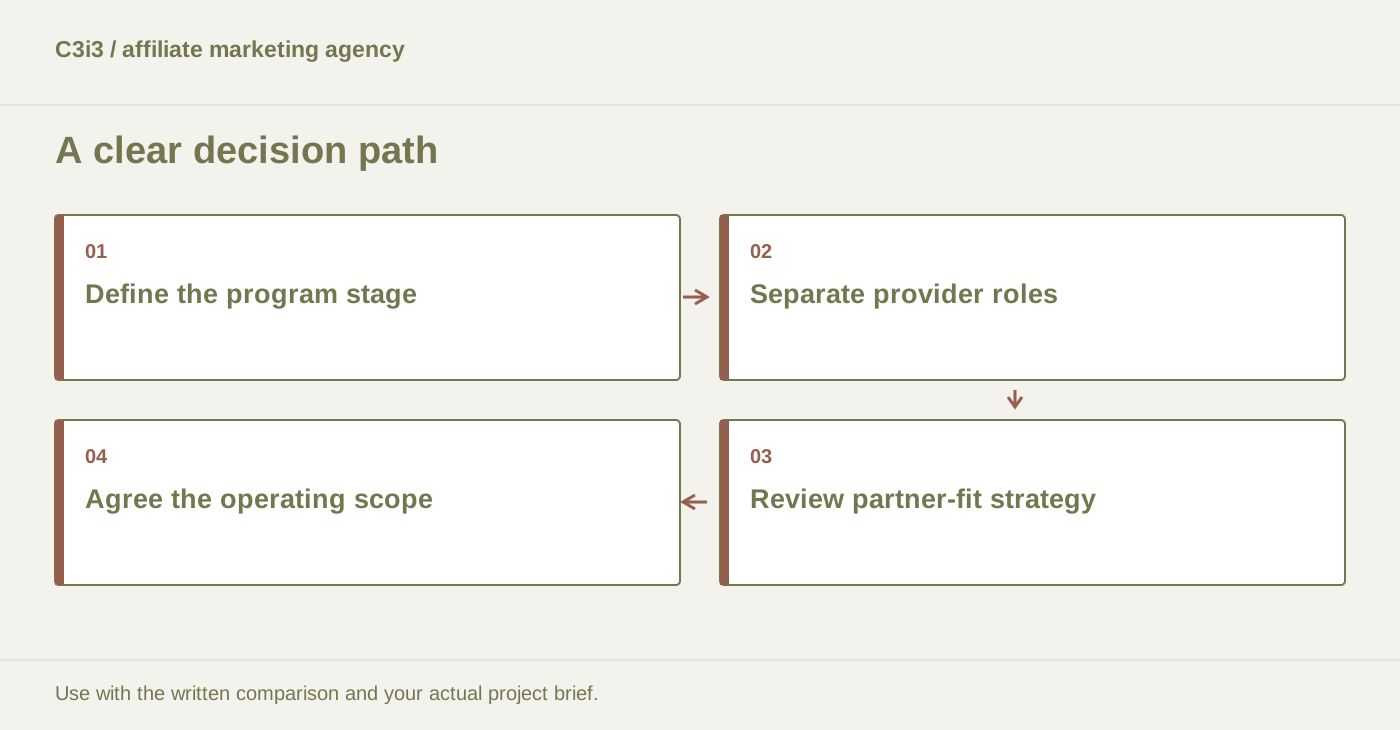
- Define the program stage.
- Separate provider roles.
- Review partner-fit strategy.
- Agree the operating scope.
What else do local business buyers ask?
Do I need an agency if I already have affiliate software?
Possibly. Software and management services address different responsibilities. Identify the planning and operational work your team still needs.
Does a local agency have access to every creator?
No provider can guarantee every partnership. Ask how it researches fit, approaches suitable partners and manages the resulting relationships.
Should the agency guarantee affiliate sales?
Ask for defined work, clear operating responsibilities and honest reporting. Partner and customer decisions are not fully controlled by the agency.
Which sources can help you verify these decisions?
The frameworks and hypothetical examples are C3i3 editorial analysis. The linked primary sources provide platform, usability or disclosure context for the relevant decisions.
How can C3i3 help you plan the right next step?

Share your current website, the customers you want to reach and the work you want to improve. C3i3 brings design, content, technology and marketing into a coordinated project scope.
Review C3i3’s background, explore affiliate marketing or tell us about your project.