









































In this article
A San Francisco brand with existing customers may find that a new affiliate program records sales without showing whether it reaches new people. Recruitment should be connected to the role a partner plays in discovery, evaluation or conversion. That makes the partner portfolio more useful than a long list of coupon links.
Planning a project? Explore San Francisco web design and marketing support and affiliate marketing services.
How should a San Francisco brand recruit affiliates who add value?
Start with the customer journey. A shopper may need an explanation, a comparison, a demonstration or confidence about product fit. Identify which of those needs the brand’s current marketing leaves underserved, then look for partners positioned to answer them.
Geography matters when the offer is local, but many San Francisco brands sell beyond the region. Match partners with the actual customer and shipping or service coverage. A creator’s home city is not enough to establish the audience’s ability to buy.
How do I find an affiliate marketing agency that looks beyond application counts?
Ask it to explain how a partner becomes active and useful. Recruitment is only one stage. The provider should address onboarding, access to accurate information, content readiness and the support needed to help a suitable partner publish.
Request a sample partner-fit rationale and a review plan. An agency should be able to distinguish a relevant but inactive partner from an unsuitable one. The response should show how the brand’s resources will be used, not simply promise a large number of outreach messages.
Which partner types should a brand consider?
Consider the roles that fit your customers: educational content, product demonstrations, specialist recommendations or a defined promotional opportunity. Different partners may contribute at different stages. Describe the intended contribution before deciding how many partners belong in each category.
Avoid assuming one type is inherently incremental. A creator can reach existing customers, while a promotion partner may reach someone new. The useful question is what evidence you can gather about the audience, customer overlap and behavior associated with the partnership.
For the connected decision, read Affiliate Marketing for Small Business: How to Recruit Creators Who Fit Your Products.
What should the recruitment message and onboarding provide?
Explain the product fit, the audience you hope to serve, the available materials and how the program works. A suitable partner needs enough information to decide whether the offer is relevant. Do not substitute a generic commission invitation for a clear product and customer explanation.
After acceptance, provide maintained product information, approved creative and a contact for questions. Confirm the process for links, codes and any required disclosure review. Good onboarding reduces preventable confusion and makes it easier to distinguish lack of fit from a partner who simply lacked usable materials.
How can I assess whether affiliates bring new customers?
Use the customer and transaction information your business appropriately maintains, with a documented definition of new. Compare results by partner type and time period while preserving privacy and acknowledging missing data. A first tracked purchase may not be the person’s first exposure to the brand.
Keep attribution and incrementality separate. A platform may credit a transaction under its rules without proving the purchase would not otherwise occur. Use the evidence to guide a careful review, and consider more structured testing when the decision warrants it.
What should change when recruitment is not producing useful activity?
Look for the stage where the process stalls: response, onboarding, publication, suitable traffic or customer action. Each suggests a different intervention. More outreach will not necessarily fix missing creative or a product page that fails to explain compatibility.
C3i3 can help connect partner materials with the store and content strategy. Bring the program’s current workflow and the questions partners keep asking. A more focused recruitment and activation plan can address an identified gap before the brand expands the partner count.
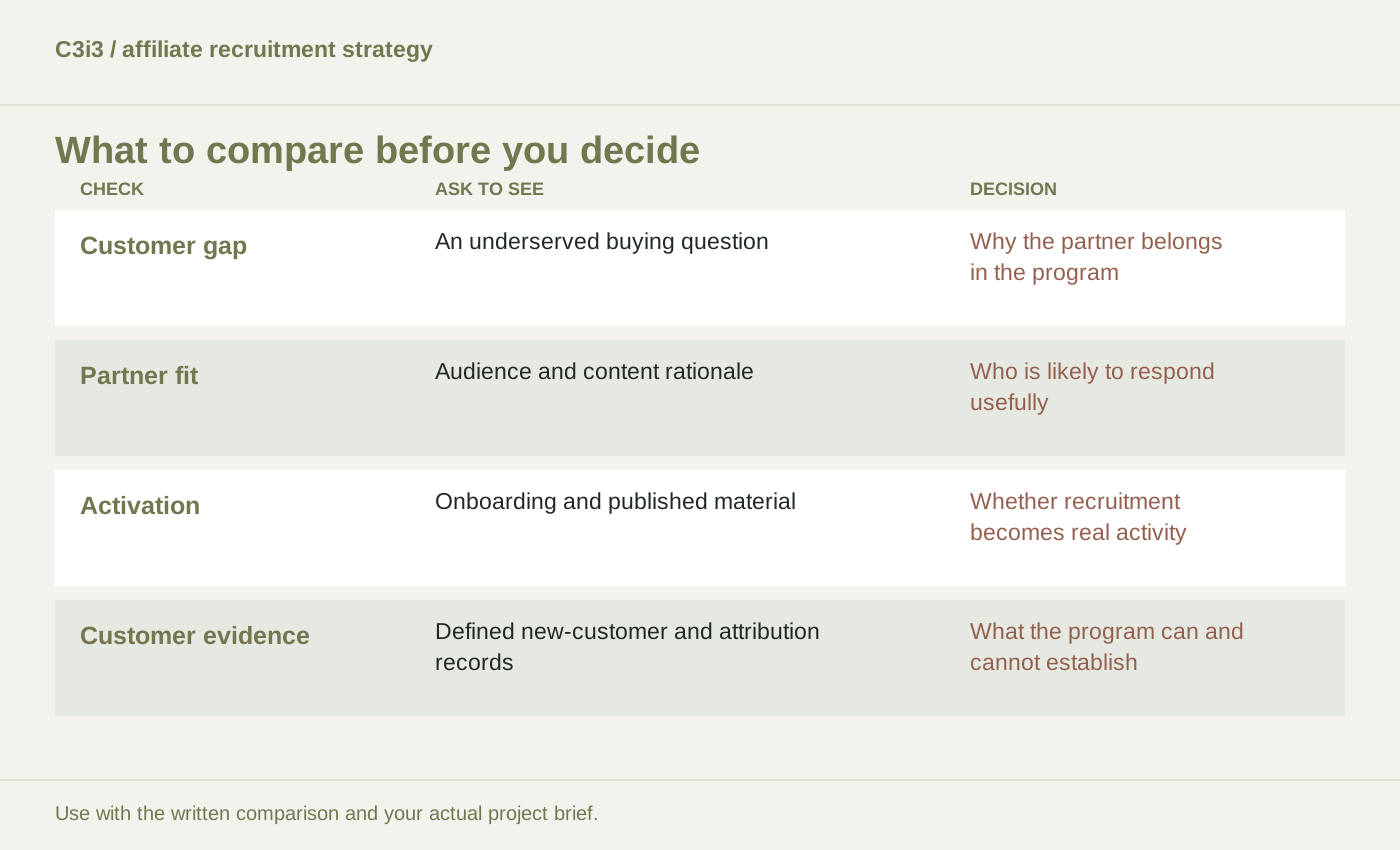
How do the key evaluation criteria compare?
| What to compare | Evidence to request | Decision it supports |
|---|---|---|
| Customer gap | An underserved buying question | Why the partner belongs in the program |
| Partner fit | Audience and content rationale | Who is likely to respond usefully |
| Activation | Onboarding and published material | Whether recruitment becomes real activity |
| Customer evidence | Defined new-customer and attribution records | What the program can and cannot establish |
How could a San Francisco brand revise its partner mix?
Imagine a brand receiving many applications from promotion sites while customers repeatedly ask how to choose between two product versions. It decides to test a small group of partners who can explain that comparison with approved materials.
The review tracks activation, relevant questions and available customer context rather than application volume alone. This hypothetical approach does not prove that educational partners always produce more new customers. It creates a clear reason for the test and a way to evaluate what follows.
What should you remember before the next step?
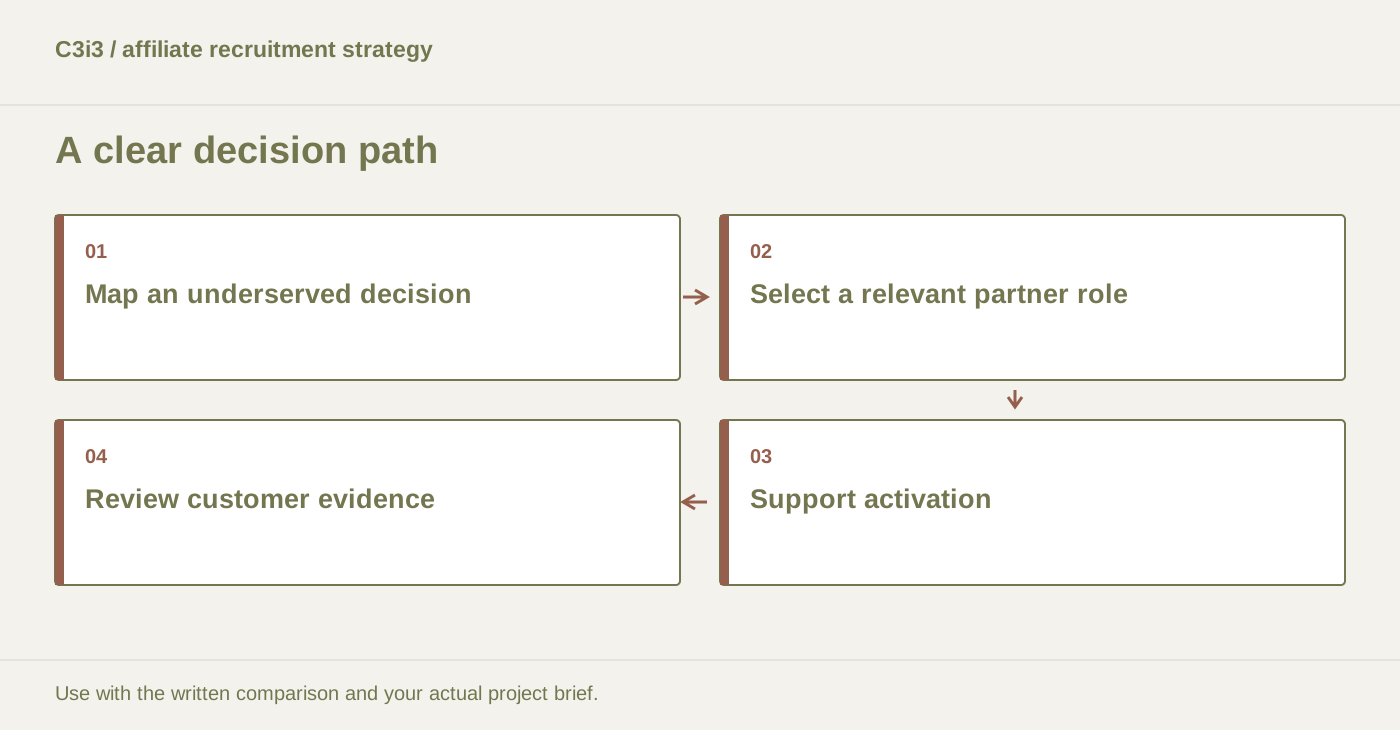
- Map an underserved decision.
- Select a relevant partner role.
- Support activation.
- Review customer evidence.
What else do local business buyers ask?
Does an affiliate sale always represent a new customer?
No. Check your definition and available customer records. The tracked transaction may come from an existing customer.
Should I exclude every promotional affiliate?
No. Evaluate the role, terms and evidence for your particular program rather than applying a universal rule.
Can local affiliates help an online brand?
Yes, when their audience and content fit the offer. Assess customer coverage separately from the partner’s location.
Which sources can help you verify these decisions?
The frameworks and hypothetical examples are C3i3 editorial analysis. The linked primary sources provide platform, usability or disclosure context for the relevant decisions.
How can C3i3 help you plan the right next step?

Share your current website, the customers you want to reach and the work you want to improve. C3i3 brings design, content, technology and marketing into a coordinated project scope.
Review C3i3’s background, explore affiliate marketing or tell us about your project.