






































In this article
A recorded voice once meant booking the speaker again when a campaign changed. Voice cloning can make revisions possible without another recording session. That convenience makes the initial agreement more important, not less.
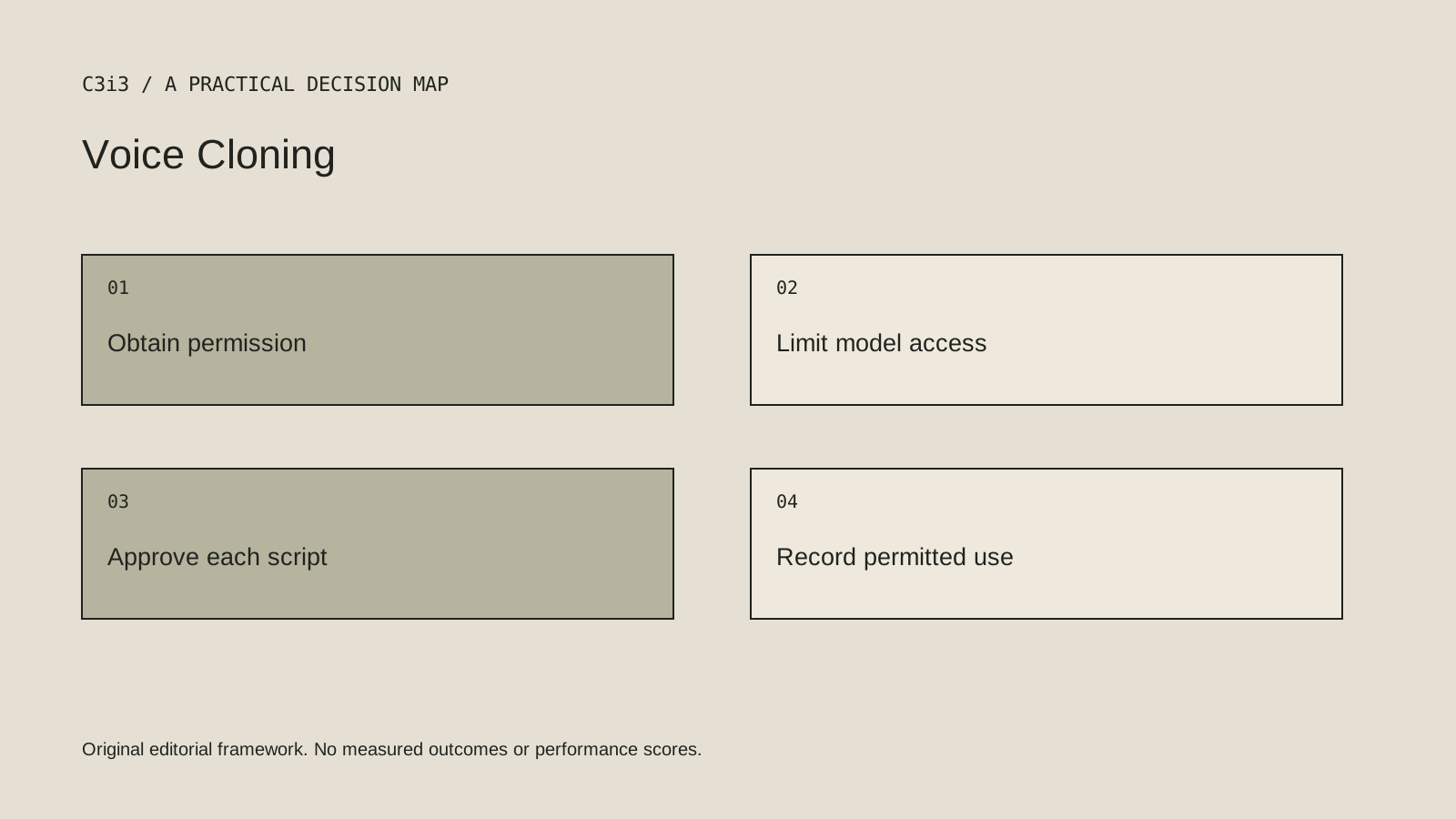
The company needs to understand what it may create. The speaker needs to understand how their identity may be used. The production team needs to know who can access the model and who can approve new output.
Why is voice cloning different from editing a recording?
An edited recording rearranges material that a person actually delivered. A voice model may generate words the person never said. That changes the questions a brief must answer, including what future scripts are permitted and how the speaker will be represented.
The US Copyright Office’s digital-replicas report explains why copyright and protections concerning identity are distinct issues. It is a policy report, not a substitute for current law or a contract tailored to an actual project.
What should permission cover?
Specify the campaign, channels, languages and permitted types of statement. Discuss whether the model can be used for new products, customer support or a future campaign. A vague agreement to use a recording leaves important operational decisions unresolved.
Also clarify how permission ends and what happens to generated material already distributed. These are questions to resolve with appropriate professional advice, rather than assumptions an editor should make while delivering an export.

Who should have access to the model?
Treat access as a production responsibility. Identify the account owner, approved operators and the person who authorizes a new script. Store the source recordings and generated files using an arrangement appropriate to the project.
Avoid handing a broadly usable voice model to everyone who only needs a final audio file. A distributor uploading a commercial does not necessarily need the ability to create additional speech in the speaker’s voice. Match access to the actual task.
How do you review a generated voiceover?
Check the script before generating and listen to the complete output afterward. Names, technical terms, emphasis and pauses can change the meaning. Compare the audio with the captions and product claims so that the campaign presents one coherent message.
Keep a version record containing the approved script, voice output, language and publication use. When a correction is needed, this is more useful than a folder of files labeled final, final-new and final-approved.
What should a business take away from the technology?
A repeatable voice can be helpful where a campaign genuinely needs recurring narration. But convenience should not conceal whose identity is being used or who remains accountable for the words.
If permissions or control are unclear, consider a conventional recording, a clearly licensed synthetic narrator or a different presentation. The best production choice is the one the business can explain and manage after the first commercial is finished.
Put the decision into practice
- Separate recording rights from authorization to create a voice replica.
- Define the campaign, channels and permitted statements.
- Limit generation access to approved operators.
- Approve scripts and listen to final output.
- Keep a version and permission record.
Sources and editorial method
Reviewed November 6, 2026. Linked announcements retain their original dates. Product documentation establishes described capabilities; it does not establish that a subject is currently a search breakout. Examples and decision frameworks are editorial analysis.
Questions readers ask
Does paying for a voice recording automatically include cloning rights?
Do not assume so. Rights depend on the agreement and applicable law. Resolve the intended use explicitly before creating a model.
Can voice cloning make revisions easier?
It can support a revision workflow, but the script, authorization, pronunciation and final output still require review.
How C3i3 can help
C3i3 helps businesses turn a clear customer question into useful content, a coherent digital experience and a manageable production process. Bring the product, page or workflow you are reviewing so we can discuss the work it needs.