






































In this article
A phone, camera accessory and laptop may all need power during a location shoot, but a large battery-capacity label does not tell you whether one bank suits all three. Outputs, cables and supported charging requirements matter.
These five documented models are a starting point for comparing the actual equipment you carry. Check current availability and transport requirements before planning around a particular unit.
How we chose these 5 options
This editorial shortlist uses official product documentation and the practical criteria below. The order groups different workflows; it is not a laboratory performance ranking. We have not represented these products as hands-on tests. Features, availability and account access can change, so check the linked documentation for your intended setup.
| Criterion | Question to answer |
|---|---|
| Device requirements | Which voltage, power and charging standards do the devices need? |
| Ports and cables | What changes when several outputs are used together? |
| Transport and operation | Which conditions and carrier rules apply to the actual battery? |
1. Anker Laptop Power Bank (25K, 165W, Built-In and Retractable Cables), A1695
25,000 mAh / 90 Wh cell capacity. Two built-in USB-C cables and a status display.
Consider it for: A kit that needs compatible laptop and phone charging with fewer loose cables.
Check before choosing: 165 W is a combined output figure, not a per-device figure. Anker limits three- or four-device combined output to 130 W; usable delivered energy is lower than cell energy.

2. UGREEN 145W 25000mAh 3-Port Power Bank, SKU 90597A
25,000 mAh / 90 Wh cell capacity. Two USB-C ports and one USB-A port with LED status display.
Consider it for: A mixed-device kit that needs a high-output primary USB-C connection.
Check before choosing: The official specification lists 140 W maximum on USB-C1 and 65 W on USB-C2, but the 145 W product label is the combined limit. Do not add individual maxima together.
Read UGREEN 145W 25000mAh 3-Port Power Bank, SKU 90597A official documentation
3. CUKTECH 20 Power Bank 25000mAh 210W, P23
25,000 mAh cell-capacity class with two USB-C ports and one USB-A port. TFT status display showing electrical information.
Consider it for: A team that wants to see charging status while distributing power among devices.
Check before choosing: The 210 W rating is a combined-output ceiling. USB-C1 and USB-C2 have different maxima; nominal capacity is not the amount delivered to the camera or laptop after conversion.
Read CUKTECH 20 Power Bank 25000mAh 210W, P23 official documentation
4. SHARGE Shargeek 170 (170W, 24K)
24,000 mAh / 86.4 Wh cell capacity. Two USB-C ports, one USB-A port and status display.
Consider it for: A multi-device kit where visible status and an IP66-rated enclosure are relevant.
Check before choosing: The output changes with the port combination. IP66 is not a claim of safe immersion or safe wet-port charging. Manufacturer travel language is not a substitute for the carrier's current rules.
5. NITECORE NB20000 Gen3
20,000 mAh / 72 Wh cell capacity in an approximately 291 g body. Two USB-C ports with pass-through charging support.
Consider it for: Phone and small-accessory support where carrying weight matters more than laptop-class output.
Check before choosing: Single-port output is at most 22.5 W and total dual-port output is 15 W. It is not a high-output laptop bank. Avoid exact usable-capacity comparison because retrieved manufacturer documents list different rated-energy values.
How to narrow the shortlist
Make an equipment list and check each manufacturer’s power requirements. Match the bank, port and cable together. A headline maximum can differ from what a particular device receives, especially when several outputs are in use.
Separate a charging plan from a runtime promise. Device settings, use and conversion losses affect the result. Keep an appropriate fallback for an assignment where losing power would prevent delivery, and do not assume every camera can operate as intended while connected.
A practical check before committing
Use the actual devices and cables in a controlled rehearsal. Verify which ports negotiate the needed charging mode and review behavior when a second device is added. Check the unit’s labeling and documentation for transport planning rather than relying on a marketplace headline.
What this comparison does not establish
Airline and carrier requirements can differ and change. Confirm the actual route and battery requirements with the carrier; this comparison does not establish transport approval.
Put the decision into practice
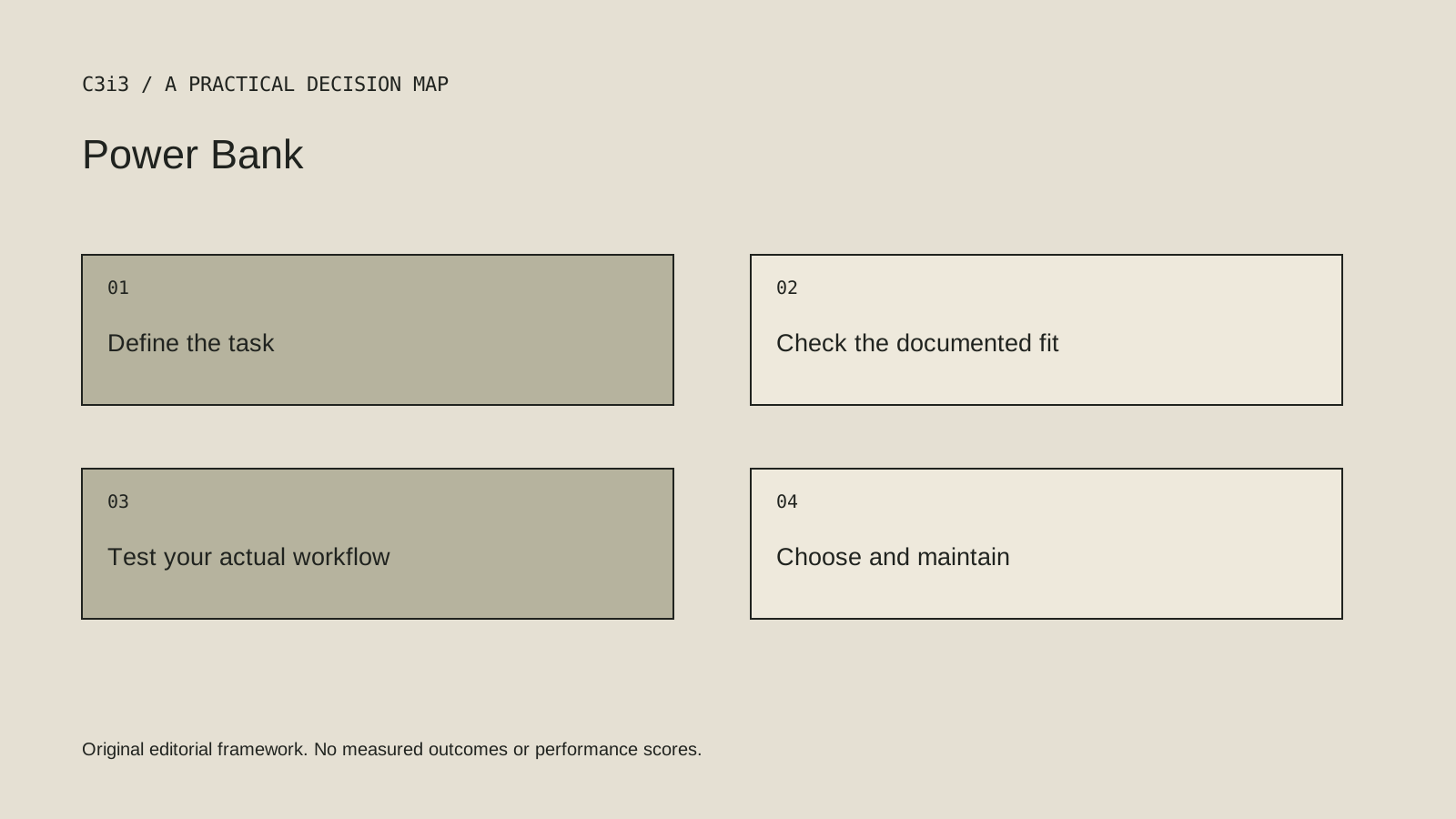
- Which voltage, power and charging standards do the devices need?
- What changes when several outputs are used together?
- Which conditions and carrier rules apply to the actual battery?
- Review the current official documentation and actual handover.
Sources and editorial method
Reviewed November 6, 2026. Linked announcements retain their original dates. Product documentation establishes described capabilities; it does not establish that a subject is currently a search breakout. Examples and decision frameworks are editorial analysis.
- Anker Laptop Power Bank (25K, 165W, Built-In and Retractable Cables), A1695 official documentation
- UGREEN 145W 25000mAh 3-Port Power Bank, SKU 90597A official documentation
- CUKTECH 20 Power Bank 25000mAh 210W, P23 official documentation
- SHARGE Shargeek 170 (170W, 24K) official documentation
- NITECORE NB20000 Gen3 official documentation
Questions readers ask
Is the first option the best choice for every business?
No. The list covers different use cases. Use the stated criteria and your actual requirements to decide which options deserve further evaluation.
Are these hands-on product reviews?
No. They are research-based editorial comparisons using official documentation and practical selection criteria. No claim of personal testing or a guaranteed result is made.
How C3i3 can help
C3i3 helps businesses turn a clear customer question into useful content, a coherent digital experience and a manageable production process. Bring the product, page or workflow you are reviewing so we can discuss the work it needs.