









































In this article
A creator can live in the Bay Area while most of the audience lives elsewhere. Another creator may be based outside the region but reach many customers your business can serve. For a local influencer campaign, separate production convenience from the geography of the people who can act on the message.
Planning a project? Explore Bay Area web design and marketing support and influencer marketing services.
Do I need a local influencer to reach Bay Area customers?
Not always. Start with where the customer can buy or use the offer. A local appointment, restaurant visit or event has different geographic requirements from an online product that ships nationwide. The creator’s content and audience should match that practical action.
Local creators may offer useful familiarity or production access. Those advantages should be stated separately from audience reach. Ask what evidence supports the assumption that suitable people in your service area will see and understand the content.
How do I find the best local influencer marketing agency near me?
Ask an agency to explain both audience selection and production logistics for your exact offer. A useful proposal identifies what needs to happen locally and what can be coordinated remotely. It should not turn a Bay Area address into the sole reason for choosing a creator or provider.
Compare how candidates handle uncertainty in audience data. They should say what the available information measures and what it cannot establish. A thoughtful local strategy may begin with a small test or a combination of content and distribution rather than one large creator commitment.
Which geography evidence should I request?
Request relevant, current audience summaries where the creator can appropriately share them, plus context about the platform and measurement period. City-level detail may be unavailable or incomplete. Do not treat country-level audience data as proof of reach within a specific neighborhood or service radius.
Look at the content itself as well. Does the creator regularly discuss places or activities relevant to the audience you need? This is contextual evidence, not a substitute for measured geography. Record the distinction in the selection rationale.
For the connected decision, read Micro Influencers: 7 Checks Before a Small Brand Starts a Campaign.
What should local campaign content explain?
It should explain the offer, the relevant location or coverage and what someone should do next. If attendance, booking or availability is limited, use approved facts and a maintained destination. Content can become misleading when a viewer reaches an expired offer without clear context.
Prepare the destination before publication. A local visitor should not have to search a general homepage to find the event, service or product shown. Match the campaign promise with the page and keep the booking or inquiry process usable on a phone.
When does a national creator make sense for a local brand?
A local business may sell online, serve visitors or want reusable creative for a wider campaign. A national creator can fit those objectives when the audience and distribution plan are appropriate. State the reason rather than presenting national reach as local market penetration.
If paid distribution or content reuse is planned, agree those rights and responsibilities explicitly. A production asset and an organic creator post are different deliverables. The brand should know which one the proposal is primarily designed to provide.
How should I review a local influencer campaign?
Review the action the offer made possible: relevant bookings, event inquiries, destination visits or other agreed signals. Add qualitative feedback when people ask recurring questions or misunderstand coverage. A view count alone cannot establish that a local campaign reached suitable customers.
C3i3 can help coordinate the content, destination and inquiry journey around that action. Bring the real service area, offer conditions and production needs. The most useful local plan connects those facts with evidence, rather than adding city names to a campaign with no geographic logic.
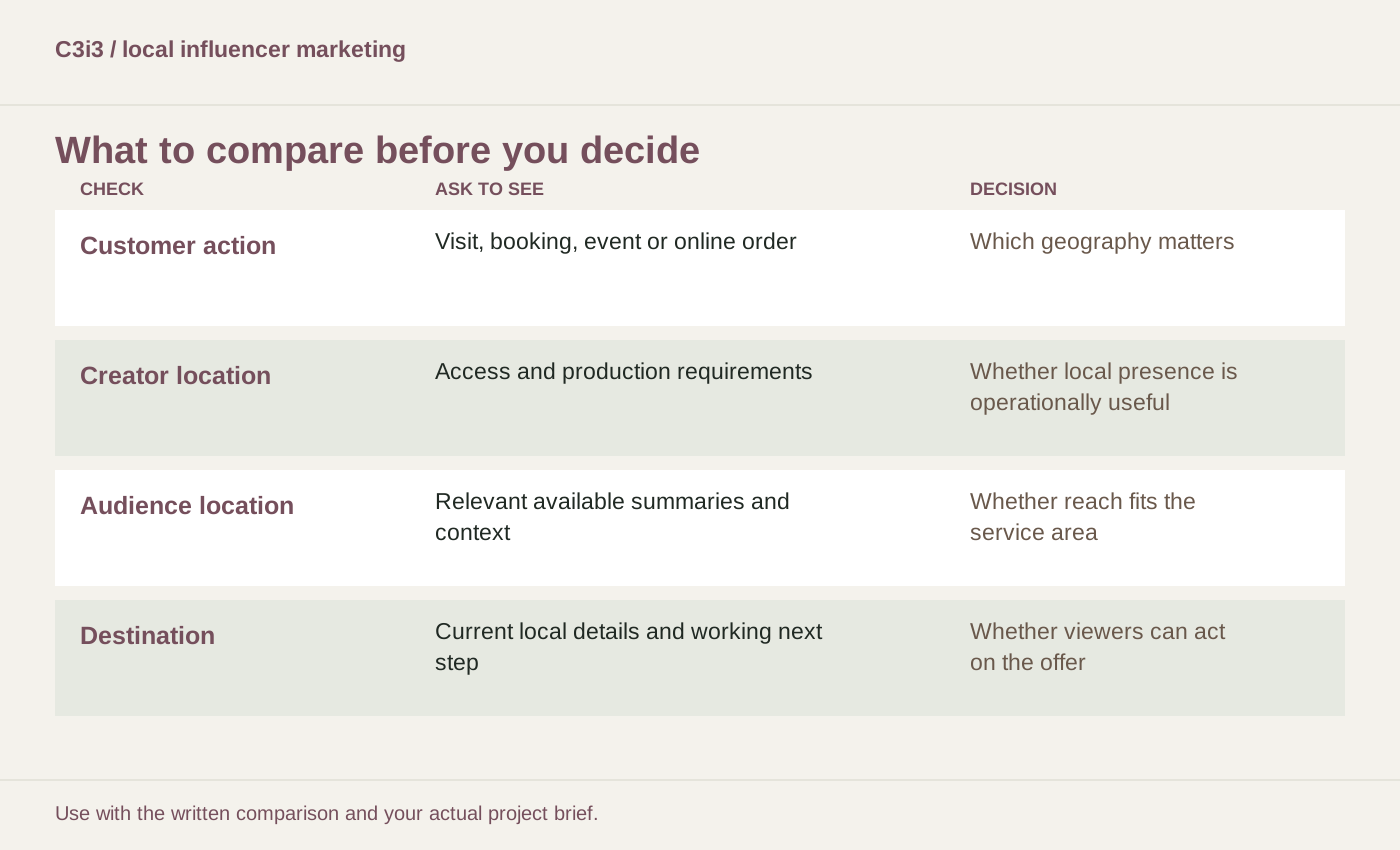
How do the key evaluation criteria compare?
| What to compare | Evidence to request | Decision it supports |
|---|---|---|
| Customer action | Visit, booking, event or online order | Which geography matters |
| Creator location | Access and production requirements | Whether local presence is operationally useful |
| Audience location | Relevant available summaries and context | Whether reach fits the service area |
| Destination | Current local details and working next step | Whether viewers can act on the offer |
How could a Bay Area restaurant and product brand choose differently?
Imagine a restaurant promoting reservations and a packaged-food brand promoting online orders. The restaurant needs people who can realistically visit, while the product brand may welcome customers across its shipping area. Both can need local filming, but their audience requirements differ.
The campaign brief separates those decisions. It asks for evidence of relevant reach and a suitable destination for each offer. This hypothetical comparison does not establish that one creator size or platform will outperform another; it makes the geography question answerable.
What should you remember before the next step?
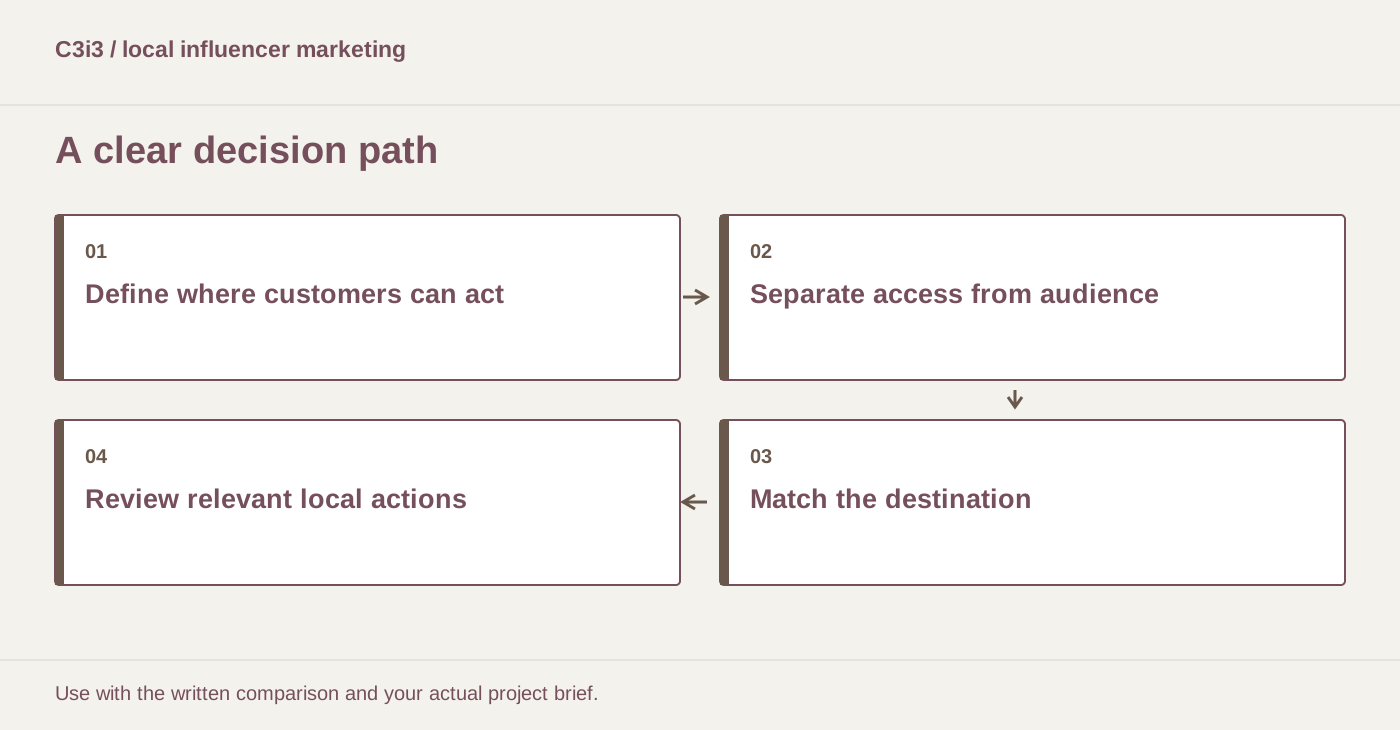
- Define where customers can act.
- Separate access from audience.
- Match the destination.
- Review relevant local actions.
What else do local business buyers ask?
Does a local hashtag prove local reach?
No. It can provide context, but it does not establish who saw the content or whether those people can become customers.
Can one campaign serve local and national customers?
Yes, when the offer, content and reporting distinguish the intended actions. Avoid mixing the results without context.
What if city-level audience data is unavailable?
Record that limitation. Use appropriate contextual evidence and a bounded test rather than inventing a precise local audience estimate.
Which sources can help you verify these decisions?
The frameworks and hypothetical examples are C3i3 editorial analysis. The linked primary sources provide platform, usability or disclosure context for the relevant decisions.
How can C3i3 help you plan the right next step?

Share your current website, the customers you want to reach and the work you want to improve. C3i3 brings design, content, technology and marketing into a coordinated project scope.
Review C3i3’s background, explore influencer marketing or tell us about your project.