







































In this article
Someone wants to see how a product works before they read a specification. Someone else wants an explanation from a person who understands their problem. They may begin inside a video or social platform rather than with a conventional website search.
Social search is useful to discuss as a discovery behavior. It is not a reason to announce that Google has disappeared or that every customer uses the same app. The practical question is whether your business has something helpful to show when the search happens there.
What are people trying to learn from a social search?
A search for a service can hide a practical question: what happens during the work, what should I check or how does the result look? A short video can reveal details that a service label does not explain.
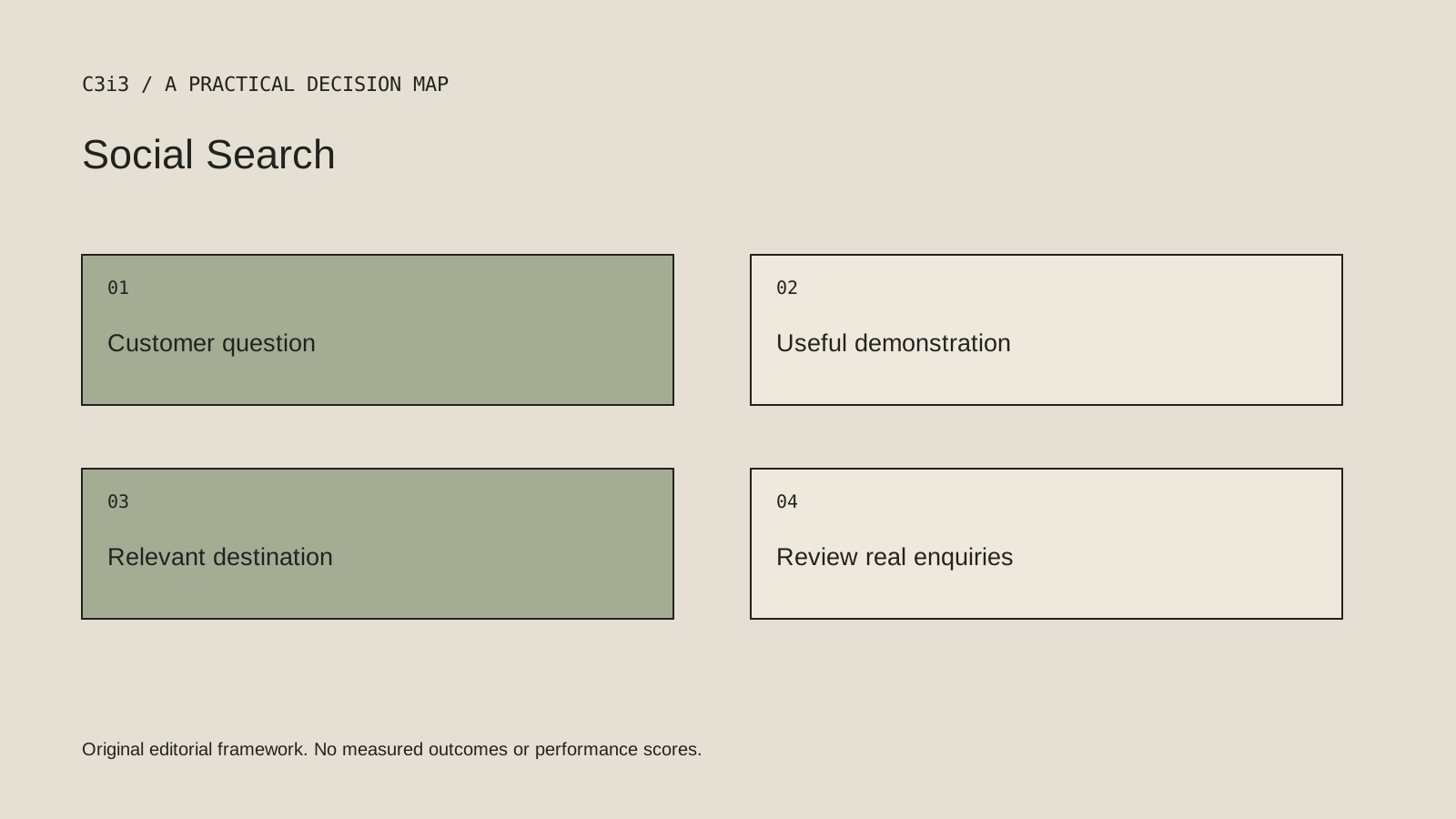
Use the questions your sales and support teams repeatedly receive. Choose one question for one piece of content. A specific explanation gives the viewer a reason to watch and makes it easier to describe the video accurately in its title and caption.
How do you make a demonstration searchable?
Name the product, service and problem in ordinary language. Say what the viewer will learn near the beginning and keep on-screen text readable. Captions help people follow the explanation, but they should be checked rather than accepted blindly.
Use the platform’s current publishing guidance for the format. Do not fill the caption with unrelated popular terms. A viewer who arrives expecting one subject and receives another has not been helped by the extra reach.

What should happen after someone watches?
Choose an appropriate next step: a detailed guide, a product page, a specification or a contact route. The destination should continue the same conversation. Do not make someone restart the investigation on a generic homepage when a relevant page exists.
Check the destination on a phone. A useful video can still lead to a confusing page, an inaccessible form or an outdated service description. Discovery and the website experience belong in the same review.
How can a small team maintain the work?
Create a question bank from real conversations and identify who can verify each answer. Record several related explanations when the product or subject expert is available. Repurposing should preserve meaning rather than cutting every clip to an arbitrary length.
Keep the source material organized so a corrected claim can be updated across versions. A post that was accurate for an older product or policy may need a new explanation rather than another round of promotion.
What should you measure?
Use available platform evidence to understand discovery and engagement. Then use your own website and enquiry records to investigate what happened next. These are connected stages, not interchangeable totals.
A popular video can attract viewers who are unlikely to become customers. A smaller explanation may produce more relevant questions. Interpret the evidence in relation to the intended audience and keep uncertainty visible when attribution is incomplete.
Put the decision into practice
- Choose a real customer question.
- Use the product or service name in the title and explanation.
- Check captions and on-screen information.
- Link to a destination that continues the topic.
- Separate engagement from relevant enquiries.
Sources and editorial method
Reviewed November 6, 2026. Linked announcements retain their original dates. Product documentation establishes described capabilities; it does not establish that a subject is currently a search breakout. Examples and decision frameworks are editorial analysis.
Questions readers ask
Should we replace website content with social videos?
No. The formats serve different stages of discovery and evaluation. Keep a useful owned destination and make the social explanation valuable on its own.
Should every post include our city?
Only when location helps answer the question or reflects actual service coverage. Unrelated city names do not improve the usefulness of a demonstration.
How C3i3 can help
C3i3 helps businesses turn a clear customer question into useful content, a coherent digital experience and a manageable production process. Bring the product, page or workflow you are reviewing so we can discuss the work it needs.