



































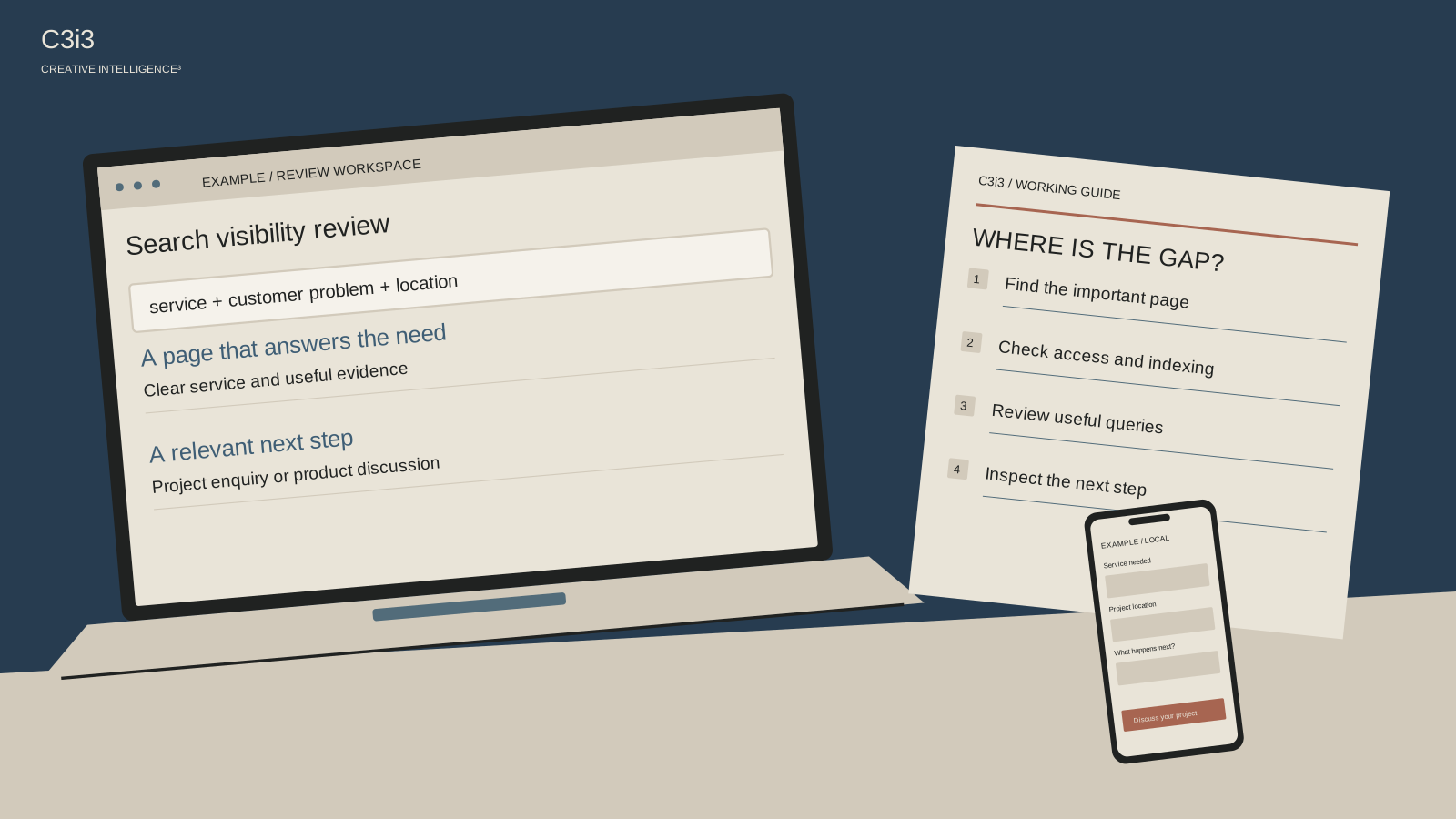
The website is finished. You have checked it on your phone, shared it with friends and added the address to your email signature. Then you open the traffic report and wonder whether anyone outside your own team has visited.
That silence is easy to interpret as a failed website. Before starting over, find out which part of the discovery process is actually quiet. A page Google has not indexed needs a different investigation from a page that appears frequently but earns few clicks. Start with evidence you can understand, then choose the next repair.
What does “no traffic” mean in your report?
Write down which report you are reading and the period it covers. A website analytics report, a Search Console report and a Business Profile report describe different activity. A low number in one is not a complete account of whether customers can find your business.
Check that your website analytics is installed and recording the intended public site. Ask the person responsible to confirm that tracking and consent behavior match the setup you expect. A missing measurement should be investigated before you conclude that nobody visited.
Then focus on organic Google Search using Search Console’s discovery and performance tools. Keep the date range visible when comparing reports. If the page launched recently, avoid comparing a short partial period with a much longer established period and treating the difference as a trend.
Can Google find and index the pages that matter?
Choose your homepage and one important service page. Open each exact public URL, then inspect it in your verified Search Console property. Record the result before asking a developer to change anything. Our new-website visibility guide walks through the distinction between a live page and an indexed page.
If the report identifies an access or indexing issue, bring that specific finding to the person who manages the site. A staging restriction, an incorrect preferred URL or an unavailable page can require a focused technical repair. Do not remove every restriction indiscriminately; private and staging areas still need protection.
Give important public pages sensible internal links. A visitor should be able to reach the service from the site’s navigation or relevant content without knowing its URL in advance. A sitemap is a discovery aid, not a substitute for a usable website structure.
Are you visible only to people who already know your name?
A referral may search for your company by name, while a new buyer searches for the work they need. Both are useful, but they represent different opportunities. Look at the queries and pages available in your performance report and distinguish company-name searches from service or problem searches.
For an illustrative San Jose industrial supplier, a homepage introducing the company may not answer a buyer’s application question. For a San Francisco service firm, a broad “solutions” page may not explain the assignment a new customer is trying to commission.
Do not turn this observation into a demand for hundreds of keyword pages. Start with a priority offer and the questions that help a qualified buyer understand it. The brand-only visibility guide explains how to map those questions to useful existing pages before adding more.
Find the first missing step
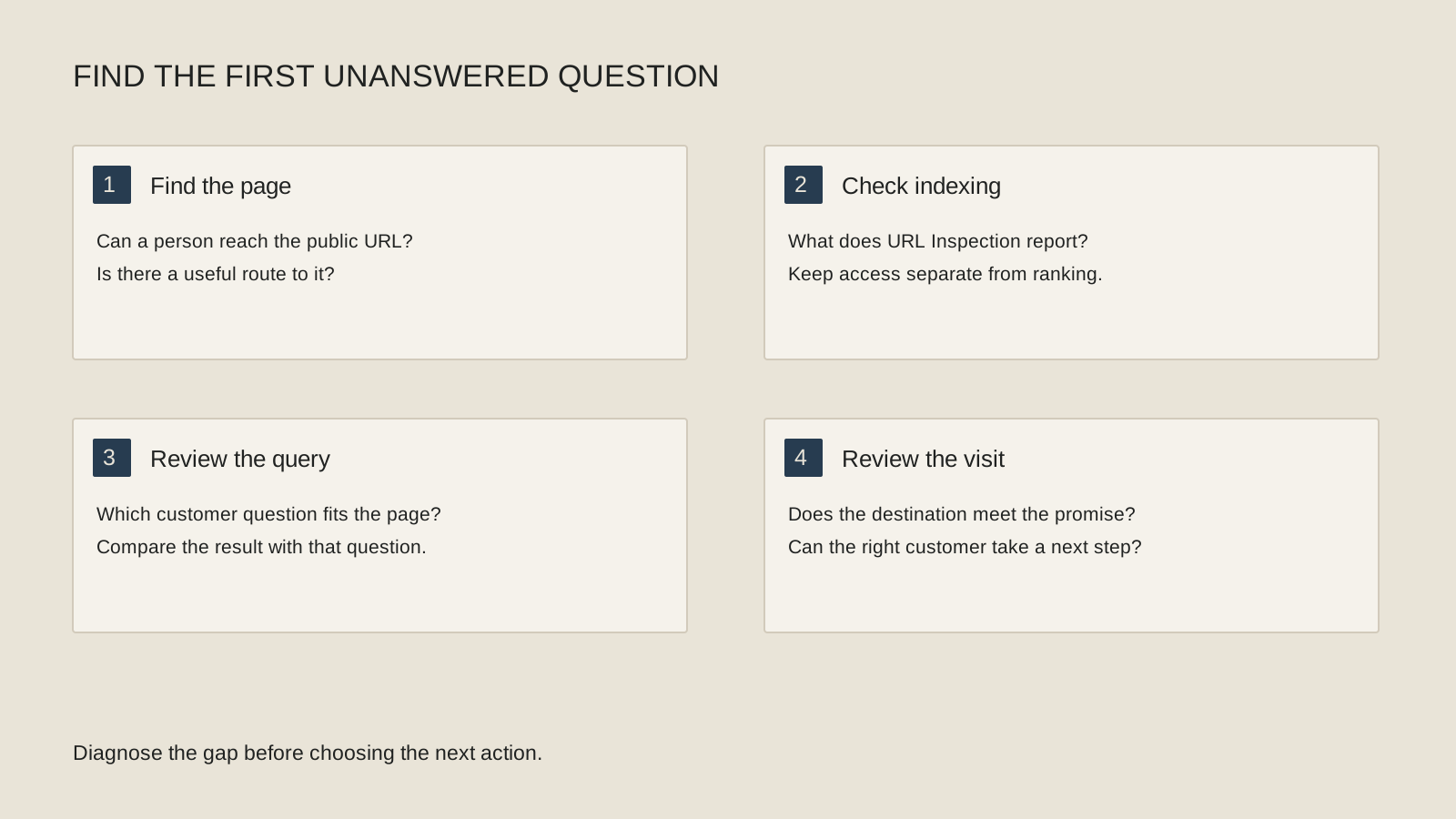
Use this as a diagnostic sequence. Each finding points to a different next check, rather than a universal SEO package.
Discovery
Can a visitor reach the priority page from useful links? Can Google access the intended public URL?
Indexing
What does URL Inspection report about the indexed page? Record the reason before changing settings.
Search relevance
Do the available queries describe your company name, your service or a different subject entirely?
Useful visits
Are appropriate searches leading to clicks and understandable next steps? Follow the journey through to the inquiry.
Are search appearances becoming visits?
When a page has impressions but few clicks, look more closely at the queries, device, page and date range involved. A broad impression total can combine very different searches. It does not tell you that every person saw an equally relevant invitation to visit.
Review the title and description associated with the page, and inspect representative search results. Does the wording match the actual service? Does it give a plausible reason to open the page? Google may display wording drawn from the page rather than the exact title or description you supplied.
Search results also contain features that can answer part of a question before someone clicks. Avoid assuming every change is a copywriting failure. Our impressions-without-clicks guide helps you separate a message problem from a broader change in the searches and results being measured.
Where do local discovery and AI answers fit?
A Bay Area business can need several kinds of visibility. A contractor may depend on local inquiries. A manufacturer based here may serve national buyers. Define the audience you actually want instead of treating every website visit as equally valuable.
For nearby-customer discovery, use the separate Google Maps troubleshooting pillar. Business Profiles and ordinary website results are related parts of discovery, but their diagnostics are not interchangeable.
For Google’s AI features, its AI search guidance emphasizes foundational SEO, accessible text and useful supporting media; inclusion is not guaranteed. In this series, AEO means answering real questions clearly, and AIO means making reliable information easier for AI-assisted discovery to interpret. Neither label turns a paragraph or a graphic into a promise of an AI citation.
What should you do first this week?
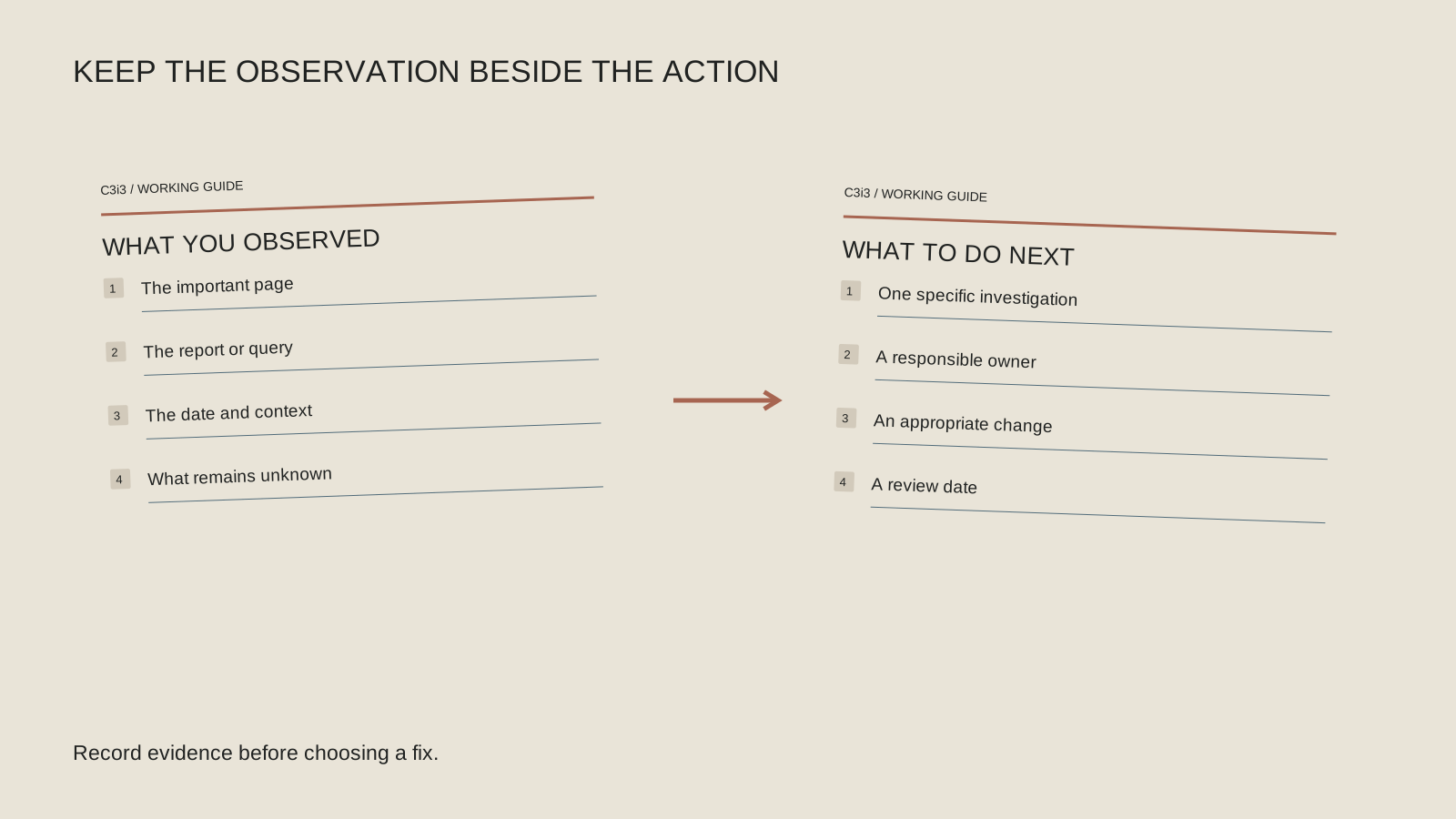
Make a short list of findings, not a long list of services to buy. Name the page, the observed problem, the evidence and the person who can resolve it. A confirmed indexing restriction comes before polishing a description for a page Google cannot serve.
Keep a copy of the page and the relevant report before making changes. Repeat the original check afterward and allow an appropriate observation period for the question you are testing. Search results and demand vary; a quiet day or a single improved position does not establish the effect of your edit.
If the site receives visits but suitable customers still disappear, move to our website customer-path review. Finding a business and deciding to contact it are separate steps. Diagnose the step in front of you so the next investment has a clear purpose.
Keep this checklist beside you
Two questions owners ask next
Does a new website automatically get search traffic?
Publishing makes the site available. Discovery, indexing and relevance still need attention, and Google does not guarantee inclusion or a level of traffic.
Should I buy ads while SEO develops?
That depends on the offer, budget and ability to handle inquiries. Fix a broken page or unclear contact route before sending more paid visitors to it.

How C3i3 Can Help
C3i3 can help turn “we need more traffic” into a prioritized scope. Our SEO services can support technical and content review, while local SEO addresses nearby-customer discovery. Where AI visibility matters, we can connect that work with AI search optimization. Bring the pages and reports you can access; we can help identify the next useful check and define what implementation and ongoing measurement should include.