



































In this article
The homeowner asks how a heat pump installation would work. Your video answers with technical terminology, equipment close-ups and a long list of features. They finish with the same practical questions: what happens at my house, what needs assessing and what am I agreeing to?
An explainer video for an HVAC business should bridge that gap. It can make an unfamiliar service easier to understand without pretending to assess a property remotely. The best starting point is the customer's decision, then a carefully limited explanation of the technology and the installation process.
Choose the question before choosing the animation
Write the question the film will answer in ordinary language. What happens during an installation assessment is a different subject from how a heat pump transfers heat. A short video can connect them, but one should remain the primary task.
Ask the office which explanations regularly need repeating. Identify the point where customers become confused and the information they need next. This gives the script a business purpose grounded in actual conversations rather than a list of industry features.
Decide what the film will not establish. It cannot determine a home's system size, electrical requirements or final installation scope. Those boundaries should shape the wording and diagrams from the beginning, not appear as an afterthought.
Explain the basic idea with one clear visual
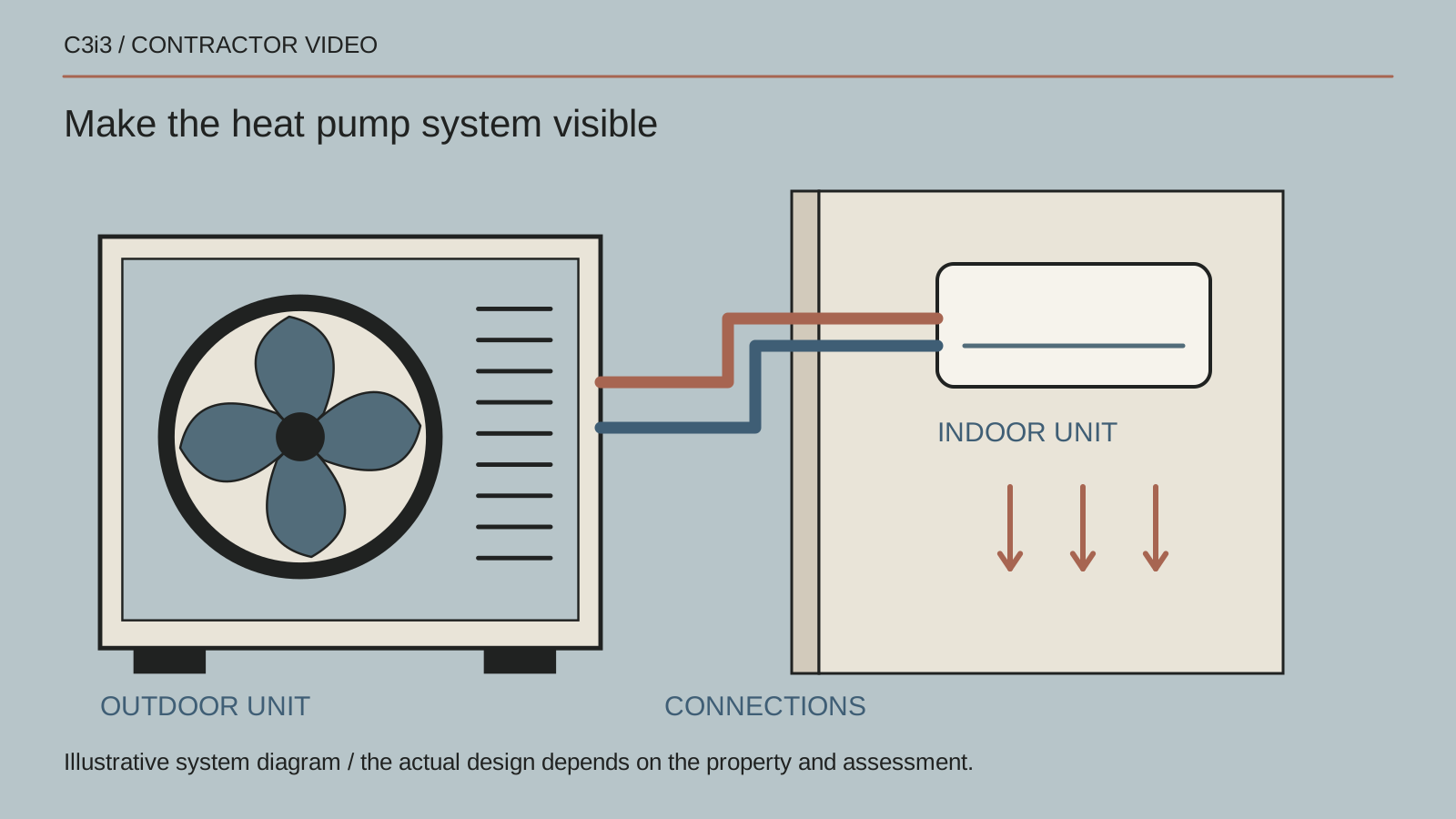
Use a simple visual to show that a heat pump moves heat rather than presenting every internal component. The DOE overview is a useful general reference, while a qualified specialist should review your specific explanation.
Label the diagram as illustrative and make the mode clear. Avoid arrows that suggest the system always operates in the same direction or that every product has the same layout. Keep technical simplifications accurate enough for the question being answered.
Show a small number of meaningful elements at once. If the screen contains a wall of labels while the narration covers another point, the viewer must choose which explanation to follow. Use the visual sequence to reduce that effort.
Show the assessment as a decision stage
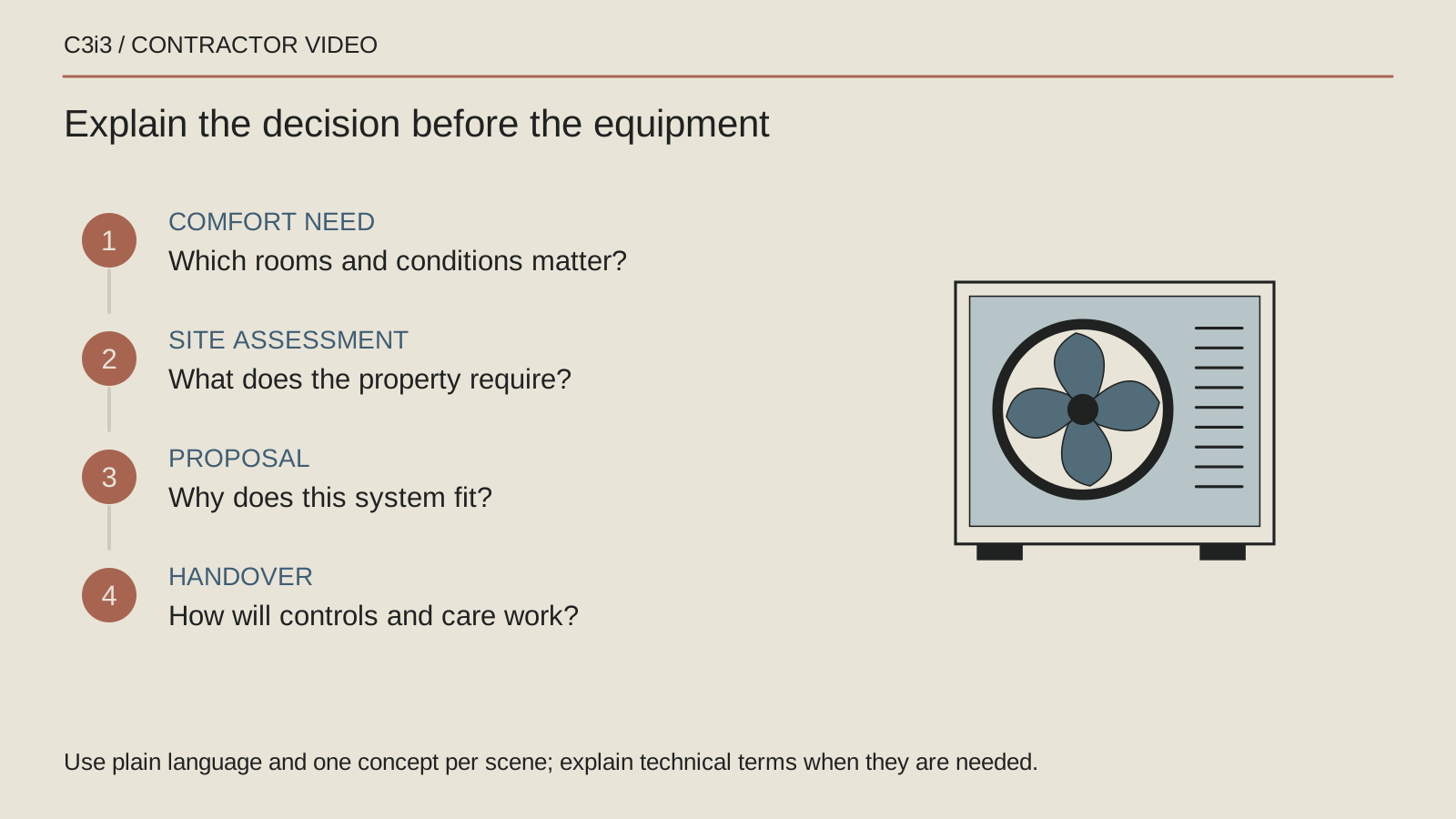
Explain what your qualified team evaluates and which questions depend on the actual property. Describe the information a homeowner can prepare, such as existing equipment details and their comfort concerns, without asking them to inspect unsafe areas.
Use a sequence diagram for assessment, proposal, agreed work and handover. Show where scope is confirmed and where coordination may be needed. Do not imply that every installation requires an identical electrical change, schedule or approval route.
Link the film to a fuller service explanation or the heat pump installer checklist. The viewer should be able to continue researching without having to call simply to understand the basic engagement.
Write the narration as a conversation, then review the claims
Draft a plain-language script and read it aloud. Replace unexplained acronyms and long sentences with specific descriptions. Keep the customer's main question visible in the brief so technical detail does not gradually take over.
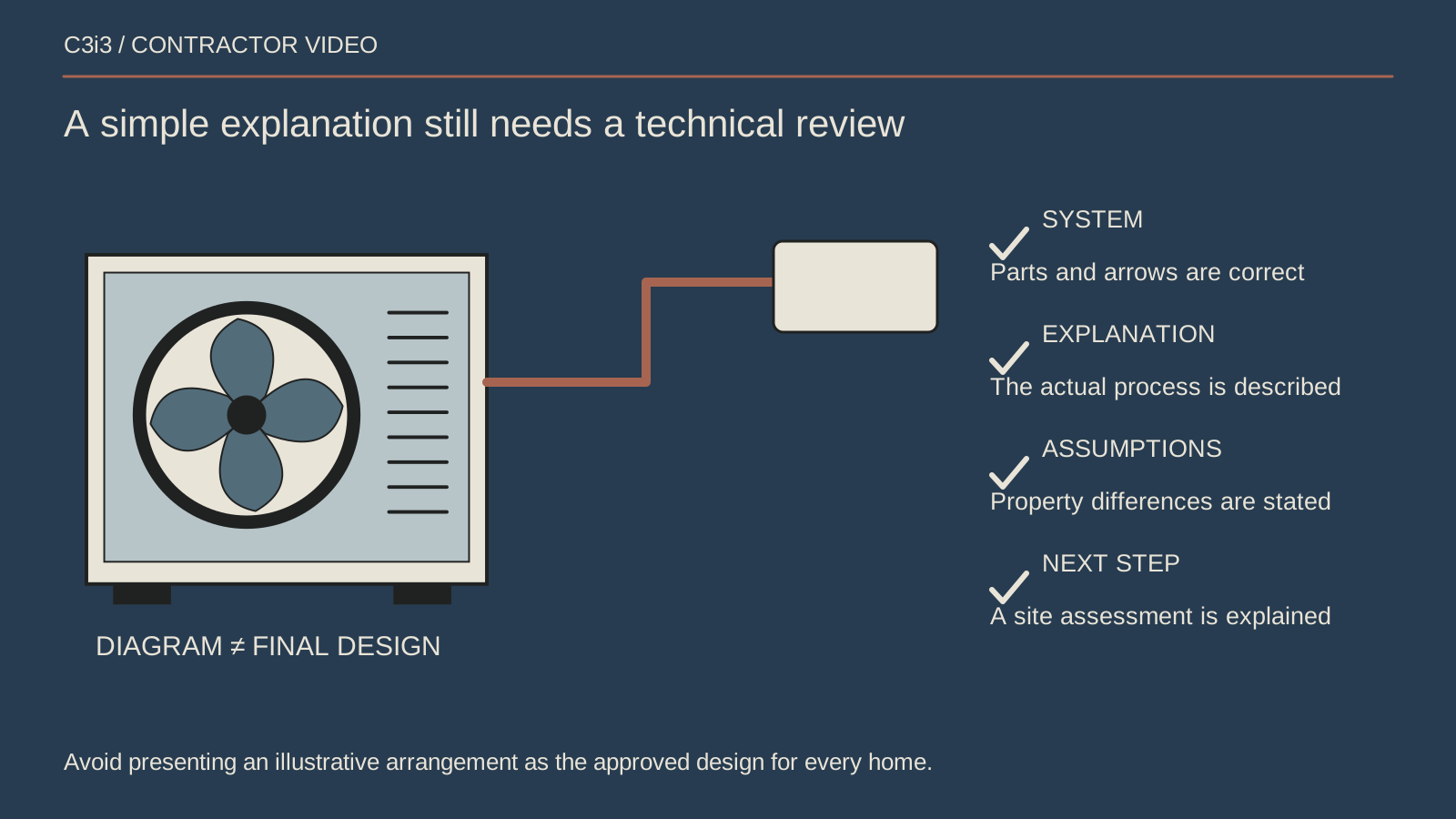
Mark every factual claim requiring approval: performance, suitability, credentials, warranties and program eligibility. Have the responsible expert check those statements before the animation is finalized. A late correction to the narration may also require changing several visual frames.
Keep the explanation centered on assessment, agreed responsibilities and the homeowner’s next decision. Have a qualified reviewer confirm that the script describes the actual service. The film remains more useful when its core explanation reflects a maintained process rather than a temporary promotional message.
Make graphics, captions and sound work together
Use consistent object shapes, short labels and enough contrast for phone viewing. Animate the point being explained rather than adding movement to every element. A subtle reveal can show sequence; unnecessary motion can make a simple idea harder to follow.
Provide accurate captions for the narration and check that important meaning is not carried by color alone. Listen to the final audio for pronunciation and natural pacing. Do not approve a voice merely because the text is technically correct.
Review the actual mobile version with someone unfamiliar with the service. Ask what they believe the next step is and what service the film describes. Their interpretation can expose an ambiguity the production team no longer notices.
Publish the explainer where the question arises
Place the video beside the assessment or installation explanation on your website. Give it a useful title and a text summary so people can read the information when watching is inconvenient. Keep the contact invitation clear and modest.
Test playback, captions and the surrounding page. If the video is hosted on a public platform, check the description and destination links there as well. The same approved explanation should remain coherent across versions.
Use the contractor video planning framework to review the film's role. If customers still ask the same unanswered question, revise the explanation before ordering a longer or more elaborate animation.
Keep this checklist beside you
Questions before the next step
Can an explainer replace a heat pump assessment?
No. It can explain the process and prepare a homeowner for the conversation. Equipment suitability and installation requirements need appropriate property-specific evaluation by qualified professionals.
Does the video need complex 3D animation?
Not necessarily. Clear two-dimensional objects and a well-planned sequence can explain the chosen question. Choose complexity only when it makes a specific concept easier to understand.

How C3i3 Can Help
C3i3 can help plan an explainer video with a clear script, original vector diagrams and a sensible website destination. Your technical team can review specialist statements while we shape the customer-facing narrative.
Bring the question your team repeatedly answers and the installation process you want to explain. We can develop a focused storyboard before production begins, so the message and visual sequence are reviewable early. A useful explanation starts with clarity, not a longer feature list.