In this article
For a clear distinction between the free listing and paid campaigns, read our Google Ads, Local Services Ads, and Google Business Profile comparison.
Your Google Business Profile may be the first thing a customer sees, before they open your website or speak with your team. A wrong phone number, unclear service area, or outdated opening time can interrupt that first conversation.
For a San Francisco business, the useful starting point is a practical review of what a customer can discover and do. Check the real information first, then decide what needs ongoing attention.
Who should control your Google Business Profile?
Make sure the business knows which account manages the profile and who can make changes. A former employee or an outside supplier should not be the only person able to help when information needs correcting.
Keep a clear record of responsibility
Identify the person who approves business details and the person who maintains them. Keep access arrangements in an appropriate account-management system, rather than putting passwords into a shared content calendar. When people change roles, review who still needs access.
Represent the real business
Google's business representation guidelines say the profile should reflect the business as it exists in the real world. Use its recognized name and accurate category information; do not add promotional wording to the name simply to attract searches.
Before creating another listing, check whether the business already has a profile. If there is an ownership problem or an apparent duplicate, investigate the existing listing and the available support process instead of creating more confusion.
Should you show an address or a service area?
The answer depends on how you actually serve customers. A place people can visit and a business that travels to customers are different situations. Your profile should make that distinction clear.
Follow the rules for your business model
Google's service-area guidance says a business that does not serve customers at its address should remove that address from the profile. A qualifying hybrid business can show its customer-facing location and service area.
Describe coverage you can deliver
Do not add every Bay Area city because it looks ambitious. Discuss travel time, delivery boundaries, appointment availability, and the kinds of jobs your team can support. The public information should match the answer someone receives when they call.
For a fictional San Francisco catering business, useful coverage information might distinguish delivery availability from pickup at a real location. The details should come from operations, not from a list of neighborhoods copied into the description.
If the website also needs a local explanation, use our local service-page guide to plan the information around the actual service.
Which profile details should you test as a customer?
Open the public profile on a phone and follow the actions a new customer would take. This reveals issues that can be easy to miss while reviewing a settings screen.
| Detail | What to verify |
|---|---|
| Hours | The displayed hours reflect when customers can actually visit or contact the business. |
| Phone | The number reaches the right team and has a useful response process. |
| Website | The destination works on mobile and explains the relevant offer. |
| Booking or ordering | Any action shown leads to a functioning, appropriate destination. |
Include the handoff after the click
A correct link is only the beginning. Confirm who receives a booking, form submission, or message, and what happens when that person is unavailable. Avoid promising a response time that the team has not agreed to support.
Our website copy guide helps check whether the destination answers the questions a visitor brings with them.
What should the description, services, and photos explain?
Give people enough information to recognize what the business does and whether it fits their situation. Plain descriptions are more useful than a collection of broad claims.
Use specific, supportable wording
Review the services you actually provide, who they are suitable for, and any important limitations. Keep the website and profile consistent when an offer changes. Google provides separate fields for different business information, so use each field for its intended purpose.
Show the business customers can expect
Use accurate images that help someone recognize the place, product, service, or work. Obtain the necessary permissions before publishing identifiable customer material. A visual should clarify the experience rather than imply a project, location, or team that does not exist.
Keep a simple asset list: what the image shows, where it is approved for use, and who can provide an updated version. This makes maintenance easier when the shop, products, or service presentation changes.
How should you request and respond to reviews?
Make it straightforward for customers to share a genuine experience. Build a consistent request process into an appropriate point after the service, rather than treating reviews as a one-time campaign.
Ask without offering an incentive
Google's review guidance prohibits incentives in exchange for posting, changing, or removing reviews. Keep requests focused on honest feedback, and do not write reviews on behalf of customers.
Respond as a real business
A useful reply acknowledges the feedback and addresses a relevant point. Avoid repeating the same promotional paragraph under every review. When a situation requires account details or private information, invite the customer into an appropriate private conversation.
Record recurring concerns for the operational team. If customers repeatedly misunderstand what is included, that may be a reason to improve the service explanation as well as the reply. Feedback is useful beyond its appearance on the profile.
How often should you review the profile, and what should you measure?
Review it when hours, services, contact details, or locations change, and give it a regular place in the marketing routine. Set a review rhythm your team can sustain instead of waiting until a customer reports an error.
Connect activity with real enquiries
Review the performance information available to the account alongside website activity and enquiries. Separate a profile interaction from a qualified lead or a completed sale. Ask the team what customers wanted and whether they could be served.
Google's local-ranking guidance describes relevance, distance, and how well-known a business is as factors. Maintaining a profile does not give you control over every local result or guarantee a particular position.
Assign the next action
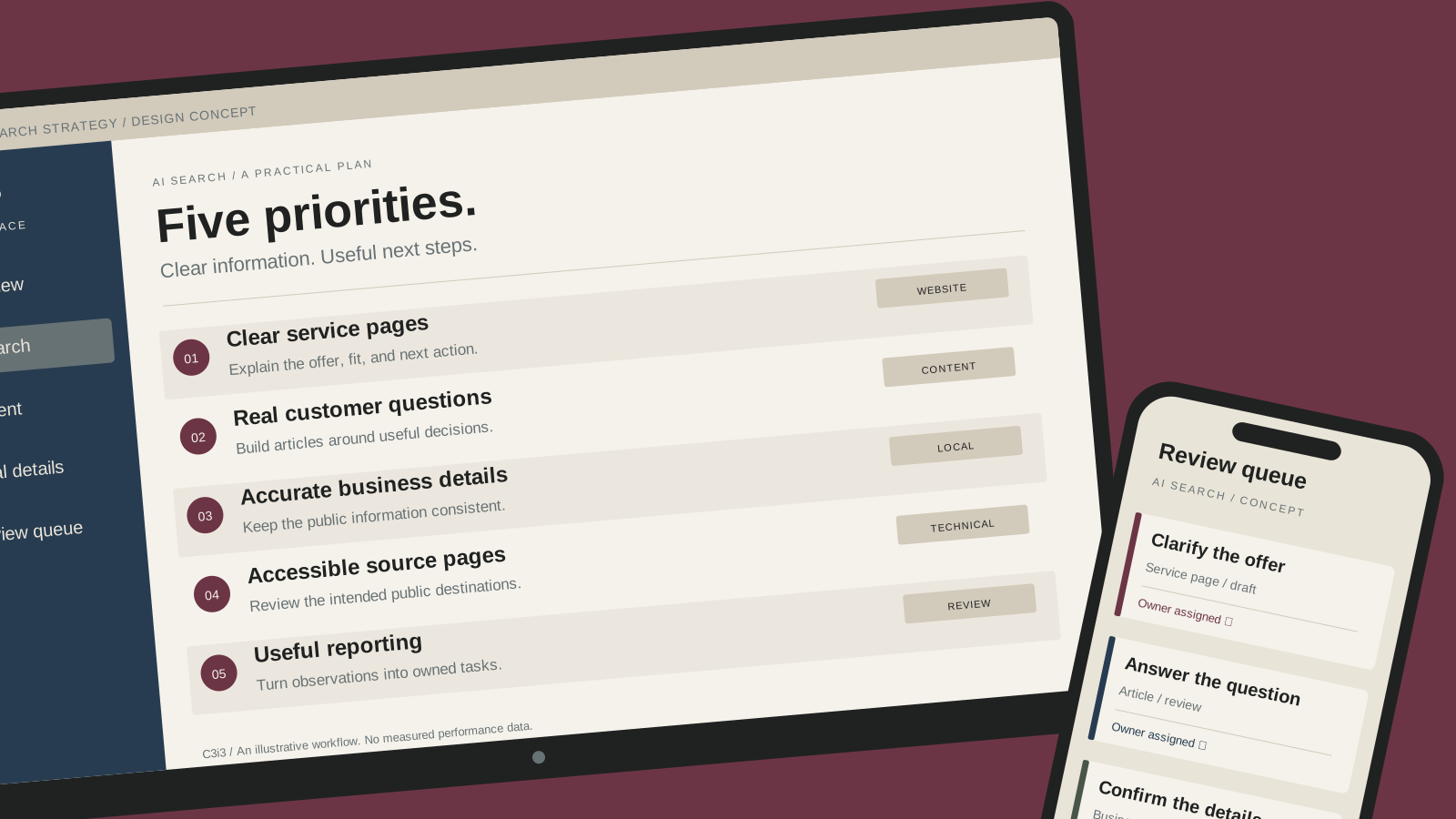
Keep a short list of corrections, content needs, and unresolved questions. Give each item an owner. Our five AI search strategies explains how profile maintenance can sit alongside the website, content, and enquiry process.
For the broader connection with answer-based search, read what AI search optimization involves.
Are the essentials in order?
Work through these checks with the person responsible for business information.
More about maintaining a useful profile.
Should every city we serve have a separate profile?
Do not treat a service-area list as permission to create separate locations. Review the rules that apply to the actual business model and any genuine additional location. A website can explain legitimate coverage without implying that you operate a staffed office in each city.
Does completing the profile guarantee more customers?
No. Accurate information helps people assess and contact the business, but demand, suitability, competition, customer experience, and follow-up still matter. Review useful enquiries and completed work alongside profile activity.
Can an agency maintain the profile for us?
Yes, with appropriate access and a clear scope. The business should remain involved in approving facts, reporting operational changes, and responding to customer issues. Agree who handles each part before the work begins.
A profile is one part of the customer journey. Our Bay Area SEO approach connects accurate local information with useful website pages and a clear next step.
Does your local information tell the right story?
We can review the profile, website, and customer journey as connected parts of your marketing.