



































In this article
You search for roof repair and see other businesses. You search again from another location and the order changes. Before concluding that a competitor has a secret SEO trick, separate what you observed from what you actually know. A single result screen cannot tell you how many enquiries another roofer receives.
SEO competitive analysis for roofers should identify a useful next action on your own site. The goal is to understand the questions, page types and evidence appearing for work you genuinely provide, then find where your website fails to give the customer an equally useful answer.
Start with the repair work you actually want
List the real repair situations the business assesses: a reported leak, damaged flashing or another defined service within your capability. Avoid adding every roofing term a keyword tool returns. The list should reflect the work your office can discuss and your team can deliver.
Separate repair intent from replacement, installation and do-it-yourself research. A homeowner asking why a ceiling stain appeared needs different information from one requesting a roof replacement quote. You can serve both readers through distinct explanations without merging every phrase into one title.
Record the intended service area and customer task beside each query. This prevents a national informational term with a large estimate from displacing a smaller, commercially relevant question your actual customers need answered.
Compare the same search context each time
Create a simple observation log: query, location context, device, date, result type and destination page. Distinguish map results, advertisements, directories and ordinary website results. They are different surfaces and should not be combined into one unexplained position number.
Inspect several relevant queries rather than repeatedly checking your favorite phrase. Do not assume your own browser represents every customer. Use consistent checks to identify patterns, while recognizing that results can vary by context and time.
Keep named competitors in private research notes. Your public article or service page should explain your own offer and useful customer information. There is no need to publish speculative claims about another roofer's marketing, finances or technical work.
Study the destination page, not just its headline
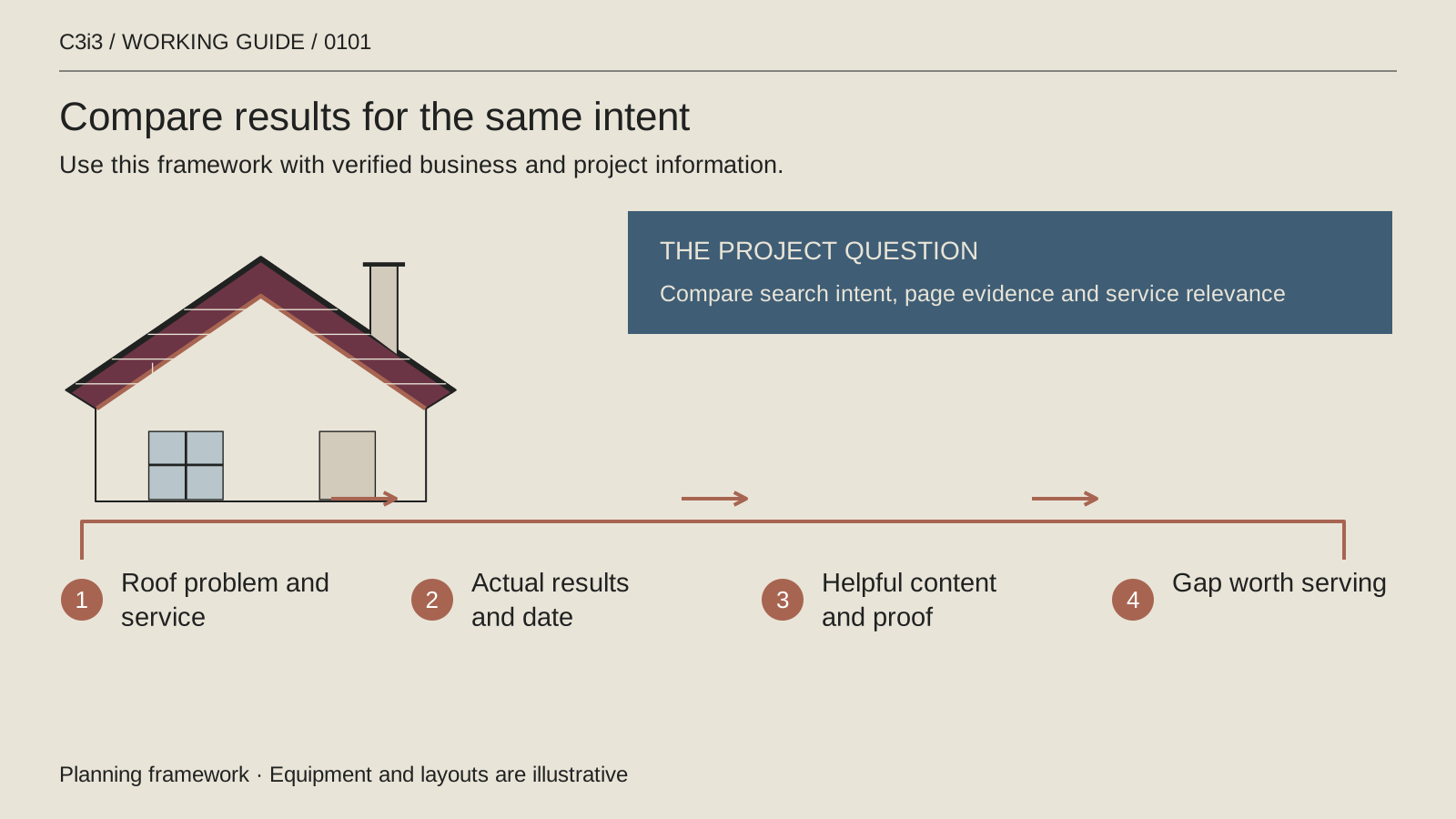
Open the pages that appear relevant and note what customer task each serves. Does the page explain the repair assessment, coverage, limitations, project evidence and enquiry process? Is it a directory page, a useful guide or a focused service destination?
Record observable features instead of copying wording or treating every feature as a ranking cause. A highly placed page may contain a large gallery, but that does not prove gallery size caused the placement. The useful question is whether your reader is missing information that matters.
Create a comparison worksheet with columns for question answered, evidence supplied, next step and gap on your own site. This turns a vague competitor report into an editorial brief you can act on.
Use Search Console to find your own missed opportunity
Review queries and landing pages in Search Console's performance report. Look for relevant repair searches producing impressions and examine which page receives them. Check whether the visible title and destination actually match the customer task.
Treat the metrics carefully. An impression is not a visitor, a click is not a qualified enquiry, and an average position is not a permanent placement. Some query data is unavailable or limited. Compare like periods and record major site or campaign changes.
If the wrong page receives the query, investigate its content and internal links before creating another page. A useful repair explanation may already exist but be difficult for people and search systems to discover.
Fix the biggest customer gap before adding more pages
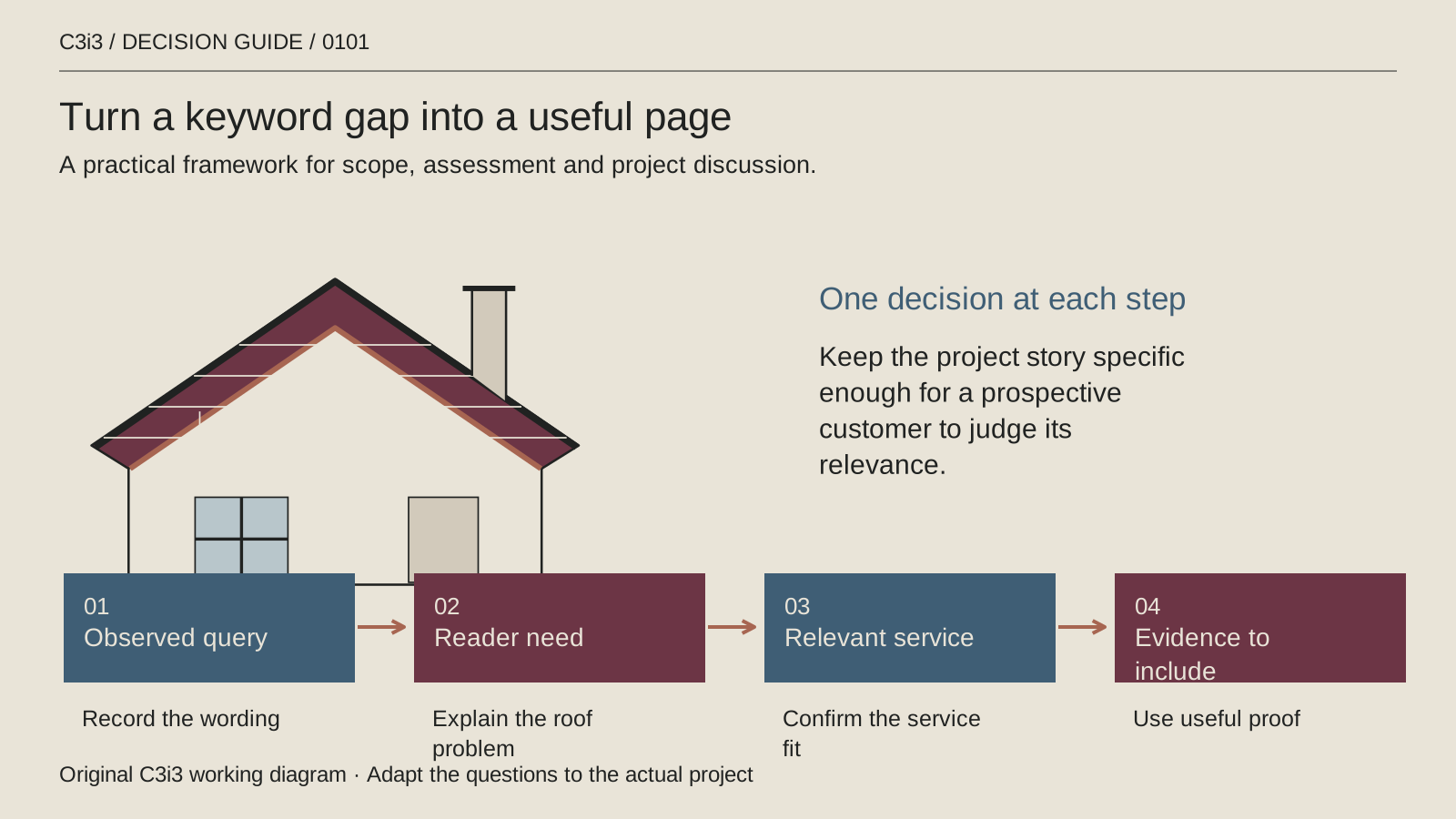
Choose one improvement that the evidence supports. It might be a clearer repair assessment section, relevant completed-work evidence, a better mobile contact route or an internal link from a related guide. State what the change is intended to help the reader do.
For an East Bay business, use genuine coverage information and explain relevant logistics. Do not create a separate near-identical page for every neighboring city. A local page needs a distinct purpose and maintained information, not a city name pasted into repeated paragraphs.
Google's people-first content guidance is a useful quality check. The page should resolve a customer question even if no ranking report were attached to the project.
Review results without turning estimates into certainty
Record the change and allow for the time and traffic needed to observe a useful pattern. Review relevant search activity alongside actual enquiries and the office's qualification notes. Check whether the repair requests fit the service you intended to promote.
If visibility improves but enquiries remain weak, inspect the offer and customer path. If enquiries increase but are mostly unsuitable, revisit the contractor positioning framework. Each problem calls for a different response.
A good competitive analysis ends with a decision, an owner and a way to review it. A large spreadsheet of estimated competitor keywords can be interesting, but it has little value until it changes a useful part of your own website.
Keep observations and conclusions separate
| Research field | Record | Do not infer |
|---|---|---|
| Search context | Query, location context, device, date | A permanent universal position |
| Result destination | Page type and question answered | A competitor’s booked work |
| Your own page | Relevant query and destination | That every impression is a lead |
Keep this checklist beside you
Questions before the next step
Can I know exactly how many leads a competing roofer gets?
Not from public rankings or keyword estimates. Those observations do not reveal answered calls, qualified enquiries or booked work. Keep the analysis limited to what the source can establish.
Should every roof repair keyword have its own page?
No. Group phrases that share the same customer task. Create a distinct page when it serves a different need and you have useful, specific information to provide.

How C3i3 Can Help
C3i3 can help connect SEO audit findings with service-page content and the enquiry process. We can review the queries you care about, the pages receiving attention and the information customers still need.
Bring your actual repair services and the results you have observed. We can separate measured data from estimates and prioritize a practical change. The goal is a clearer customer path and an accountable improvement plan, with defined responsibilities and a reviewable next step.