



































In this article
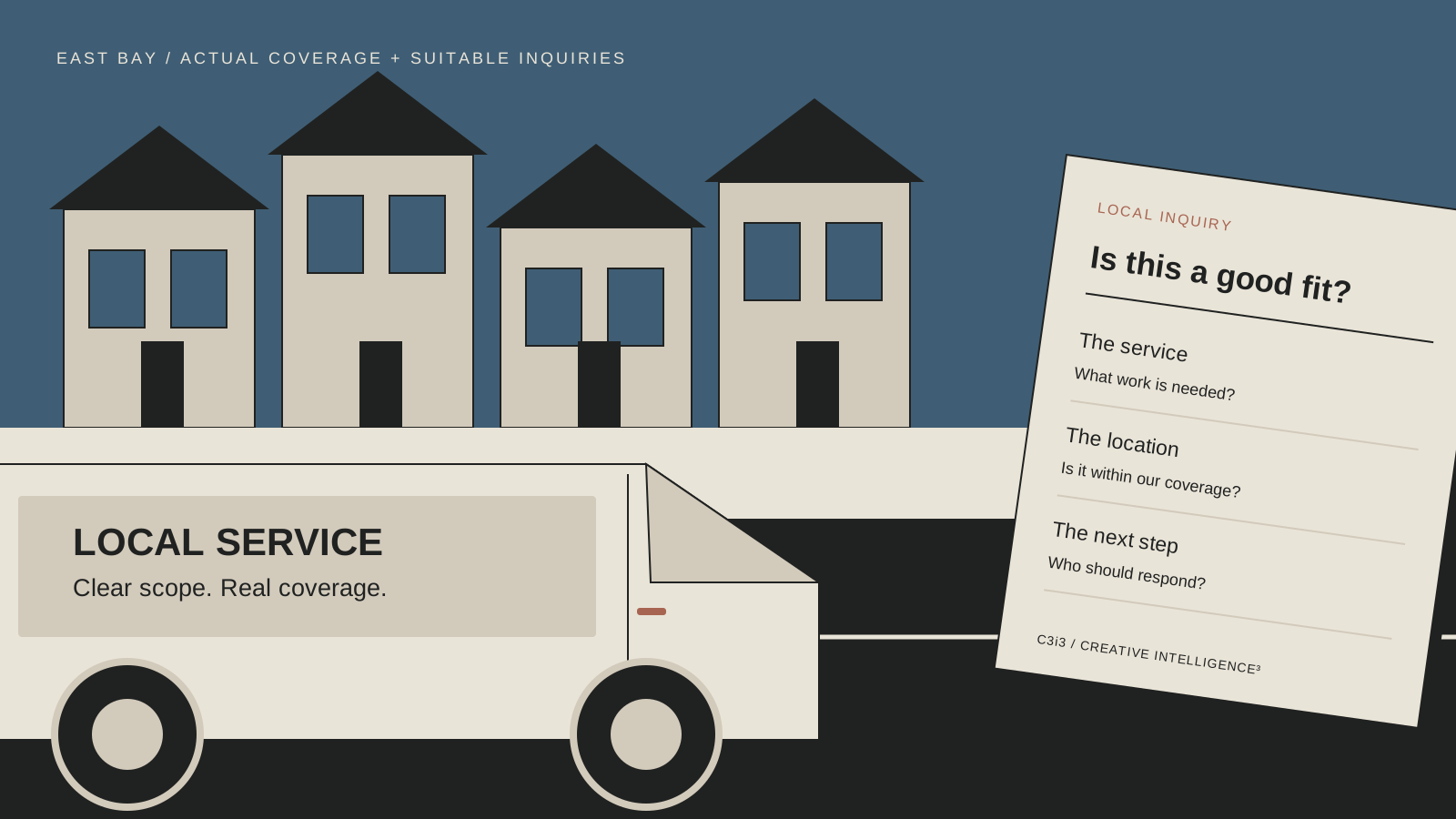
An East Bay service business can appear in search and still receive the wrong inquiries. Customers may misunderstand the service area, request work below the company’s scope or struggle to find a working contact option on a phone.
A useful local SEO program examines that full path. For a business serving Oakland, Walnut Creek, the Tri-Valley or nearby communities, the content should explain the actual service arrangements instead of treating every city as another keyword to repeat.
Why can local website traffic fail to produce suitable leads?
Traffic can be poorly matched to the offer, the page can leave important questions unanswered, or the inquiry process can fail. Those causes require different remedies, so begin with evidence rather than assuming the business simply needs more visits.
Review which services people request and where they are located. A page may attract customers for a service the company no longer provides. A broad article may attract readers who want to perform the task themselves. Neither observation necessarily means the website needs a larger content library.
Then inspect the page and contact path. Can a visitor tell the service scope, coverage and next step? Does the form work on mobile? Does the team receive the message and know who should respond? A visibility improvement cannot compensate for a request that is never handled.
Practical tip: Review a recent sample of inquiries and label the reason for a poor fit. Use categories such as wrong service, outside coverage, unsuitable project scope or spam. Those patterns give the agency a concrete first brief. The SEO company selection guide helps you assess its response.
How should an East Bay service business describe its coverage?
Describe where you actually work and any arrangements that affect the customer. Distinguish an office or shop people can visit from cities where you perform on-site services.
A business serving Oakland and the Tri-Valley may need to explain travel scheduling, appointment availability or the services offered in each area. Use only arrangements the team can confirm. Do not imply a staffed office in every city or publish a neighborhood page simply to suggest proximity.
Local detail is useful when it changes the decision. A service may be available across the region but require a preliminary call before a site visit. Another may be limited to specific project types or areas. Explain those boundaries directly and route the reader to the appropriate inquiry step.
Try this: Ask a staff member to answer, “Can we help this person at this address with this kind of job?” The website should communicate the public information needed to answer that question without revealing private operational details.
Use C3i3’s Bay Area SEO services as a starting point for a regional scope rather than a set of invented location claims.
What should local service pages include to help customers choose?
A useful service page explains the problem addressed, who the service suits, what is included, important limits and the next step. It should give enough detail for a suitable visitor to recognize a fit.
For an illustrative maintenance company, include the equipment or property types covered, how a first assessment works and what information helps the team respond. For a consultation business, explain the first conversation and the factors that shape the scope. Avoid publishing a fixed price when the service requires an assessment and the business has not approved one.
Support claims with relevant examples, current qualifications or a clear description of the process. If you publish a project story, identify your actual role and the outcome you can substantiate. An original illustration can introduce a guide but should not be presented as a photograph of a completed job.
Google’s helpful content guidance is a useful editorial reference. The practical test is whether a customer can make a more informed next decision after reading the page.
For a page-level checklist, see what belongs on a local SEO service page; adapt the method to your actual East Bay business.
When should you create city pages or supporting local articles?
Create a separate page when it has a distinct purpose and useful evidence. A city page may be appropriate when the service arrangement or relevant experience differs. A supporting article may be appropriate when it solves a substantial question before a customer calls.
Do not create several pages that repeat the same content with a different city inserted. That makes the site harder to maintain and can leave readers unable to tell which page is authoritative. Google’s spam policies address practices including doorway abuse and scaled content abuse.
For an illustrative home-service business, a guide to preparing for a site assessment may help customers across several cities. It may not need separate Oakland, Dublin and Walnut Creek versions. Link the one useful guide from the relevant services instead.
Ask the agency to explain each page in one sentence: which question does it answer, for whom, and what should the reader do next? If several pages have the same answer, consider improving or consolidating them.
Practical tip: Keep a page inventory with the URL and purpose. Review it before approving another local-content batch so the website expands with intent rather than repetition.
How can an agency improve the contact journey for local customers?
It should test the actual path a customer follows, especially on a phone. The service page, contact action, form, confirmation and team notification all deserve attention.
Ask for the information needed to respond at first contact. A service type, general location and short description may be enough to route a request. If photos or documents are useful, explain whether they are optional and when the customer should provide them. Avoid creating a form that requires more detail than the first conversation needs.
Make the next step clear. Tell the customer what happens after submission and which channel the business uses to respond. Publish only response expectations the team can maintain. If an urgent request is outside the business’s process, explain the available contact route accurately.
Review the follow-up handoff. Who receives the request, who responds and how is its status recorded? A marketing report should not claim success from a form submission that the business never handled.
Our UX audit services and local SEO support can be combined when page clarity and inquiry usability both need work.
How do you measure whether East Bay SEO is bringing better leads?
Agree on a definition of a suitable inquiry, then review the request and outcome with the people handling sales. Track the requested service, market fit and next stage without treating every message as equivalent.
Search clicks, website actions, qualified inquiries, appointments and booked work are different measures. Where the data allows it, review the stages together. Where attribution is unavailable, say so rather than assigning every new customer to SEO.
Record other changes that matter. A seasonal surge, paid campaign, change in service availability or slower response process can affect results. Compare periods that help answer the business question and avoid drawing a broad conclusion from a few days of movement.
Use the SEO agency performance checklist to structure a monthly conversation. If you are also considering paid acquisition, our East Bay lead-cost comparison explains why qualified outcomes matter across channels.
Practical tip: End the review with one specific action: clarify a service limit, improve a page, repair the contact path or adjust follow-up. A useful report should lead to a decision the business can act on.
What else should East Bay service businesses know about local SEO?
Do we need a page for every East Bay city?
No. A separate page should answer a distinct need with accurate information. Regional coverage can often be explained clearly on the service page or a useful regional guide.
Should we count every phone-link click as a lead?
A click indicates an attempted action, not a confirmed conversation or suitable inquiry. Keep it separate from connected calls and qualified requests when those can be measured.
Can local SEO and AI search be handled together?
Yes, with a coordinated scope. Accurate service information and useful answers can support both. Read the SEO, AEO and AIO comparison before purchasing overlapping packages.
How can C3i3 help your East Bay service business improve local inquiries?
Bring your priority services, actual coverage and a few common customer questions. We can help identify the page and contact improvements that deserve attention first.
Explore local SEO services or contact C3i3 to discuss a scope that connects useful local content with a working inquiry process.