In this article
If the product names are still unclear, our national guide to Google Ads, Local Services Ads, and Google Business Profile explains the three different roles.
A cheap enquiry can become an expensive customer. An East Bay service business choosing between Google Search ads and Local Services Ads needs to look beyond the price shown beside a click or lead. The useful question is what it costs to win suitable work that the team can actually deliver.
This guide is a budgeting worksheet, not a list of supposed Walnut Creek or Concord advertising rates. It explains how to compare the two channels using your own enquiry quality, booked jobs, travel requirements, and total costs. If you are still choosing between the products, begin with our Google Ads vs. Local Services Ads comparison for Bay Area businesses.
What should count as a qualified lead for an East Bay business?
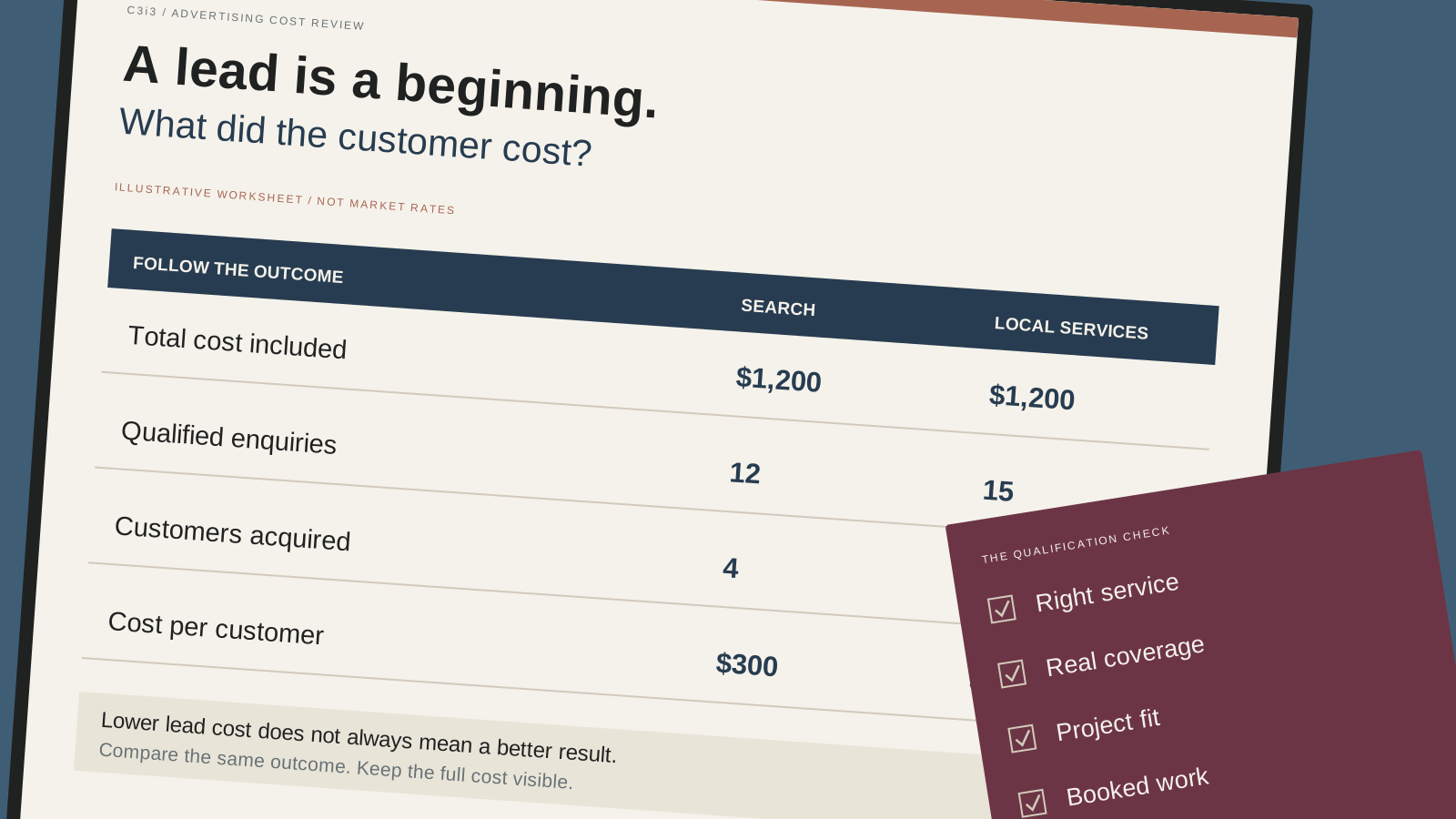
Define a qualified enquiry before comparing campaigns. For a local service company, that could mean someone requesting work you offer, in a place you can serve, within a realistic timeframe, and with a project that fits your business. A message containing a phone number is not enough on its own.
Use the same qualification rules for both channels
Give whoever answers the phone a short set of fields: requested service, job location, timing, project fit, and outcome. Record whether the enquiry became an appointment, estimate, booked job, or no further action. Use the same rules whether it came through a website or a provider profile.
Separate repeat contacts from new opportunities
One person may call twice, fill out a form, and then reply to an email. Your own review should recognize one customer journey rather than treating every contact as a separate opportunity. Keep enough notes to understand the result without collecting information that has no practical use.
Write the definitions into your small business marketing plan. This keeps the meaning of a lead from changing halfway through a comparison.
Why can you not compare a Google Ads click with an LSA lead?
A click measures a different step from a direct service enquiry. In a Search campaign, visitors may need to reach a page and decide to contact you. With Local Services Ads, Google's lead billing guidance describes charges for valid leads, with prices influenced by factors including location, job type, lead type, and bidding.
That difference does not establish which channel will be more profitable. A lower entry cost can still produce unsuitable enquiries; a higher entry cost can still lead to appropriate work. Follow the customer journey far enough to compare like with like.
Keep platform billing and business qualification separate
Google's assessment of a charge is not the same as your assessment of whether a job fits your team. Record the charge and your own outcome independently. If you dispute or receive a credit, keep the adjustment visible in the cost record rather than silently changing the original lead count.
Do not treat the Business Profile as another paid lead channel
Google Business Profile is free and can represent an eligible business on Search and Maps. Maintaining it can still take staff or agency time. Separate that work from paid advertising costs so the comparison remains understandable.
Which costs belong in your Google advertising budget?
Start with the amount charged for advertising, then add the work needed to make it useful. List account setup, ongoing management, relevant creative or landing-page work, measurement, and enquiry handling. Show one-time setup separately from recurring work so a launch month does not become a misleading long-term benchmark.
Distinguish cash spending from staff time
Both matter, but keep them visible as separate lines. A small business owner answering enquiries outside working hours is contributing real effort even if there is no separate invoice. Assign a sensible internal value if you want to understand the complete cost of acquisition.
Keep the value of the job in view
Revenue alone can hide a poor fit. Consider delivery effort, materials, travel, and whether the job displaces more appropriate work. A campaign that fills the diary can still be a weak investment if those jobs leave little room to cover the rest of the business.
Google's return-on-investment guide emphasizes evaluating advertising against business outcomes. Use your own cost structure and a consistent calculation; another company's target is not automatically suitable for you.
How do you calculate cost per qualified lead and booked customer?
Divide the acquisition costs you have chosen to include by the number of qualified enquiries or acquired customers for that activity. State which costs are included and use the same approach for both channels. Where attribution is uncertain, mark it as uncertain rather than forcing the sale into a convenient column.
| Measure | Search campaign example | Local Services example |
|---|---|---|
| Total acquisition cost included | $1,200 | $1,200 |
| Qualified enquiries | 12 | 15 |
| Acquired customers | 4 | 3 |
| Cost per qualified enquiry | $1,200 ÷ 12 = $100 | $1,200 ÷ 15 = $80 |
| Cost per acquired customer | $1,200 ÷ 4 = $300 | $1,200 ÷ 3 = $400 |
In this invented example, Local Services produces a lower qualified-enquiry cost but a higher acquired-customer cost. That is why a lead price by itself cannot settle the decision. The table also says nothing about the value or delivery cost of those customers' jobs.
Read small samples carefully
One additional booking would change these figures materially. Do not turn a small test into a claim that one platform always wins. Look for patterns over a review period appropriate to the buying process, and keep unresolved estimates separate from completed sales.
How should Walnut Creek, Concord and other East Bay service areas affect your budget?
Base the service area on how the business operates, not on a wish to appear in every city. Consider where the team starts the day, which jobs justify travel, how quickly you can respond, and whether parking or site access changes the time needed to deliver the work. These are planning questions, not claims about advertising prices in a particular city.
Group jobs that make operational sense
As an illustrative planning exercise, a team based near Walnut Creek might review Walnut Creek and Concord enquiries together when they fit its actual coverage. Another team may find a different grouping more practical. Record the job location and delivery effort so you can see whether a wider area improves the business outcome.
Do not confuse advertising coverage with an office address
Serving customers in a place does not mean you have premises there. Keep Business Profile details truthful, and check the eligibility and location requirements of each advertising product. Local Services Ads availability must be checked for your own category and area; “East Bay” is not an eligibility guarantee.
Before expanding coverage, review whether the service pages customers reach explain the real offer and area. A page should help the visitor make a decision rather than simply repeat a list of city names.
When should you increase, adjust, or pause the advertising budget?
Set review rules before the campaign starts. Decide who can change spending, what counts as an unacceptable enquiry, and which business outcome would justify more investment. Avoid treating a platform recommendation as a substitute for your own capacity and customer economics.
Fix the step that is failing
If enquiries concern the wrong work, inspect the message and service selection. If the location is wrong, review coverage and targeting. If appropriate people never receive a response, fix follow-up before buying more demand. If they reach a confusing page, improve the website or landing page.
Keep a short decision record
Record what changed, why you changed it, who approved it, and what you expect to learn. This makes the next review more useful than starting again from a dashboard screenshot. If nobody owns the coordination, consider ongoing marketing support with clear responsibilities.
Use the results to decide on a next test, not to write a universal verdict. Different services, capacity, and customer journeys can justify different choices even within the same East Bay business.
What should your advertising cost review contain?
More about comparing advertising costs.
What is a good cost per lead in the East Bay?
There is no useful single figure for every business. Start with your job economics, qualification rate, booking rate, and costs. This guide does not claim measured local click prices or lead benchmarks.
Should we spend equally on both channels?
Equal spending is not a requirement for a useful comparison. Keep the offer, qualification rules, and cost definitions clear, and recognize differences in timing and available demand. Do not split a small budget so thinly that neither test answers a practical question.
Is Google Business Profile included in Local Services Ads?
They are separate products. Direct Local Services advertisers generally need an affiliated, verified Business Profile under Google's account requirements. Profile maintenance and advertising management should be identified separately in a provider's scope.
Need a clearer view of your lead costs?
We can help organize the offer, campaign reporting, enquiry handling, and next decision around the work your business wants.