








































In this article
A potential customer asks ChatGPT how to choose an interior designer, compare a service or prepare for a consultation. Your business may be relevant, but a website that gives only a slogan and a phone number leaves many practical questions unanswered.
For a San Francisco service business, the useful starting point is the information behind a real buying decision: what you do, who you help, where you work and what a suitable customer should do next. ChatGPT visibility is one part of that wider customer journey.
How does ChatGPT find information about a San Francisco business?
ChatGPT can use search to retrieve current web information and link to sources. That is different from an answer produced without a live search. A business should therefore distinguish observations from ChatGPT search from assumptions about what a model already knows.
OpenAI identifies OAI-SearchBot as a crawler for its search features. Its documentation distinguishes that from GPTBot, which concerns potential training use. Allowing search access and allowing training are separate controls. Have your website team review the actual settings and explain any proposed change. See OpenAI’s bot documentation.
Accessible pages still need to be relevant and useful. A crawler setting is a technical input, not a reservation for a recommendation. Your pages should make the service, audience, evidence and contact details clear without requiring a visitor to interpret a vague brand statement.
Practical tip: Start with the exact public URL for your most important service. Confirm that a person can open it, read the explanation and reach it through ordinary website links. Our AI search overview provides the broader context.
For ChatGPT search, check both OAI-SearchBot permissions and hosting or CDN access for OpenAI’s published searchbot IP ranges. GPTBot concerns potential training use. ChatGPT-User handles user-triggered visits and is not the search-inclusion control. A permitted request still does not guarantee a citation.
Which questions should your San Francisco service pages answer?
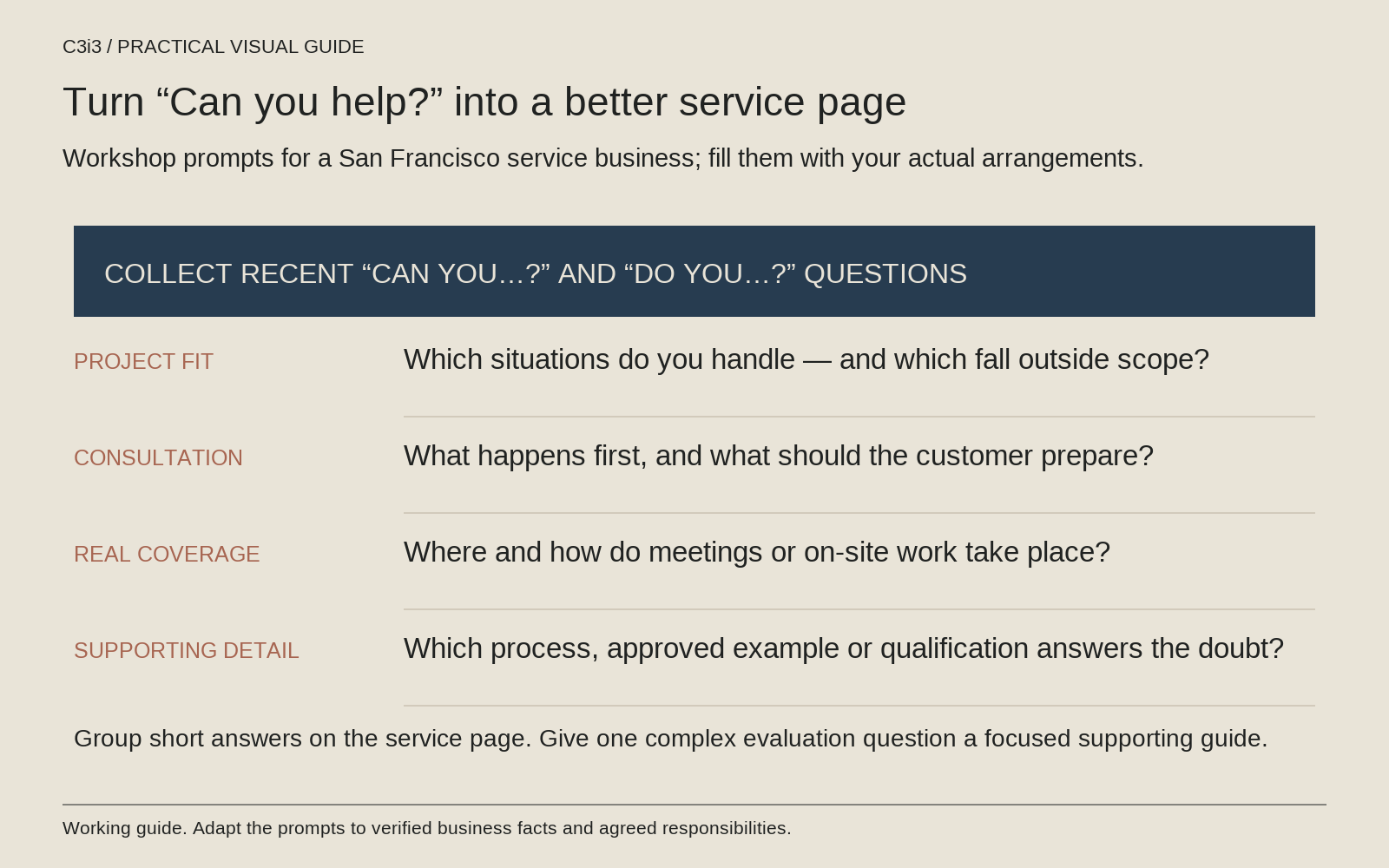
Answer the questions that determine suitability before a booking or consultation. Gather them from inquiry emails, phone conversations and the explanations your staff repeat. Treat suggested search prompts as research questions, not as measured demand unless you have verified data.
An illustrative interior design studio might answer whether it handles whole-home projects or a single room, how the initial consultation works, and whether a client needs an architect or contractor already engaged. A commercial service company may need to explain site visits, project size and operating hours.
A good answer gives the condition as well as the promise. “We serve San Francisco and Marin” becomes more useful when the page explains which services require travel, how appointments are arranged and whether any work is remote. Use only coverage and arrangements your team can confirm.
Try this: Write down five recent questions that started with “Can you…?” or “Do you…?” Group questions about the same service on its main page. Give a complex evaluation question its own guide when a short paragraph would leave important details out. Then connect the guide back to the relevant service.
How should you present service areas and local business information?
Explain the difference between an office customers can visit and a place where your team performs work. Keep the business name, contact details, hours and service descriptions consistent with the actual operation. Accepting a project in a city does not establish a staffed office there.
For a San Francisco service business, useful local information might include whether meetings take place at the client’s premises, in a studio or online. It can also include access arrangements that genuinely affect an appointment. Avoid adding neighborhood names when they do not change the answer.
Review public profiles alongside your website. If one page asks visitors to call an old number while another uses a new booking link, the inconsistency creates confusion regardless of how the visitor found you. Assign someone to review changes when hours, staff or services change.
Use the Google Business Profile checklist for San Francisco businesses as a companion to the website review. A profile and a service page serve related but different purposes. The goal is an accurate, understandable business presence rather than a collection of repeated city phrases.
What evidence makes your business information more useful?
Use evidence that supports the claim beside it. A service description may benefit from a real process, relevant work examples, current qualifications or an explanation from the person responsible for delivery. Obtain permission before publishing client information.
For a project summary, describe the starting situation, your actual role, the constraints and the result you can substantiate. If you did the design but another company handled construction, make that division clear. If a numerical outcome was not measured, do not turn a qualitative improvement into a percentage.
Original images can explain the work, but a conceptual illustration is not proof that a project occurred. Label illustrative scenarios and keep them separate from documented client work. A reader should understand which claims come from direct experience and which examples are simply teaching a principle.
Google’s people-first content guidance offers a useful editorial reference for clear, trustworthy pages. Apply the principle to the customer’s decision: what would help someone evaluate your service without requiring a sales call for every basic fact?
Practical tip: Choose one broad claim on your homepage and trace it to a page that demonstrates it. If there is no supporting detail, improve the evidence before repeating the claim elsewhere.
How do you turn AI-search visits into useful local inquiries?
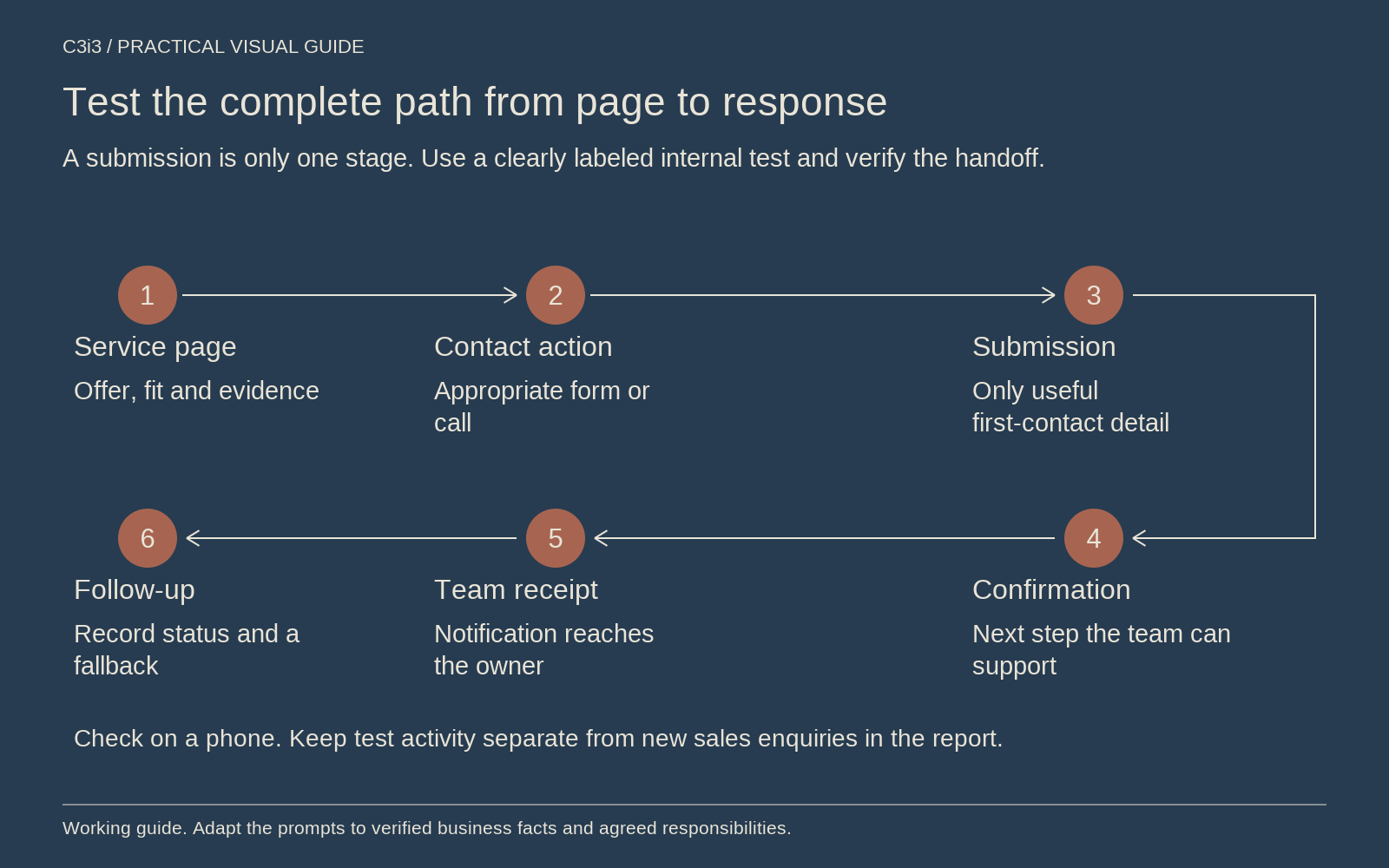
Give visitors enough information to recognize a fit and a straightforward way to contact you. Test the journey on a phone: service page, contact action, form, confirmation and the message your team receives.
A first inquiry should collect what your staff need to respond, without demanding a complete project specification. For a consultation business, service type, general location and a short project description may be enough. Explain what happens next and avoid promising a response time your team cannot maintain.
Separate spam, tests, existing-customer messages and new sales inquiries when reviewing results. A contact count that combines all four can make a campaign look stronger than it is. If a caller says they found you on ChatGPT, record that as self-reported information rather than complete attribution.
Review which questions still arise after people read the page. If prospects repeatedly misunderstand your minimum project scope, the content needs attention. If suitable prospects submit the form but receive no response, the operational handoff needs attention. Visibility, page clarity and follow-up all contribute to the outcome.
Our local SEO services and content marketing support can be scoped around that complete journey.
How should you test ChatGPT visibility and choose agency support?
Use a small, repeatable set of realistic questions. Include discovery questions without your business name, evaluation questions about the service and a separate set that names your brand. Record the platform, search mode, date, prompt, mention and linked source.
A favorable screenshot documents one result. It does not show what every user receives or prove that the result produced a customer. Keep failed observations and uncertain cases in the record, and avoid changing the prompt set simply to improve the report.
Ask an agency which service page it would improve first, what evidence it needs and who will implement the changes. Request a scope covering research, writing, technical checks and measurement. Use the AIO agency buyer’s guide to compare those responsibilities.
For a focused first project, choose one service page, one supporting question and one contact journey. Record the baseline, implement the agreed improvements and review what becomes observable over time. That creates a useful learning cycle without treating an AI recommendation as something the agency can schedule.
Compare this local approach with the San Jose B2B guide when your buyers need deeper technical evaluation.
What else should San Francisco businesses know about ChatGPT search?
Can I guarantee that ChatGPT recommends my business?
No. You can improve the inputs you control and observe selected results, but you cannot reserve a recommendation or guarantee the answer each user receives.
Should we add a page for every San Francisco neighborhood?
Create a separate page only when it answers a distinct need with useful, accurate information. Closely overlapping pages can make the site harder to maintain and navigate.
Which related guides should we read?
Start with the AI-search pillar, the Google AI Overviews guide and the measurement tools guide.
How C3i3 Can Help
Bring one public service page and the question a prospective customer would ask. C3i3 can help review its clarity, evidence and next step.