








































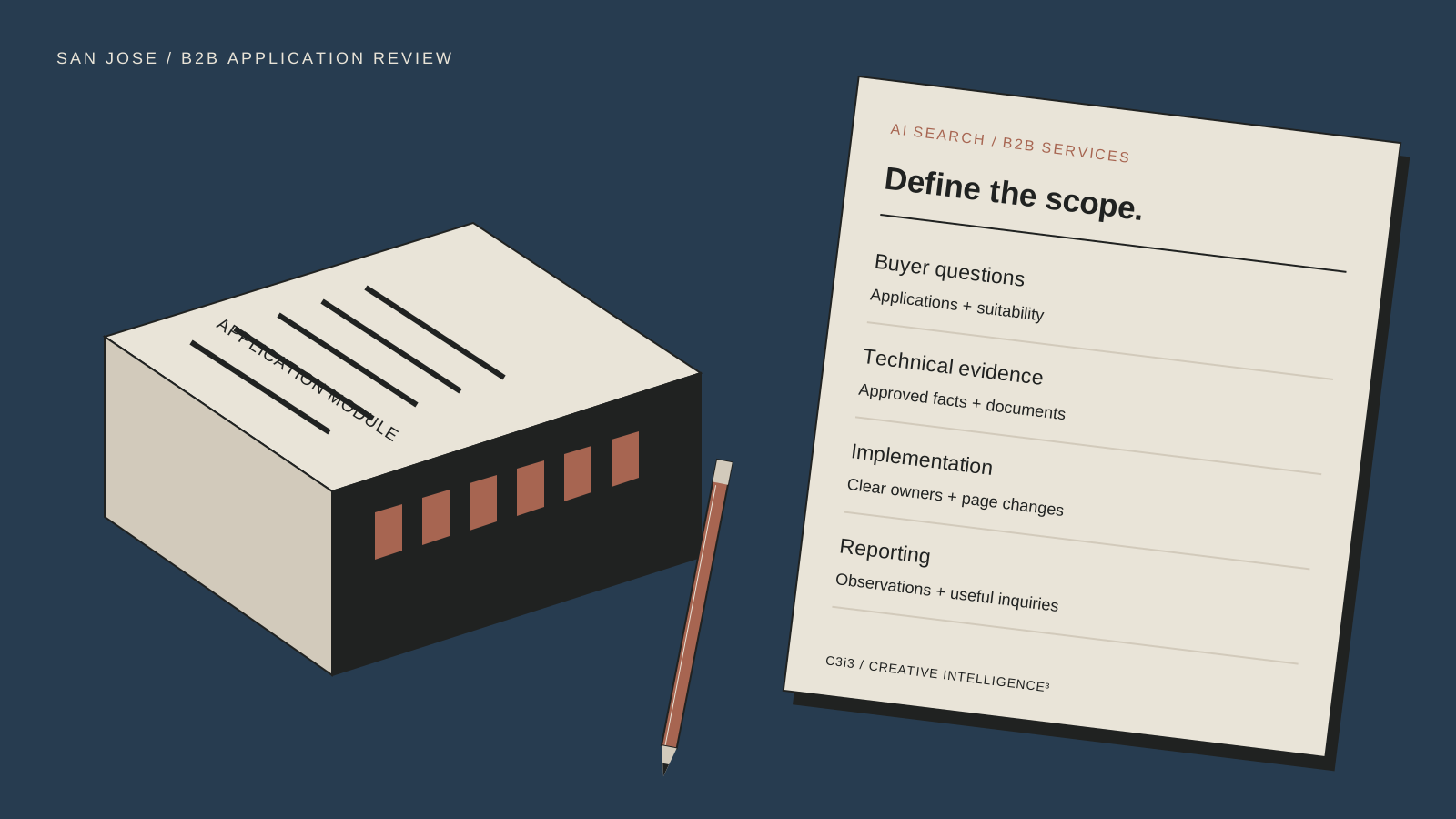
In this article
A San Jose company selling a technical product or B2B service needs more than a general promise of AI visibility. Its buyers may include engineers, operations staff, purchasing teams and executives, each looking for different evidence before a conversation begins.
A useful agency scope connects those questions to the actual website. It names the pages to improve, the technical checks to perform, the people who will verify claims and the observations that will be reported afterward.
What should an AI search optimization service assess first?
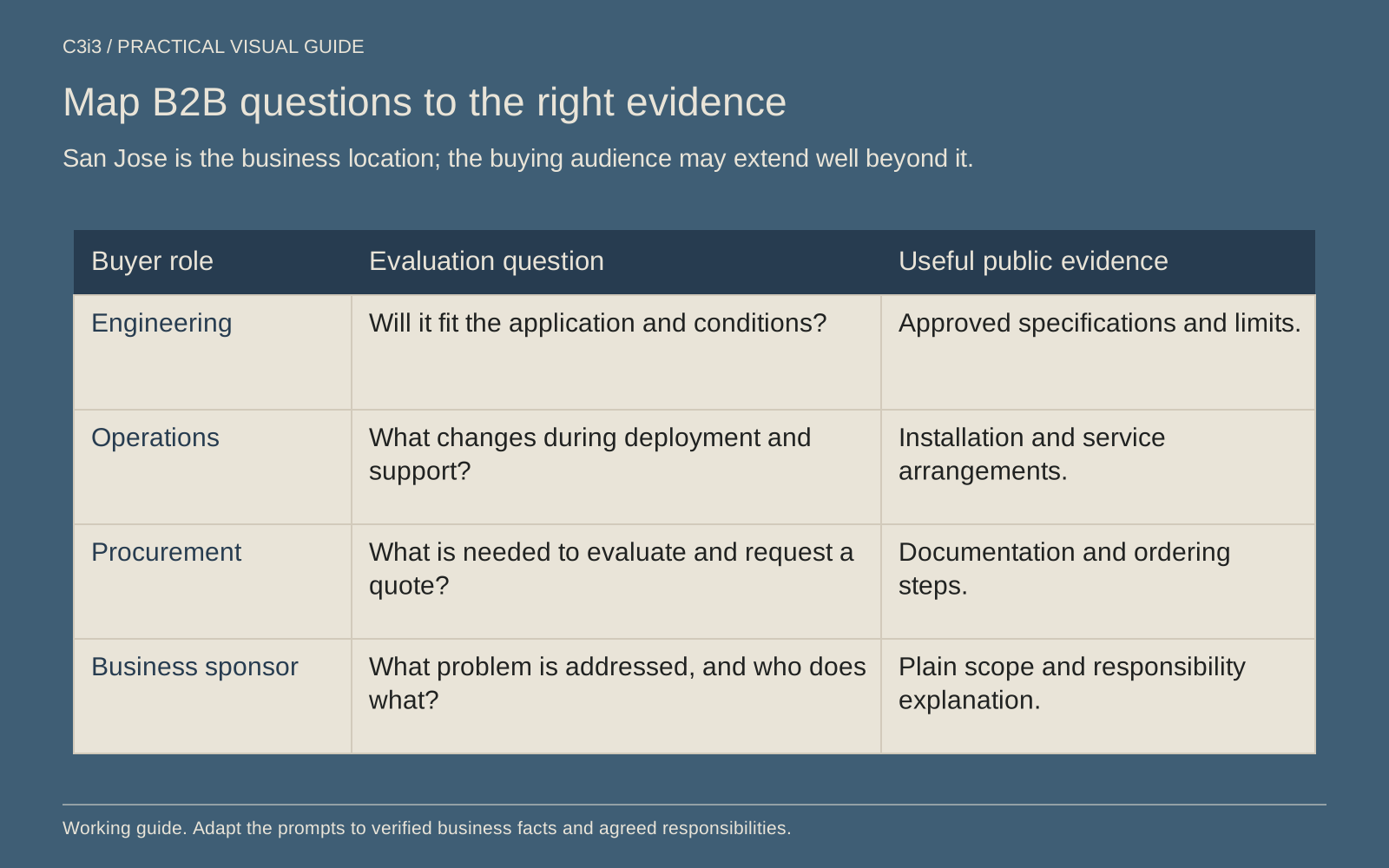
It should begin with your offer, buying audience and current customer journey. Being based in San Jose does not mean your market is limited to San Jose. A company selling nationally should explain national service or delivery arrangements accurately, while identifying where local access matters.
Ask the team to map the first discovery question, the evaluation questions and the information required for an initial discussion. A facilities manager may ask whether an equipment service covers a type of site. An engineer may need operating conditions or compatibility details. Procurement may need scope and documentation before requesting a quote.
The review should examine the pages that serve those decisions. If a key application appears only in a downloadable catalog, consider whether the website gives enough context to identify the right document. If important services are buried in navigation, make the route clearer.
Practical tip: Bring a recent suitable inquiry and an unsuitable inquiry to the kickoff. Remove private information and compare the questions each prospect asked. That gives the agency concrete evidence of what the website should clarify. The AI-search pillar explains the foundation behind this work.
Which research deliverable should you expect?
Ask the provider to turn buyer research into an inspectable output: the question, its source, the page it should improve and the person who can approve the answer. That is more useful in a contract than an undefined promise to “research AI keywords.” A search-volume estimate, a customer interview and an editorial hypothesis are different evidence.
| Deliverable | What acceptance should establish |
|---|---|
| Question-to-page map | The proposed page and reader decision are named; existing overlap is considered. |
| Source and review record | A responsible expert checks claims against approved source material. |
| Acceptance example | One revised section demonstrates the agreed depth, accuracy and next step. |
Use the San Jose B2B page-evaluation guide for the buying-team and application-page questions. This guide focuses on what an AI-search provider should deliver and how your team can accept it.
What technical and factual checks should the scope include?
The scope should identify access problems, ambiguous page signals and unsupported business claims. Ask for affected URLs and named responsibilities rather than a report with unexplained severity scores.
Technical work can include reviewing crawl access, indexing signals, canonical URLs, internal links and the visibility of important text. For Google AI features, the published guidance says the page must meet ordinary search requirements and be eligible for a snippet. There is no special AI schema requirement. See Google’s guidance.
Fact checking should cover the specifications, qualifications, applications and project claims on the selected pages. A writer should not infer that one tested configuration supports every possible environment. Distinguish manufacturer documentation, your own experience and a hypothetical planning example.
If a page includes structured data, it should match the content visitors can read. Google’s structured data policies explain that markup must accurately represent the page. Adding markup does not establish an independently verified certification or a guaranteed citation.
Practical tip: Assign an internal technical reviewer before writing starts. An unowned approval step can delay an otherwise straightforward project.
Which website pages and supporting articles should an agency improve?
Give each page a clear job. The main service page explains the offer, suitability, scope and next action. A supporting guide answers one substantial evaluation question. An application note or specification provides deeper evidence where appropriate.
Connect those pages through descriptive links. A reader evaluating suitability should be able to reach the relevant documentation, understand its limits and return to the service or inquiry step. Google’s crawlable links guidance is a useful technical reference for ordinary link implementation.
Preserve an existing URL when the topic and intent already have a suitable home. Expanding a weak page is often clearer than creating another page with the same purpose under an AI-search label. If consolidation is recommended, ask how existing links and redirects will be handled.
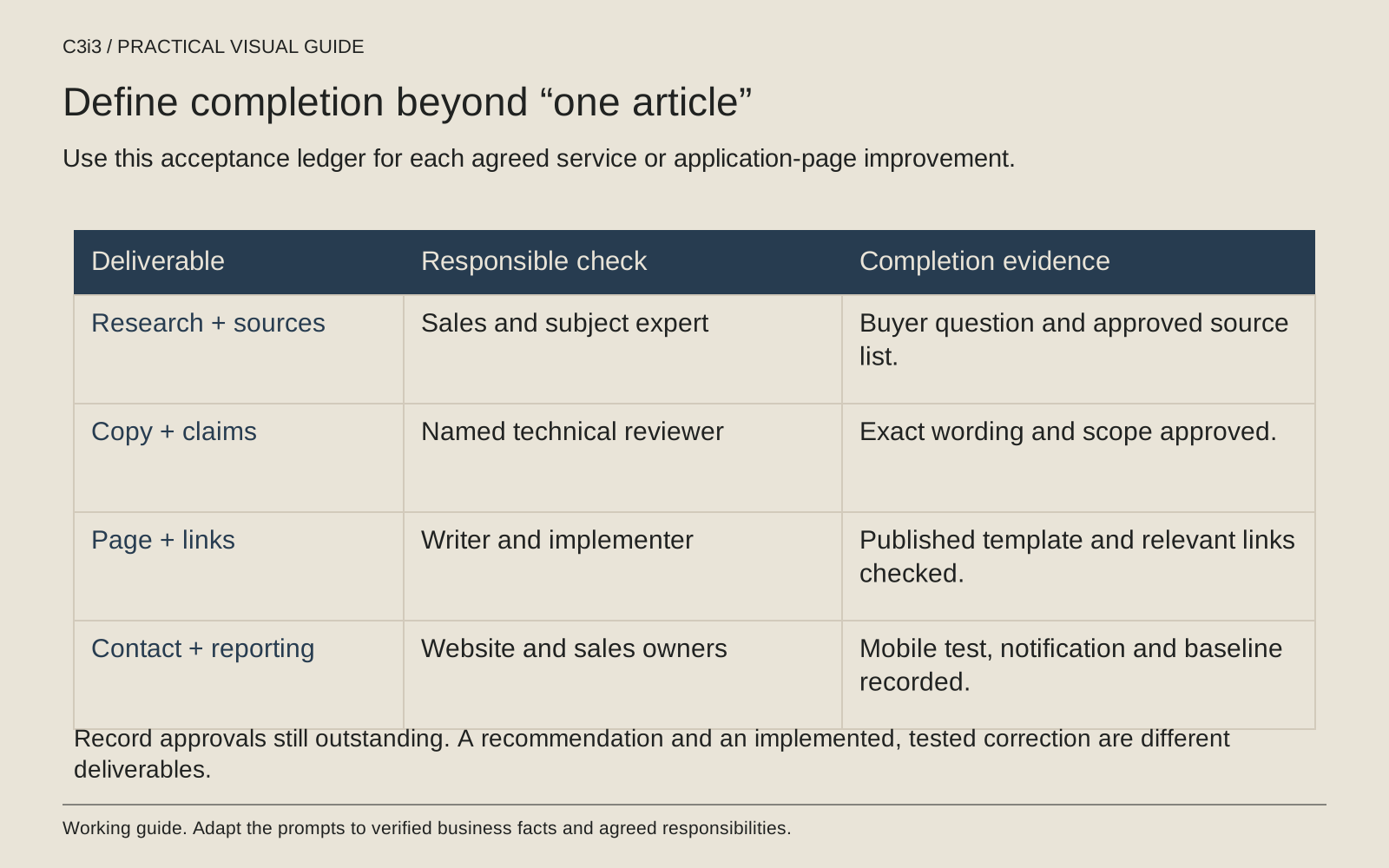
A realistic content deliverable includes the page copy, sources, internal links, metadata, artwork, review comments and implementation status. “One article” is incomplete as a scope if nobody is responsible for putting it into the approved template or connecting it to the rest of the site.
Practical tip: Review a simple map of the proposed pages before production. You should be able to explain in one sentence why each page exists.
How should AI-search services support qualified B2B inquiries?
They should make it easier for a suitable buyer to ask a specific question and for your team to respond effectively. Explain which information helps at first contact and which details can wait for a technical discussion.
For a component supplier, the first request might ask for the application, expected quantity and a way to contact the buyer. For a consulting engagement, a project goal, current system and timing may be enough. Collect only the information needed for that stage and explain the next step.
A report should distinguish a product-document download, an application question, a quote request and a qualified opportunity. These are different levels of intent. Review the definitions with the sales team so a visitor opening a PDF is not automatically reported as a lead.
When someone arrives from an identifiable AI referral, preserve that observation while recognizing its limits. When a prospect self-reports an AI assistant as the discovery source, record that separately. Longer B2B journeys often involve multiple visits and people, so a single session rarely explains the whole sale.
Our B2B writing services can help make those evaluation and inquiry steps clearer.
What should the agency deliver and report each month?
Ask for a short record of completed changes, outstanding approvals, observed results and next priorities. Each item should point to a page or a defined task so the work is easy to review.
For example, the report might identify an updated application page, a corrected internal link, an expert-approved explanation and a tested quote form. It can then show available search data, a fixed prompt sample and the quality of relevant inquiries. Completed tasks and business outcomes should appear as different kinds of evidence.
Google also provides a separate AI-search impressions report. Keep those impressions distinct from visits and inquiries. The measurement guide explains the sources and their limits.
Use the agency selection guide to compare proposals and the measurement guide to assess reporting. A useful scope makes the ongoing decision clear: which page or obstacle deserves attention next, and what evidence supports that choice?
What else should San Jose companies ask about AI-search services?
Do B2B companies need daily AI-generated articles?
There is no universal publishing quota. Prioritize useful questions, accurate evidence and implementation quality. A small number of substantive page improvements may address a more important problem than frequent broad articles.
Will the agency need access to confidential specifications?
It needs enough verified information to write accurately, but not every internal document belongs in a public workflow. Agree what can be shared, who reviews it and which material remains private.
Which related guides explain the other search platforms?
Read the Google AI Overviews guide and the ChatGPT visibility guide. Platform-specific checks should sit within one coordinated website plan.

How C3i3 Can Help
Bring your current scope and the pages it should improve. C3i3 can help distinguish research, technical access, content changes and measurement.