



































Marketing Channel Strategy.

Give each channel
a reason to exist.
Marketing channel strategy defines where to reach your customers and what each channel should help them do. C3i3 connects search, your website, content, paid promotion, and follow-up around a clear customer journey.
When every channel is treated as a separate project, the business can become busy without becoming clearer. A social post, search result, landing page, and sales reply may tell different stories or lead to different next steps.
We identify the customer decision first. Then we assign channel roles, choose useful destinations, and agree the resources and evidence needed to test the plan. A channel can be deferred when its audience, content requirements, or operating effort do not fit your business.
Choose the right role
Separate discovery, evaluation, inquiry, and follow-up.
Connect the destinations
Make each activity lead to the page or conversation it needs.
Reduce scattered effort
Choose a manageable mix with explicit owners and dependencies.
Specific work.
A usable handover.
The proposal confirms the final scope and format. The following components make the work useful to the people responsible for the next step.
- 01Customer decision map
The important questions and actions between discovery and inquiry.
- 02Existing channel review
A review of channel activity, destination pages, operating effort, and available performance evidence.
- 03Channel-role matrix
A clear job for each selected channel and the next step it supports.
- 04Destination-page requirements
The offer, proof, information, and inquiry route a campaign needs.
- 05Test and resource brief
The people, content, budget boundary, and review criteria needed for a useful test.
- 06Prioritized channel sequence
An order of work based on dependencies and capacity rather than platform popularity.
Keep the work
connected.
Explore a focused service below, or use the parent service to choose a broader starting point.
Integrated Marketing Plans
Connect your website, search, content, advertising, and follow-up with a practical integrated marketing plan. Define channel roles, budget, and owners.
Explore integrated marketing plansMarketing Budget Planning
Marketing budget planning turns an available investment into a practical sequence of work. C3i3 helps you separate setup, content, media, software, and ongoing effort so you can choose what to fund and how to review it.
Explore marketing budget planningNeed to understand the website first?
An audit can identify search or answer-readiness gaps before you commit to a wider plan.
SEO Audit Services AI Visibility AuditA clear process.
An accountable decision.
01Map the customer decision
We define what a customer needs to understand before contacting you.
A usable journey map.
02Review the current mix
We compare channel roles, content demands, website destinations, and recorded results.
A list of strengths and gaps.
03Choose a connected first phase
We select the channels that can support one another and identify the work needed before launch.
A channel and destination plan.
04Set the review point
We agree which outcomes, costs, and customer responses will inform the next decision.
A focused testing brief.
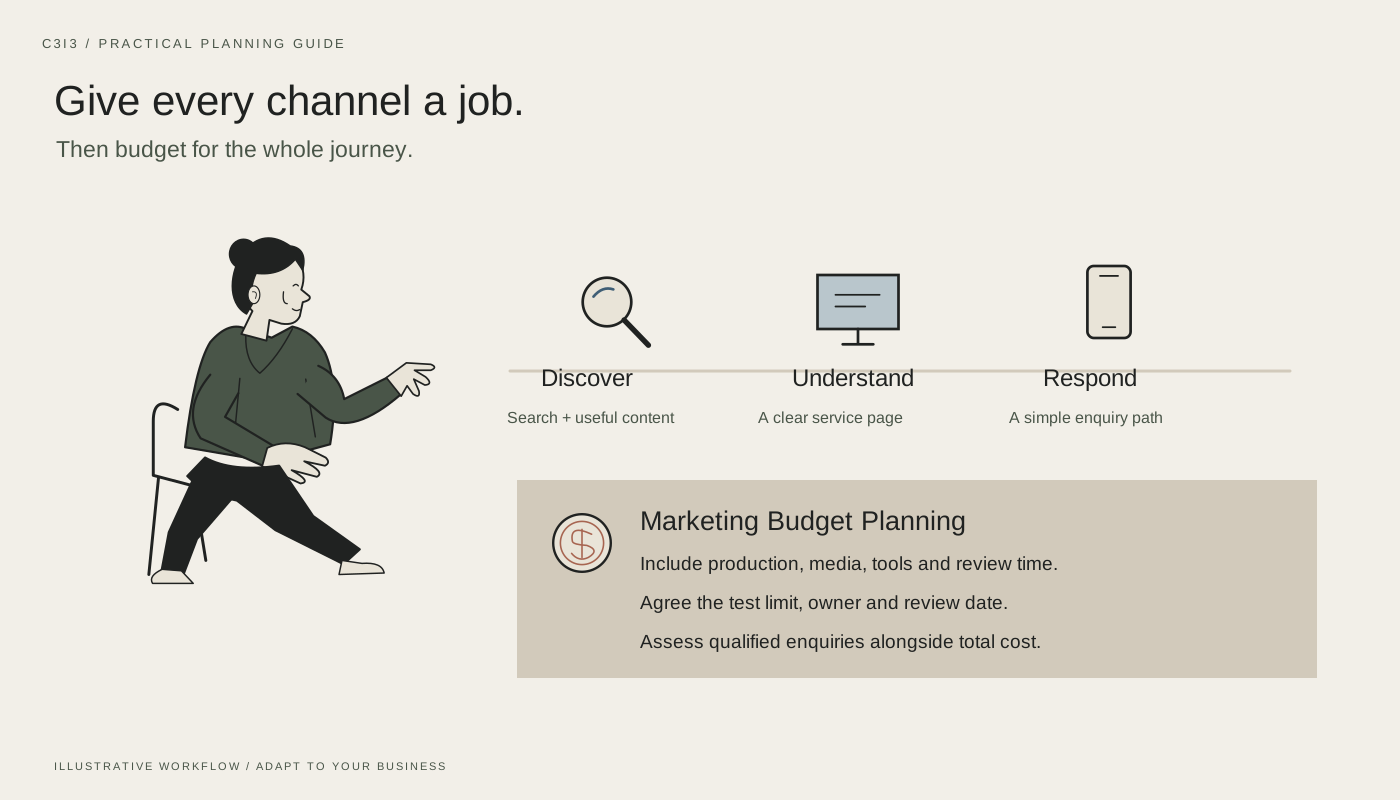
One customer journey. Different channel jobs.
An illustrative professional service firm may use search to answer a specific question, an explanatory service page to establish fit, and a short email follow-up to prepare a conversation. The strategy gives each channel a job and makes the transition between them understandable.
| Decision or stage | What we examine | Why it matters |
|---|---|---|
| Search | Answer a clear service question | Reach someone with a relevant need. |
| Website | Explain scope, proof, and next steps | Help the person decide whether to inquire. |
| Follow-up | Confirm context and arrange the right conversation | Keep a useful inquiry from stalling. |
Agree the boundaries.
Then begin.
We can plan the channel mix for one offer or review how several channels work together. Media buying, creative production, SEO implementation, and ongoing management are separate delivery scopes.
We confirm deliverables, access requirements, responsibilities, milestones, review rounds, and fees in writing. Bring the decision you need to make; you do not need a polished brief.
Useful questions.
Clear answers.
What is a marketing channel strategy?
It is a plan for using selected ways of reaching customers, with a defined role, destination, owner, and measure for each.
Do we need to be on every platform?
No. The mix should fit your audience, offer, resources, and ability to maintain useful content and responses.
How do you decide between SEO and advertising?
We consider the customer question, timing, website readiness, operating resources, and available evidence. Different channels may support different stages.
Can you review channels we already use?
Yes. We can assess their role, destinations, costs, and available outcomes before recommending what to keep or change.
Does the plan include our website?
Yes. A channel plan needs a useful destination. We identify the page information and inquiry route required for the selected activity.
What if our tracking is incomplete?
We record what is known, identify the most useful measurement gaps, and avoid interpreting missing data as proof that a channel failed.
Is campaign execution included?
Execution is scoped separately. The strategy can be handed to your team or used to brief C3i3 delivery.
What should we bring to the first conversation?
Share your website, main offer, current channels, available reports, and the decision you are trying to make. An incomplete starting picture is workable.
A clearer next step.
Let’s find it together.
Tell us what you want to improve, what you have tried, and where you feel stuck. We’ll help define the next practical step.
Tell us what you need