



































In this article
Use AI to plan technical content from approved product sources. A Bay Area manufacturer’s guide to claim ledgers, variants, expert review and publication.
What is a suitable AI task in technical content marketing?
Choose a task that helps the team organize or explain verified knowledge. An assistant might develop an outline from approved application notes, identify unanswered buyer questions or propose a clearer structure for a product-family page. The reviewer should be able to compare the output with the source material.
Do not begin with an unrestricted request to write authoritative technical content about a product. General model knowledge may not reflect the current version or the business’s approved claims. A plausible explanation can become misleading when it borrows a condition from another product or turns a suggestion into a fact.
The manufacturing marketing strategy pillar helps select the buyer question and evidence. This guide focuses on the editorial workflow, not AI on a factory floor or automated engineering validation. Keep that purpose explicit when choosing tools and reviewers.
What belongs in an approved technical source pack?
Collect the current product records, relevant documentation, approved terminology and any application explanations the business may use. Identify versions and owners. Keep conflicting or outdated material separate so the assistant and reviewer do not treat every file as equally authoritative.
| Item | What to record |
|---|---|
| Product identity | Family, model or variant covered |
| Current source | Document and revision used for the draft |
| Claim boundary | Conditions and limits that must remain |
| Expert owner | Who confirms the technical meaning |
| Publication permission | What information may be used publicly |
| Open questions | What the draft must not guess |
Use only material appropriate for the intended tool and workflow. Confidential application details or restricted customer records may require a different arrangement. The purpose of the source pack is to make the allowed evidence clear, not simply to upload as many documents as possible.
How do you build a claim-to-source ledger?
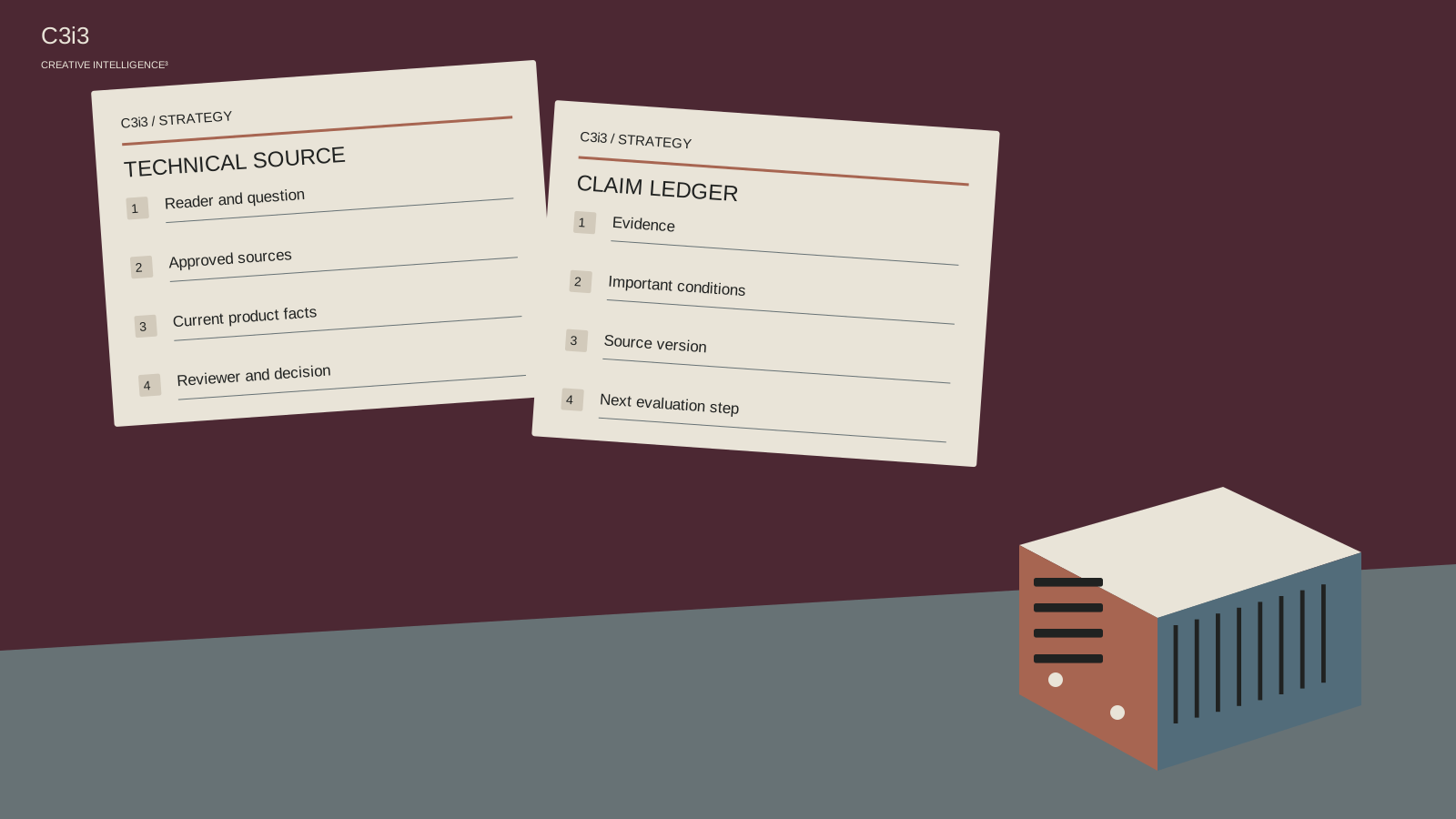
Record each important statement beside the source that supports it, the relevant product version and the person who can approve it. Include the wording used in the final asset when it differs from the source. This makes it easier to see whether editing has changed the meaning.
A ledger entry might identify a documented interface or an approved application condition. It should not convert a general industry fact into a claim about a particular model. When the source does not support the proposed statement, narrow the wording, collect evidence or remove the claim.
Keep the ledger with the content through layout and publication. A table label, caption or diagram can communicate a claim as strongly as a sentence. Review those elements too. Our technical writing guide explains the complementary work of organizing instructions and reference information for a defined reader.
How should AI handle similar products and variants?
Require the draft to stay within a named product or family boundary. Similar naming and appearance do not establish identical behavior. If the source describes different configurations, preserve the distinctions instead of combining their most attractive features into one description.
Test the workflow with difficult examples: a missing field, an obsolete document or two variants with a meaningful difference. The useful output may be a question for an expert rather than a finished paragraph. A system that fills every gap can be less trustworthy than one that marks the limits clearly.
For multi-line organizations, assign source ownership by product and brand. The industrial product-line guide shows why that matters across a broader portfolio. Keep the content workflow aligned with the people and records that can confirm each statement.
What should an expert review check beyond numerical accuracy?
Check the implication of the whole explanation. The values may be copied correctly while the text suggests a compatibility, use or guarantee that the source does not establish. Ask whether an unfamiliar buyer could draw a false conclusion from the combination of headline, diagram and paragraph.
Review terminology, prerequisites and limitations. Simplification should make the subject easier to understand without removing what changes the answer. A marketing editor and a product specialist can have different but complementary roles: one checks the reader’s path, while the other confirms the technical meaning.
NIST’s generative AI profile provides a primary reference on risks such as confidently incorrect output. The practical response in this workflow is traceable sources and qualified review, rather than treating fluent text or a confident model answer as evidence.
How do you make technical content useful to a buyer?
Start with the question the buyer is trying to resolve. A product-family introduction, an application explanation and a task guide serve different needs. Use the format that helps the reader evaluate or understand the subject instead of stretching every assignment into a long article.
Add original value through a clear decision framework, an approved explanation or a useful comparison of conditions. Do not create pages for every keyword variation when they would repeat the same answer. Google’s helpful-content guidance emphasizes useful, reliable information; it does not provide a special ranking benefit for AI-generated volume.
Keep the next step appropriate. A reader may need a specification, a related application page or a technical conversation. The content should make that route understandable without pretending that a marketing article replaces the evaluation needed for a particular use.
What should the publication and maintenance process include?
Approve the source version, final copy, diagrams and page presentation. Keep conditions close to the claims they explain and make documents easy to identify. A correct draft can become confusing when design separates a qualification or links to an unrelated product file.
Define change triggers. A revised specification, discontinued variant or updated application note can affect several pages. The ledger and product map should help the content owner find those dependencies. Do not leave maintenance dependent on a writer remembering which source was used months earlier.
The manufacturing website planning guide connects those responsibilities to page types and inquiry paths. In a larger organization, identify the product, marketing and technical owners who approve different changes so a clear process survives team transitions.
How should you evaluate an AI technical content pilot?
Choose one bounded family or application and a small set of source materials. Record the draft, corrections, reviewer effort and final decision. Include examples that should cause the workflow to stop or request more information. The pilot should show how uncertainty is handled, not only how quickly a complete paragraph appears.
Assess whether the content helps the intended reader and remains maintainable. A large output count is not a useful result when experts must reconstruct the sources or remove unsupported claims. Keep the original goal visible and compare the full review process with the previous method.
C3i3’s content strategy and AI marketing consulting services can help define the task, sources and review framework. Preserve the technical ownership that makes the finished content credible, whether the business is a local manufacturer or a larger multi-line organization.
What should you check before the next step?
More questions about technical content marketing.
Can AI generate missing specifications from similar products?
No. Missing technical facts need an authoritative source or a qualified decision. A similarity is a prompt for investigation, not evidence that a value or capability applies to another product.
Should every technical article have an engineer as its writer?
The appropriate team depends on the subject. An editor or technical writer can organize and explain the material, while a qualified product expert verifies the meaning and claims. Assign those responsibilities explicitly.
Does expert review guarantee search rankings?
No. It supports accuracy and reader trust, but rankings and indexing depend on multiple factors. Evaluate the content’s usefulness and technical implementation without promising a search position.
What decision does your business need to make next?
Bring us the audience, the business question and the material you already have. We can help define a useful scope and connect the content to the right next action.