








































In this article
Hiring a marketing employee looks straightforward until you list everything the role needs to cover. Writing, design, search, reporting and website changes rarely fit one person's experience equally well. You may pay for the employee and still manage several specialists yourself.
Outsourced support can save money when you buy a defined amount of coordinated work instead of building unused internal capacity. It can also cost more than expected when extra projects, tools and your own coordination are omitted. Compare complete arrangements before treating the smaller headline number as the better decision.
Define equivalent work before comparing cost
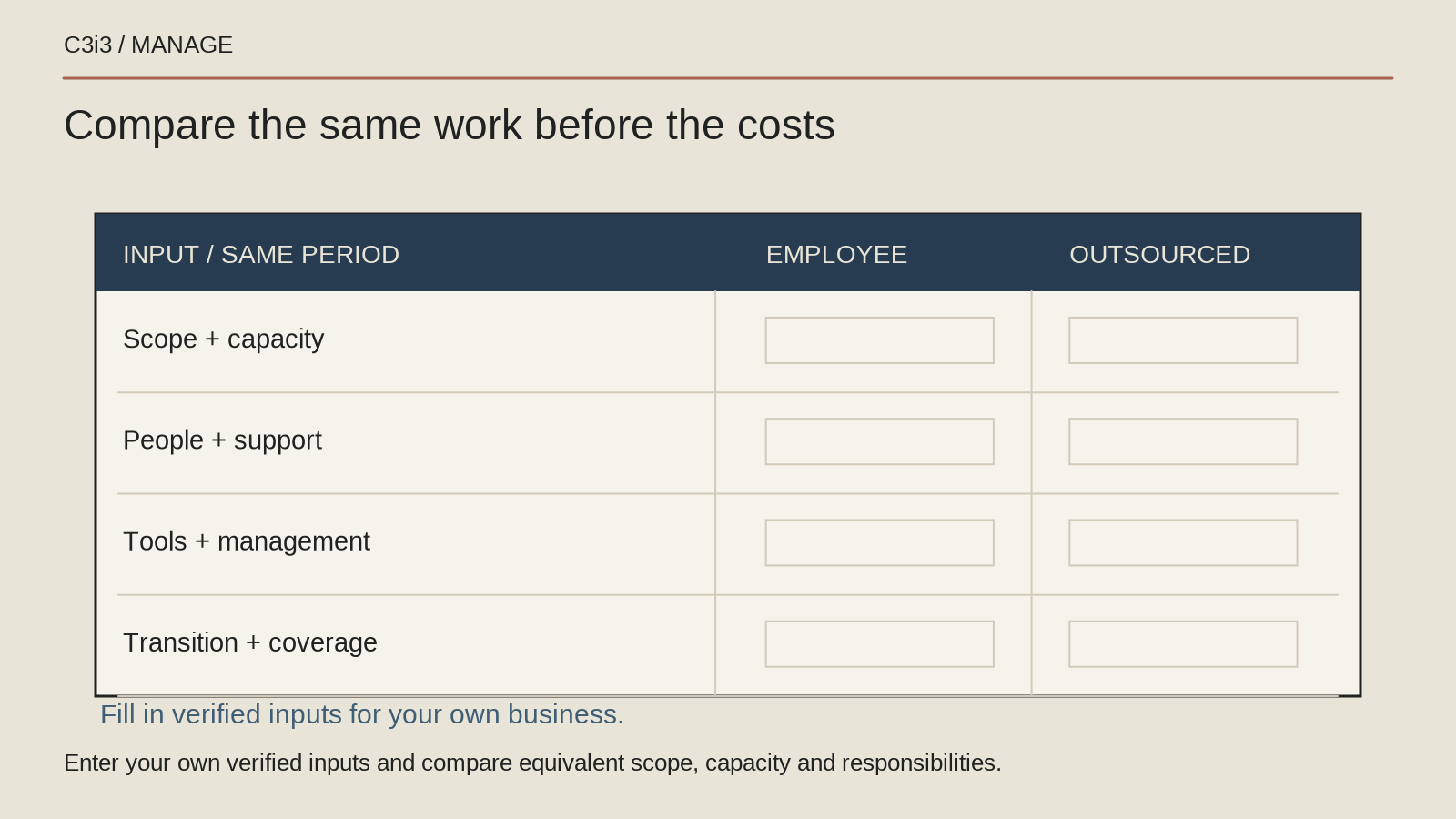
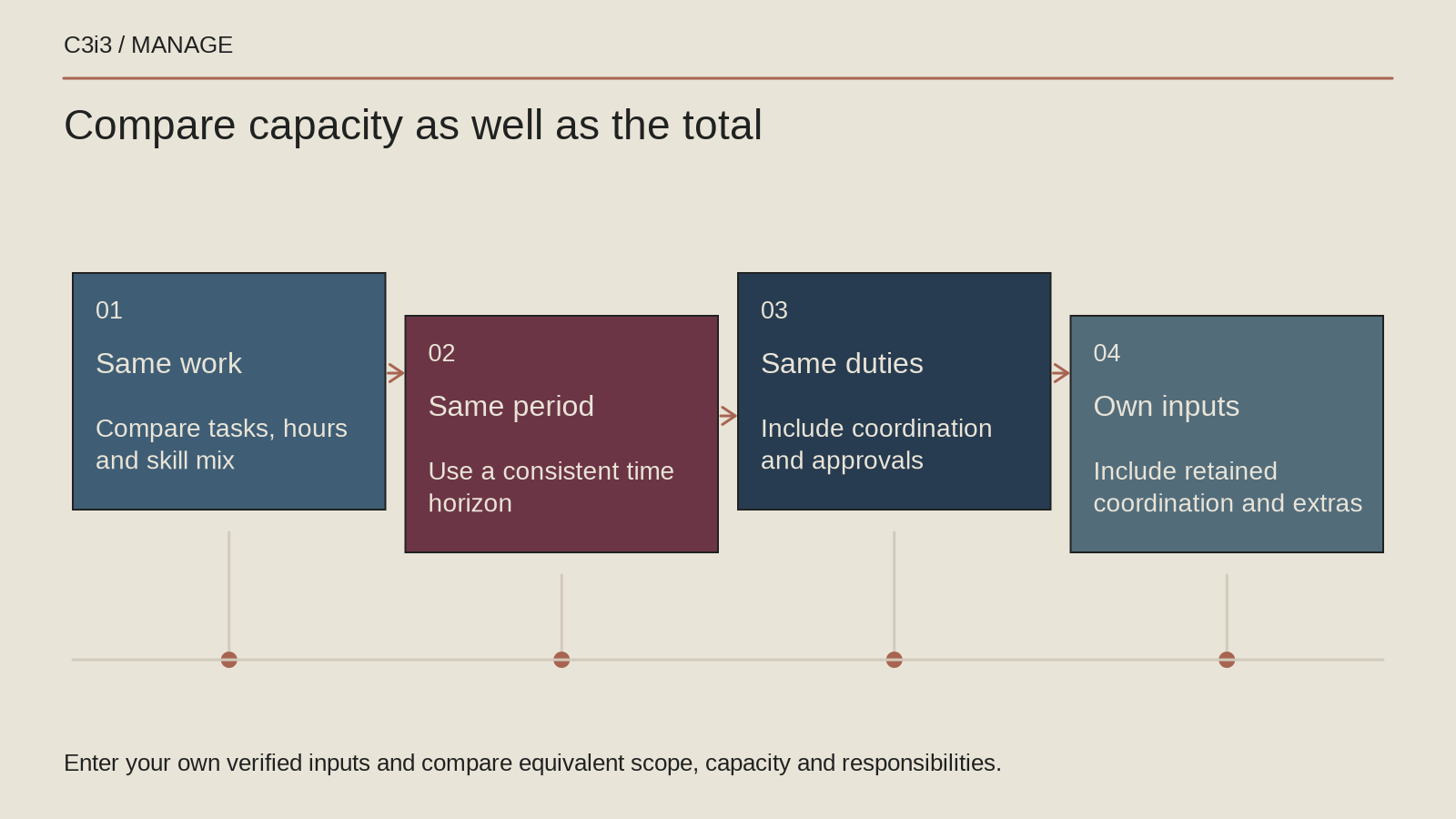
Write a common scope for both options: recurring outputs, specialist skills, turnaround expectations, review rounds and responsibility for coordination. Include website and account support when required. A proposal covering only production should not be compared with an employee expected to manage planning and suppliers as well.
Record what the business will still do. Customer interviews, service decisions and final approvals take time under either model. If the agency needs an internal coordinator, include that capacity instead of describing the arrangement as entirely managed.
Separate advertising spend from service delivery on both sides. Moving the same media budget between columns does not demonstrate a staffing saving.
Use national wage data as context
The Bureau of Labor Statistics reports a May 2025 median annual wage of $78,760 for market research analysts. That national occupation is a reference point, not a local quote for a marketing manager or a complete multidisciplinary team. Responsibilities and location matter.
BLS also reports that private-industry wages represented 70.0% of employer compensation and benefits 30.0% in June 2026. Those national averages are measured per hour worked. They are not a precise benefits rate for your proposed hire.
Do not multiply an annual salary by a general BLS loading factor and call the result an exact employer cost. Build your comparison from your own actual assumptions.
Build a full annual employer cost worksheet
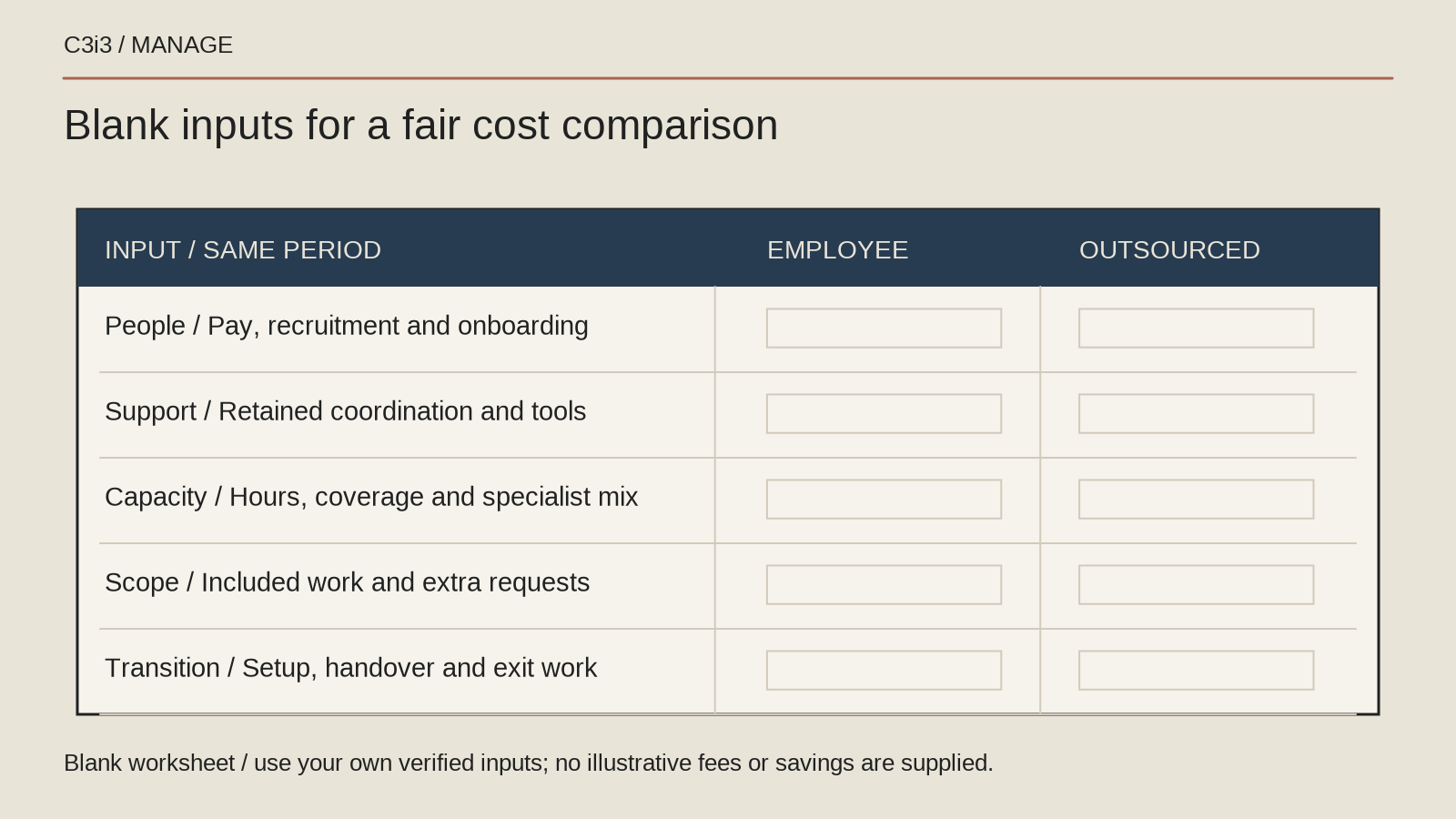
Start with annual salary, then add actual employer-paid benefits, employer payroll costs, required equipment and software, recruiting and onboarding costs, and any outside specialists the role still needs. Identify one-time items separately so the second year is not confused with the first.
Account for management time using a consistent assumption. Your own time has a capacity consequence even when no additional cash leaves the business. Keep cash expense and estimated internal time visible as separate lines if that makes the comparison easier to understand.
Avoid counting paid leave twice. If annual salary already covers paid time off, do not add the same salary payments again. Separately estimate genuine additional coverage costs where relevant.
Build the all-in outsourced cost beside it
Start with the contracted service fee and add work outside the included scope, onboarding, tools billed separately and retained internal coordination. Check whether design, technical changes, reporting and supplier management are included or require separate arrangements.
Record the limits beside the total. An outsourced team may supply several skills across a limited workload. That can suit an owner who needs occasional specialist work, but it does not provide unrestricted access to every team member or the continuous availability of an employee.
Ask how additional demand is handled before it arrives. A lower fee loses meaning if routine requirements repeatedly fall outside the agreement or the owner must organize the gaps.
Use a hypothetical example without mistaking it for a quote
Purely for illustration, assume annual employee salary of $80,000 plus $20,000 of other employer costs, giving $100,000. Compare hypothetical outsourced support of $60,000 plus $5,000 of retained coordination, giving $65,000. The possible annual budget difference is $35,000. These are invented planning figures, not C3i3 pricing or a savings guarantee.
The worksheet is: full annual employer cost minus all-in agency cost equals possible budget difference. It is useful only after checking equivalent scope. The example does not establish equal working hours, availability, output or skill coverage.
Replace every assumption with your own information. Keep the source, date and exclusions beside each figure so someone reviewing the decision can understand what the calculation includes.
Identify when an employee or hybrid is better
An employee may be the better choice when the workload needs continuous attention, frequent access to operational staff and deep knowledge that is difficult to transfer. An agency also requires supervision, so outsourcing will not solve a complete absence of business direction.
A hybrid can keep a capable internal coordinator while buying specialist execution. It may reduce gaps without pretending one employee is a designer, developer, analyst and editor. Equally, a small stable workload may not justify recruiting a broad internal team.
Consider continuity and demand changes. Ask how work continues during an absence and how each arrangement handles a busy period. A fair comparison includes those practical differences alongside the annual totals.
Compare your own annual arrangements
Enter annual amounts using your own records or a scoped proposal. These fields start blank. No figure is a C3i3 quote. Values stay in this page and are not submitted by this worksheet.
Keep this checklist beside you
Questions before the next step
Will outsourcing always save my business money?
No. Savings depend on the work needed, included capacity and the support you retain internally. A lower annual total may buy less availability. Compare scope first and calculate the difference using your own assumptions.
Can I use the BLS benefits percentage as my exact loading rate?
No. It is national context per hour worked. Your costs depend on your circumstances and benefits. Build annual figures carefully, particularly where paid leave is already covered by annual salary.

How C3i3 Can Help
C3i3 can help define a realistic scope for dedicated marketing support so you can compare it with internal hiring. Bring your recurring workload, skill gaps and the coordination you currently provide.
We can explain proposed capacity, responsibilities and exclusions before you make the comparison. A useful decision starts with a clear service requirement and your own cost assumptions, with room to choose an employee or a hybrid when that fits better.